

I spend a lot of time in workshops and garage setups where 12V devices need steady, reliable current, and I’ve learned that the wrong supply can turn a clean project into a troubleshooting session. Industrial 12V power supplies come in flavors that look similar on paper but behave very differently in practice, from slim DIN-rail modules that snap into control cabinets to bench-top converters that hum along beside radios and test gear. This list sorts through eight solid options across form factors and amperage levels, so the right match for your workload is easier to spot. Whether you run low-current control logic or push serious wattage to LED arrays, there’s something here worth plugging into.
The Main Contenders

Mean Well HDR-60-12 Din-Rail Power Supply

Pyramid PS3KX 2.5A Bench Power Supply

Pyramid PS7KX 5A Bench Power Supply

HOMELYLIFE DC 24V to 12V 10A Buck Converter
Henxlco AC 110V to DC 12V 10A Adapter
BOSYTRO 480W 40A Switching Power Supply
BOSYTRO 1000W 83.3A SMPS 12V

BOSYTRO 1200W Max 100A SMPS Converter
Inside Each Recommended Option
This Mean Well unit is built for control cabinets, not bench tops. The slim 17.5mm housing snaps onto standard TS-35/7.5 or 15 DIN rail, which is the metal mounting strip found inside most industrial enclosures, freeing up precious panel space when you’re stacking multiple modules side by side.
It accepts a wide 85–264VAC input range, meaning you can drop it into most wall-socket standards worldwide without a separate transformer. Universal AC input, isolation class II (meaning it relies on double insulation rather than a grounding wire), and short-circuit, overload, and over-voltage protections make it a quiet workhorse that mostly disappears once wired in.
Points In Its Favor
- Ultra-slim 1SU width fits dense cabinet layouts where real estate is tight.
- Free-air convection cooling means no fans to clog or replace in dusty shop air.
- LED power indicator gives a quick visual confirmation without a multimeter.
- Adjustable DC output voltage lets you fine-tune for voltage-sensitive sensors.
Things To Consider
- At 54W and 4.5A, it lacks the headroom for motor or LED arrays that draw serious current.
- DIN-rail mounting means it needs an enclosure, so it’s not a plug-and-play desktop option.
Right Fit For
Panel builders and automation techs who need clean, reliable 12V logic power inside a DIN-rail enclosure.
A Better Fit Elsewhere
The Pyramid PS7KX suits hobbyists better who want a bench-top unit with screw terminals rather than a panel-mount module.
The PS3KX is a classic linear regulated bench supply, meaning it uses a heavy transformer and analog regulation instead of high-frequency switching, which produces cleaner DC with very little ripple noise. At 2.5A continuous and a 13.8V output (slightly above 12V to compensate for voltage drop under load in radio gear), it’s aimed squarely at hobby benches running CB radios, scanners, and small test circuits.
Unlike the Mean Well DIN-rail module above, this one is meant to live on your workbench with screw-type terminals up front for bare-wire connections. A built-in cooling fan keeps the linear regulator from getting too toasty during long transmit sessions.
A Few Strong Suits
- Linear regulation delivers low-noise output, which sensitive audio gear tends to appreciate.
- Screw terminals accept bare wires, spade lugs, or ring terminals without extra adapters.
- Compact footprint fits smaller workbenches where a full lab supply would be overkill.
Trade Offs
- At 50W input and 2.5A output, it struggles with anything beyond light radio or sensor loads.
- Linear designs run heavier and hotter than switching supplies, so it adds noticeable bulk to a bench.
Built With In Mind
HAM radio operators and hobbyists running low-current 12V devices who value clean, regulated output over raw wattage.
Look Elsewhere When
The Pyramid PS7KX makes more sense for anyone stepping up to 5A loads on the same benchtop format.
The PS7KX doubles the current capacity of its smaller sibling while keeping the same bench-friendly form factor. At 5A continuous output and 70W input, it’s the go-to for more demanding test rigs, mobile audio benches, and HAM stations running multiple radios.
It shares the 13.8V nominal output with the PS3KX, so it pairs well with vehicle-style gear that expects slightly elevated voltage. Screw terminals and a cooling fan round out a design that’s been around long enough to feel familiar in any home lab.
Real-World Strengths
- 5A output handles multi-radio benches and moderate amplifier loads with room to spare.
- Linear regulation keeps ripple low for sensitive receivers and audio circuits.
- Same screw-terminal layout as the PS3KX, so swapping between the two is seamless.
Honest Caveats
- Still heavier and warmer than switching alternatives because of the linear transformer design.
- Not designed for permanent rack mounting, which limits installation flexibility.
Feature Snapshot
Who It Suits Best
Home lab users and radio hobbyists who need more current than a basic 2.5A supply but still want a clean linear output.
Consider Something Else When
The BOSYTRO 480W 40A switching unit suits anyone running motors or printers that pull far more current than a benchtop linear can deliver.
This HOMELYLIFE module is a step-down buck converter, meaning it efficiently lowers a higher DC voltage to a lower one with minimal energy wasted as heat, rather than a brick that accepts AC wall power. It takes 18–32V DC input and delivers a stable 12V at up to 10A, making it perfect for trucks, buses, RVs, and solar setups where 24V battery banks are common.
It’s a bare-board module rather than a finished supply, so you’ll want to mount it in a project box or somewhere protected from the elements. At over 90% efficiency, it runs cooler than linear regulators and sips less current from your source battery.
The Helpful Details
- Wide 18–32V input range handles real-world battery voltage swings without complaint.
- High efficiency keeps heat output low, which matters in enclosed vehicle cabinets.
- Built-in over-voltage, over-current, over-temperature, and short-circuit protections shield downstream gear.
Practical Considerations
- Exposed board design requires a project enclosure for safe automotive or outdoor mounting.
- No AC input means it can’t replace a wall adapter, only step down an existing DC source.
Made For
Vehicle electricians and DIY builders who need to tap 12V accessories from a 24V battery bank.
Skip It When
The Henxlco 120W adapter makes more sense for plugging into a standard wall outlet for LED strip projects.
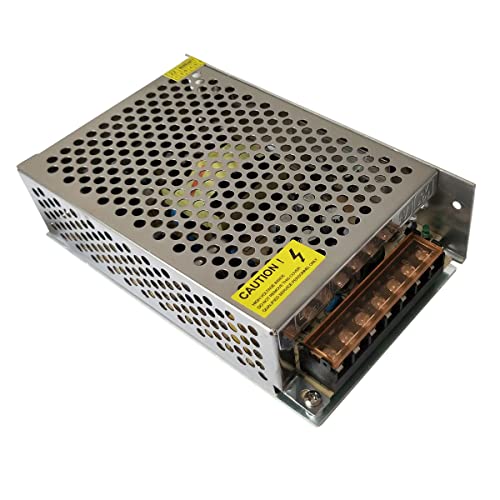
Henxlco’s 120W adapter is a switching supply aimed at LED strip and CCTV installations. A slide switch on the side lets you toggle between 110V and 220V AC input, useful if you’re sourcing the same model for projects on different continents.
It outputs 12V DC at 10A total across two independent channels, so you can run separate LED runs or camera sets without daisy-chaining wire nuts. The output voltage is also adjustable by roughly ±15%, which helps compensate for voltage drop on longer cable runs.
What It Does Well
- Two output channels simplify multi-zone LED or camera setups without extra splitters.
- Adjustable output voltage trims brightness or compensates for long wire runs.
- Dual input voltage switch covers 110V and 220V standards in a single unit.
Points To Keep In Mind
- Indoor use only, so it needs a weatherproof housing for outdoor LED or CCTV runs.
- Power cord is sold separately, adding to the total install cost.
Who Will Love This
LED strip installers and small CCTV operators running multi-channel setups from a single wall outlet.
Not Your Match When
The BOSYTRO 1000W 83.3A supply fits anyone running high-wattage signage that exceeds this adapter’s 120W ceiling.
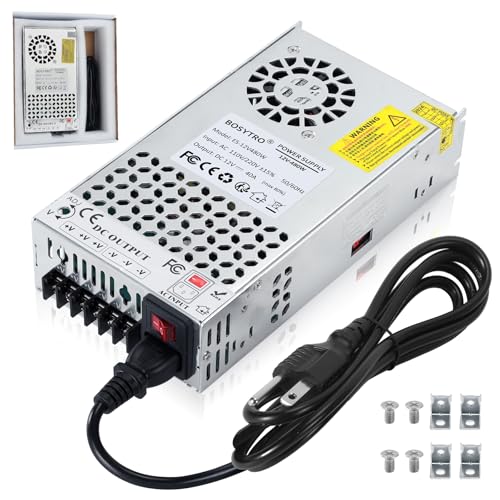
BOSYTRO’s 480W unit pushes the category into serious territory at 40A continuous output. Unlike the smaller Henxlco adapter above, this one brings upgraded input terminals and a built-in safety switch, so you can cut power without unplugging the whole rig.
It’s a switching supply designed for 3D printers, motor pumps, CCTV racks, and lab computers. Three output channels let you distribute load across multiple devices without external splitters.
Noteworthy Benefits
- Safety switch on the front panel offers quick power cycling without yanking cords.
- Three output channels handle multiple devices from one supply cleanly.
- Upgraded input terminals speed up wiring compared to older pigtail designs.
Where It May Fall Short
- Cooling fans tend to ramp up under sustained 40A loads, adding audible noise to quiet rooms.
- Larger chassis demands more shelf or bench space than compact adapters.
Quick Facts
Best Suited To
Makers and small-shop owners running 3D printers, pump motors, or multi-camera CCTV systems from a single source.
Reach For A Different Pick When
The BOSYTRO 1200W Max 100A converter suits anyone whose loads regularly push past 40A and need extra breathing room.
Stepping up the wattage ladder, this BOSYTRO SMPS (switched-mode power supply) delivers 1000W at 83.3A continuous. The matte aluminum housing and multiple ventilation holes are designed for sustained high-current output without thermal throttling.
It accepts both 110V and 220V AC input, so it adapts to most shop or sign-installation environments. Compared to the 480W unit above, this is the choice when you’re running long LED signage runs or large CCTV arrays that demand serious current headroom.
Why It Works Well
- Aluminum housing pulls heat away from internal components during extended high loads.
- Dual AC input compatibility covers both North American and European mains voltage.
- 83.3A continuous output future-proofs installs as you add more devices over time.
Factors To Consider
- Larger form factor requires dedicated shelf or rack space in busy workshops.
- Peak power claims differ from continuous ratings, so size your loads for sustained draw.
Spec Overview
The Right Fit
Sign shops and commercial CCTV installers running multi-display or multi-camera setups that pull serious wattage.
Swap It Out When
The Pyramid PS3KX bench supply makes more sense for tiny test circuits that need only a couple amps.
The biggest unit in this roundup delivers up to 1200W and 100A of 12V output, designed for car audio competitions, RV solar systems, and 3D printer farms. It accepts a wide 110–240V AC input, so it travels well between projects and continents.
Nickel-plated copper terminals replace older screw-clamp designs, giving a more secure connection that resists corrosion in mobile or marine environments. Compare that to the Henxlco adapter above, and this is the heavyweight sibling built for serious continuous loads.
The Practical Payoff
- Up to 100A continuous output handles competition audio amps and printer farms.
- Nickel-plated terminals resist corrosion in humid or mobile installations.
- Wide AC input range covers both North American and European mains standards.
Less Ideal Details
- Massive heat output demands good ventilation, so enclosed cabinets need extra airflow planning.
- Bulkier than smaller supplies, which complicates portable or tight-space installs.
Key Attributes
Whose Shelf It Belongs On
Car audio competitors, RV solar builders, and serious 3D printing operations with high aggregate current draw.
Where Another Pick Suits Better
The Mean Well HDR-60-12 fits anyone who needs 12V for a small control panel rather than a kilowatt-scale build.
Picking the Right 12V Supply for Your Setup
Match the Form Factor to the Install
The first fork in the road is where the supply will actually live. DIN-rail modules like the Mean Well HDR-60-12 are purpose-built for control cabinets and need a proper enclosure with a TS-35 mounting strip. Bench supplies from Pyramid sit on a workbench and connect via screw terminals, which works well for testing and hobby electronics. Open-frame switching supplies assume you’ll mount them in a project box, on a shelf, or inside a larger chassis. Picking the wrong form factor is the most common reason a “perfect on paper” supply ends up returning.
Size Wattage With Headroom
Wattage ratings tell you how much continuous current a supply can deliver, but real loads rarely behave perfectly. Motors draw startup surges, LED arrays dim slightly under load, and printer hot beds cycle on and off. Sizing your supply at roughly 20–30% above your calculated worst-case load keeps thermals in check and extends component life. That extra margin also means the supply isn’t constantly running at 100%, which helps fans stay quieter and capacitors last longer.
Check Input and Output Compatibility
Industrial 12V supplies come in two flavors: AC-to-DC adapters that plug into a wall outlet, and DC-to-DC converters that step down a higher battery voltage. The Henxlco and BOSYTRO units handle AC mains for shop or sign work, while the HOMELYLIFE module only accepts DC input for vehicle and solar installs. Make sure your source voltage matches before anything else, or you’ll end up with a fried board and a wasted afternoon.
Look at Protections and Noise
Short-circuit, overload, and over-voltage protections are standard on most modern supplies, but the way they engage varies. Linear supplies like the Pyramid bench models produce cleaner DC with less electrical noise, which matters for sensitive audio or radio gear. Switching supplies are lighter and more efficient but introduce high-frequency ripple that some circuits can hear. Match the supply type to the sensitivity of what’s downstream.
Common Shopping Slip Ups and Premium Picks
Pitfalls Shoppers Hit
The most frequent mistake is buying a supply rated for just barely enough current. Motors, LED arrays, and printer hot ends all draw more at startup than their steady-state rating, and a supply running at 95% capacity constantly will fail sooner than one loafing along at 70%. Another common slip is ignoring input voltage range, especially for buyers sourcing from international warehouses. A 220V-only supply will let out the magic smoke the moment it meets a 110V wall outlet, and the small slide switch on dual-voltage supplies is easy to miss in product photos.
Where The Extra Money Goes
Higher-wattage supplies cost more because they need heavier transformers, larger heatsinks, and more robust fan systems to dissipate heat. Aluminum housings, nickel-plated terminals, and active cooling designs all add manufacturing cost, but they also translate directly into longer service life under sustained loads. For most home workshops, a mid-tier 480W unit covers the bases without overspending. The 1000W and 1200W monsters earn their keep when your work involves competition audio, long LED runs, or printer farms where downtime costs more than the supply itself.
Frequently Asked Questions
What’s the difference between linear and switching 12V supplies?
Linear supplies use a heavy transformer and analog regulation to produce clean DC with very little ripple noise, making them ideal for radios and audio gear. Switching supplies use high-frequency electronics to step voltage down, which makes them lighter, cooler-running, and more efficient, but introduces some electrical noise.
Can I use a 12V supply for LED strips and CCTV cameras?
Yes, both run on 12V DC, but make sure the supply’s amperage covers the combined load of every device on the circuit. LED strip wattage varies by length and density, while CCTV cameras typically draw 1A or less each, so a 10A supply handles a healthy mix.
How much headroom should I leave when sizing a 12V power supply?
Aim for at least 20–30% more capacity than your calculated worst-case load. This keeps the supply from running hot, extends its lifespan, and absorbs startup surges from motors and capacitive loads without tripping protections.
Are DIN-rail supplies only for industrial use?
DIN-rail supplies are designed for control cabinets, but hobbyists and home automation enthusiasts use them too. Anyone building a structured wiring panel, smart home relay box, or 12V distribution board can benefit from the clean, modular mounting style.
Do I need a cooling fan in my 12V supply?
Most supplies rated above 100W include a fan or rely on convection cooling through a finned housing. For low-current applications under 60W, fanless designs work fine. For sustained high loads, an actively cooled supply prevents thermal shutdown and extends component life.
Closing Remarks
Eight supplies, eight different jobs, and one simple truth: the right 12V supply is the one that matches your form factor, your load profile, and your tolerance for noise. Run through your worst-case wattage, pick a form factor that fits where you work, and leave yourself a little headroom for the projects you haven’t planned yet. The right pick here is whichever one disappears into your workflow and just does its job.
