

A power outage in the middle of a storm is the kind of small disaster that turns into a big headache fast. Fridges warm up, routers die, work calls drop, and anyone on a CPAP or home medical device suddenly has a clock ticking. I’ve spent enough time helping friends prep their homes to know the right backup turns a stressful night into a manageable one. This list covers the whole spread, from whole-home tri-fuel generators to compact UPS units that keep a desk alive.
The Essentials At A Glance

Enphase IQ PowerPack 1500Wh Solar Generator Kit with 400W Panel and IQ Cart

Enphase IQ PowerPack 1500Wh + 200W Solar Panel Kit

Westinghouse 14500 Peak Watt Tri-Fuel Home Backup Portable Generator

Honda EU2200i Companion 2200 Watt Inverter Generator

EF ECOFLOW Delta 3 Portable Power Station 1024Wh 1800W
Enphase IQ PowerPack 1500Wh Portable Power Station

APC BX1500M 1500VA/900W UPS Battery Backup

Enphase IQ PowerPack 1500Wh + IQ Cart

APC BR1500MS2 1500VA/900W Pure Sine Wave UPS
APC BE600M1 600VA/330W Battery Backup
More On The Choices That Made The List
Starting off the list is the most complete solar backup kit on it, pairing a 1500Wh LFP (lithium iron phosphate) station with a 400W panel and a rolling IQ Cart. Where the smaller APC units that close out this roundup only bridge a router or two, this Enphase kit is meant to run actual household loads for hours.
Setup is straightforward enough that a homeowner comfortable with extension cords can handle it. Compared to the APC BX1500M further down, which is a stationary desktop box, this unit is mobile and self-sustaining off the sun.
Real Benefits
- Whole-room power, not just a desktop outlet strip
- LFP chemistry resists heat stress and lasts noticeably longer than older lithium-ion
- UL 9540A certification, the thermal-runaway safety standard for home battery systems, gives genuine indoor-use confidence
- Rolling cart keeps a heavy unit practical for one person to move
- IQ8 microinverter tech (the small inverter built into each solar panel that converts DC to AC) is the same family used in rooftop solar
Things To Consider
- Charging from a 400W panel takes roughly four hours of full sun, which is fine for summer but stretches in winter
- Output tops out at 1500W, so whole-home circuits like a central AC stay off-limits
Key Specs
Who It Suits Best
Anyone prepping for multi-day outages in a region with reliable sun, or households that want solar without a permanent rooftop install.
Consider Something Else When
The Honda EU2200i Companion is a better match for shoppers who need to run heavier 240V appliances or want gas flexibility instead of solar.
This kit trims down the panel from 400W to 200W but keeps the same 1500Wh LFP power station. For shoppers eyeing the Premium Pick above but unsure they need the larger panel, this is the more approachable middle ground.
The tradeoff shows up in recharge time. Doubling the panel halves the wall-clock hours needed to top up. That difference matters for storm seasons when sun can be scarce.
Everyday Advantages
- Lower panel count is easier to store in a closet or garage corner
- Same UL 9540A safety rating as the larger kit
- Pair of panels gives flexibility to chase sun around a yard
Worth Noting
- Full solar recharge stretches to around eight hours of direct sun
- Best used with wall-outlet top-ups between outages
- Foldable panels commonly need wiping down after a windy day outdoors
Made For
Households that mostly keep the unit on standby and want solar charging as a slow top-up rather than the primary refill method.
Where Another Pick Suits Better
Step up to the Enphase IQ PowerPack 1500Wh Solar Generator Kit (Item 1) if faster solar turnaround matters for your climate.
Here is where the list shifts from battery stations to combustion. The Westinghouse tri-fuel is a workhorse: 14500 peak watts on gasoline, propane, or natural gas, with a remote electric start and transfer-switch readiness. While the Enphase kits earlier are clean and indoor-safe, this is the unit that genuinely keeps a house running through a multi-day grid outage.
Tri-fuel capability matters more than people expect. During ice storms, gas pumps sometimes run dry for days. Propane and a home gas line keep the lights on. For shoppers in storm corridors, the flexibility alone can justify the choice.
Notable Upsides
- 14500 peak watts handles central air, well pumps, and electric ranges
- Tri-fuel design means the fuel source can adapt to whatever is available
- Transfer-switch ready for safe home-panel connection by an electrician
- Remote start is a small luxury that pays off in cold rain at midnight
Trade Offs
- Heavy unit, placement outdoors is essentially mandatory due to exhaust
- Engine maintenance (oil changes, spark plugs, fuel stabilizer) is part of ownership
- Quieter than open-frame units of the past, but not “quiet”
Best Suited To
Homeowners in regions with frequent multi-day outages who want whole-home coverage and have a safe outdoor spot to run it.
A Better Fit Elsewhere
The Enphase IQ PowerPack 1500Wh Portable Power Station is a smarter match for apartment dwellers or anyone needing indoor-safe backup.
The Honda EU2200i Companion is the quietest gas-powered unit in the roundup, sitting in the 48 to 57 dB(A) range, comparable to a normal conversation. Where the Westinghouse above is built for whole-home power, this Honda is a refined essentials unit: fridge, modem, lamps, a few outlets.
It is a 30A outlet model, meaning two can be paralleled with a cable for higher output. For RV owners, that 30A receptacle is the headline feature.
A Favorable Mix
- Honda inverter output (clean power safe for laptops and modern electronics)
- Companion 30A outlet allows paralleling two units for double the power
- Lightweight enough for one person to carry to a tailgate or campsite
Soft Spots
- 2200W is plenty for essentials but not enough for central AC or an electric dryer
- Gasoline only, no propane or natural gas option
- Oil and fuel maintenance still required, like any small engine
Who Will Love This
Suburban homeowners, RV travelers, and tailgaters who want quiet, reliable inverter power for essentials.
Swap It Out When
Reach for the Westinghouse 14500 Peak Watt Tri-Fuel instead if central air or electric cooking is non-negotiable during an outage.
The EcoFlow Delta 3 sits in a sweet spot between the Enphase kits and the smaller UPS units coming up. With a 1024Wh battery and 1800W output, it can run a microwave, a coffee maker, or a small space heater, none of which the APC units later in this list can touch.
Its standout trick is recharge speed. The Delta 3 series supports fast AC input (charging from a wall outlet at high wattage), so a full top-up takes around an hour rather than a full afternoon.
A Few Highlights
- 1800W inverter output covers kitchen appliances during an outage
- Fast AC wall input gets the unit back to full in roughly an hour
- Expansion-ready within the EcoFlow ecosystem
- Manageable weight for one person to move between rooms
Honest Caveats
- 1024Wh is smaller than the 1500Wh Enphase kits above
- Higher-output stations generate some fan noise under heavy load
Key Specs
Right Fit For
Urban households that want one portable unit covering kitchen gear, phones, and work-from-home setups, without a permanent install.
Not Your Match When
The Enphase IQ PowerPack 1500Wh + IQ Cart is a better choice if you want a rolling cart and larger 1500Wh capacity.
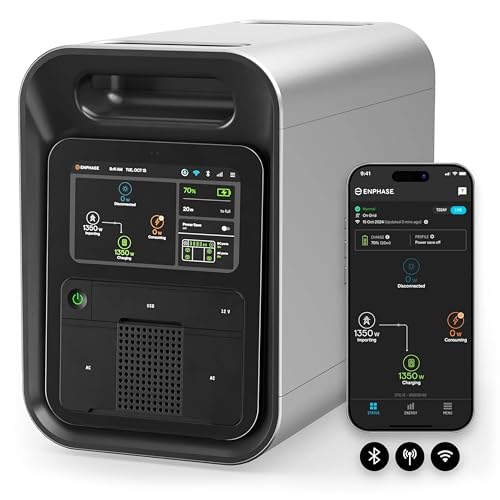
This is the panel-free version of the Enphase PowerPack line, the same 1500Wh LFP station sold without a solar panel or cart. For shoppers who already own a compatible panel or want to wall-charge primarily, this is the cleanest, simplest path into the lineup.
The certifications deserve a moment. UL 9540A covers thermal-runaway safety for home battery systems, and UL 2743 covers portable power stations used outdoors. Both are independent third-party tests, not just marketing language.
Where It Helps
- Dual UL certifications for both thermal and outdoor use
- 11 output ports including four AC, four USB-A, two USB-C, and a 12V DC car-style outlet
- Switchover in under 10ms (a millisecond, or thousandth of a second), fast enough that most electronics never notice the grid dropped
- Rated for a long cycle life, supporting years of regular backup use
Points To Keep In Mind
- No solar panel included, so wall charging is the default
- Operation range from -4°F to 122°F means garages in extreme climates may push limits
Who Should Grab It
Safety-conscious households that want a certified indoor unit and already have a charging plan figured out.
Skip It When
The Enphase IQ PowerPack 1500Wh Solar Generator Kit is a better call for anyone who wants true off-grid recharge from the start.
Now into UPS territory, the small stationary battery backups that live under a desk. The APC BX1500M is a 1500VA/900W unit designed for computers, networking gear, and home entertainment. Where the EcoFlow Delta 3 above is portable and runs kitchen gear, this one stays put and saves work.
Automatic Voltage Regulation (AVR) is the unsung feature here: small brownouts and surges get cleaned up without ever touching the battery. The battery only kicks in for real outages.
Notable Gains
- 900W output supports a gaming PC, monitor, and router together
- AVR smooths out minor voltage dips without draining the battery
- LCD shows remaining runtime and load in real time
- Battery is user-replaceable, extending the unit’s life
Some Limits To Know
- Simulated sine wave (a stepped waveform that mimics AC power but isn’t perfectly smooth) is fine for most gear but rough on some sensitive electronics
- Runtime at full load is measured in minutes, not hours
- Not designed for kitchen appliances or space heaters
Perfect Match For
Home offices, gamers, and anyone whose main worry is losing unsaved work during a brief outage.
Look Elsewhere When
The APC BR1500MS2 is a better fit for sensitive audio gear or modern workstations that demand pure sine wave output.
This configuration pairs the same 1500Wh LFP station with the rolling IQ Cart, skipping the solar panel. For shoppers who care more about mobility than solar independence, this hits a practical middle ground.
The cart itself is worth a mention: telescoping handle, locking wheel brakes, and an aluminum-and-polycarbonate frame that feels sturdier than the usual plastic rolling kits.
The Good Stuff
- Cart makes a heavy battery genuinely portable for one person
- Locking brakes keep the unit stationary on sloped floors
- Same UL 9540A indoor-safe rating as the panel-equipped kits
Practical Considerations
- No solar panel, so wall charging or a separately purchased panel is required
- Brake hardware commonly benefits from a quick check every few months
Quick Facts
Built With In Mind
Homeowners who want to wheel backup power between the kitchen, garage, and bedside without lifting.
Reach For A Different Pick When
The Enphase IQ PowerPack 1500Wh Solar Generator Kit is a better match for shoppers who want panel charging included.
The BR1500MS2 is the BR-line sibling of the BX1500M above. Same 1500VA/900W capacity, but the upgrade worth knowing is pure sine wave output (a smooth, utility-grade waveform identical to wall power, rather than the stepped approximation in cheaper UPSs).
Sensitive electronics, modern workstations with active PFC (Power Factor Correction, a power-supply feature that some UPS topologies confuse), and audio gear prefer this cleaner waveform. The difference shows up in fewer glitches and longer equipment life.
Where It Excels
- Pure sine wave output protects active PFC power supplies and audio gear
- 10 outlets total, more headroom for full entertainment setups
- LCD and AVR carry over from the BX line
- Replaceable battery extends service years
Less Ideal Details
- Higher cost than the simulated-sine BX1500M for similar capacity
- Still a stationary unit, not built for portability
Feature Snapshot
Whose Shelf It Belongs On
Power users with workstations, recording gear, or any equipment that complains about stepped sine wave output.
Another Choice May Suit
The EcoFlow Delta 3 makes more sense for shoppers who want portable power and the ability to run kitchen gear.
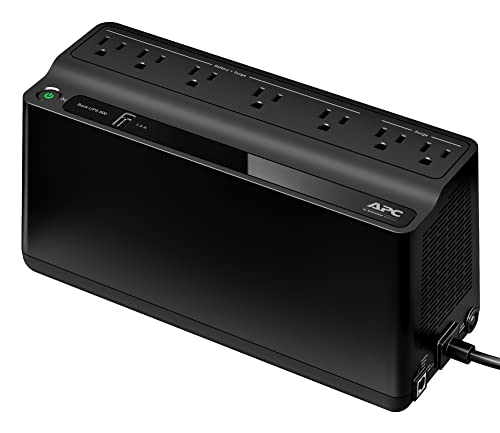
Closing out the list is the smallest, simplest unit: the APC BE600M1. A 600VA/330W UPS with seven outlets, five on battery and surge, two surge-only, and a single USB charging port. Where the BR1500MS2 above protects a workstation, this one protects the gear that keeps a household connected.
Modem, router, VoIP box, maybe a small NAS. A brief outage becomes a non-event, and a long outage still buys time to save work.
The Case For It
- Tiny footprint tucks behind a shelf or under a desk
- Five battery-backed outlets are enough for an entire networking stack
- USB port charges a phone directly
- Lowest cost of ownership in the roundup
Where It May Fall Short
- 330W output will not run a desktop PC, monitor, and router together
- Battery is sealed, not user-replaceable on most revisions
Whose Setup It Serves
Apartments, small offices, and anyone whose main goal is keeping internet and phone alive during short outages.
Where A Sibling Pick Shines
The APC BX1500M is the better upgrade path for full desktop computers and home office setups.
What Matters Most Before Choosing Home Power Backups
The right backup depends on what you’re actually trying to keep running. A fridge and a CPAP for 12 hours calls for something entirely different from a work-from-home setup or a gaming PC. Below are the practical decision points that matter most.
Capacity, Runtime, and the Honest Math
Battery capacity, measured in watt-hours (Wh), tells you how much energy the unit stores. A 1500Wh station running a fridge that draws 150W will last around 8 to 10 hours with normal compressor cycling, longer if the door stays shut. Running watts matter too: a 1500Wh station with only 1500W output cannot start a 2000W microwave. For whole-home generators, peak watts handle startup surges while running watts handle steady draw.
Fuel Type and Where You Live
Battery stations are quiet, indoor-safe, and zero-maintenance. Gas and tri-fuel generators run longer per refill but need outdoor placement, fuel stabilizer, and oil changes. Solar panels cut fuel needs but depend on weather. In sun-poor regions, a tri-fuel generator like the Westinghouse above often beats a battery kit.
Portability and Daily Use
A heavy station on a cart is great if you roll it once a month. It’s a hassle if you move it daily. Consider weight, handle design, and whether you’ll actually carry it up basement stairs in the dark.
Key Considerations Across These Picks
Common Shopping Slip Ups
The most frequent mistake is sizing purely by advertised wattage without checking what you actually plan to plug in. Induction cooktops, hair dryers, and space heaters all draw 1500W or more, and a 1000Wh battery would barely run a hair dryer for 40 minutes. The second slip-up is forgetting transfer-switch installation for whole-home generators, which an electrician typically needs to wire safely. Plan for that line item.
What The Higher Tier Buys
Stepping up from a basic UPS to a portable power station usually buys pure sine wave output, larger capacity, and solar input compatibility. Stepping from a portable station to a tri-fuel generator buys multi-day runtime, central-air support, and fuel flexibility. The honest read is that the premium tier only earns its place if your outage risk is real and prolonged. Shoppers in regions with infrequent, brief outages often do just fine with the smaller picks on this list.
Frequently Asked Questions
How long can a 1500Wh power station run a refrigerator?
A typical modern fridge draws around 100 to 200W when the compressor cycles on. With normal use, expect roughly 8 to 12 hours of runtime, longer if the door stays closed and the ambient temperature is moderate.
Are battery power stations safe to use indoors?
LFP models carrying UL 9540A certification, like several Enphase units on this list, are tested specifically for indoor home use and resist thermal runaway. They produce no exhaust and run quietly, unlike gas generators.
What is the difference between running watts and peak watts?
Running watts is the continuous power a generator can supply. Peak watts is a short surge capacity for motor startup, things like a fridge compressor or a well pump. Always match appliances to running watts, not peak.
Do I need a transfer switch for a portable generator?
For any generator hardwired into a home’s electrical panel, yes. A transfer switch prevents backfeed, which is dangerous to utility workers and can damage the generator. An electrician installs it once and it’s safe for years.
Can solar panels charge a power station during a blackout?
Yes, if the panels are still connected and the sun is out. Solar charging is slower than wall charging, but during a multi-day event, it turns a one-shot battery into a sustained backup.
Closing Remarks
The best home backup is the one that matches your real risk, your real space, and the gear you actually need to keep alive. For most households in storm-prone regions, a portable power station paired with a small generator covers the spectrum. Run the numbers on what you actually need to plug in, pick the closest match from this list, and stop worrying about the next outage before it arrives.
