

Power-hungry tools and gear demand more than a basic wall outlet can safely provide. A proper heavy-duty surge protector handles the wattage, manages heat, and keeps expensive equipment safe when the grid spikes. I put together this list to help you sort the genuine workhorses from the pretty-but-flimsy options, whether you’re wiring a workshop, a home office, or a busy kitchen.
How The Shortlist Stacks Up

CCCEI 12 Gauge Extension Cord with Outlets 50FT

CCCEI 12 Gauge Extension Cord with Outlets 100FT

CCCEI Heavy Duty Surge Protector with USB Ports 6FT

NANOLAKE Surge Protector Power Strip 18 Outlets 4800J
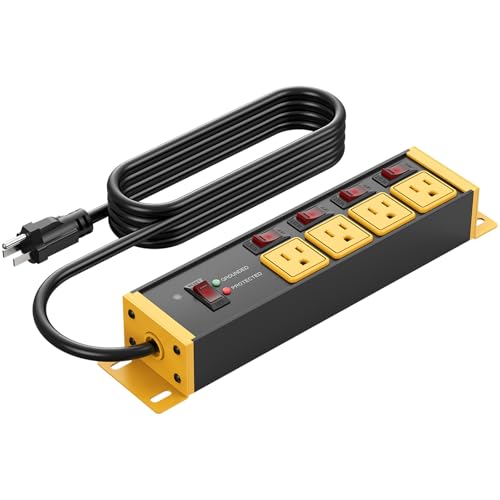
CCCEI 12 Gauge Heavy Duty Surge Protector 6FT

CCCEI Magnetic Heavy Duty Surge Protector 6FT Orange

CCCEI Magnetic Heavy Duty Power Strip 8 Ports 6FT

CCCEI 12 Gauge Heavy Duty Power Strip GFCI 8 Ports

Anker Power Strip 900J Surge Protector 35W
CCCEI Industrial GFCI Surge Protector 20A 6FT
The Strengths Of Each Pick
Fifty feet of reach gives this CCCEI strip real flexibility for a garage, basement workshop, or detached shed. The 12-gauge wire handles up to 15 amps at 125 volts, which is a comfortable margin for miter saws, air compressors, and bench grinders running one at a time.
Eight outlets and a built-in circuit breaker give you room to spread gear across multiple circuits. The flat 3-prong plug is also genuinely useful, sliding behind cabinets and workbenches where a chunky right-angle plug won’t fit. Compared to the basic wall strips many folks grab first, this one feels more like an industrial cord than a home-office accessory.
Strong Points
- 50-foot reach eliminates the need for extra extension chaining in most shops.
- 12-gauge wire rated for 15A/125V/1875W supports demanding bench tools.
- Individual overload protection trips before the breaker panel needs to react.
- Flat 5-15P plug hugs tight against the wall, freeing up floor space.
Things To Consider
- Yellow vinyl jacket shows scuffs and grime fast in dirty workshop conditions.
- Eight outlets share a single circuit, so heavy loads on every socket at once will trip the breaker.
- Bulkier than standard home strips, so it’s overkill for a bedside lamp setup.
Who Will Love This
Workshop owners and serious DIYers running multiple 15-amp tools from one wall outlet.
Swap It Out When
Reach matters more than outlet count, in which case the CCCEI 12 Gauge Extension Cord with Outlets 100FT gives you twice the run.
Hundred feet of cord solves problems no shorter strip can touch: powering a far corner of a barn, running gear out to a garden project, or reaching a detached garage from a house outlet. The 12-gauge wire here is the same heavy spec as the 50-foot version, so you don’t sacrifice current capacity for the extra distance.
Voltage drop is the real concern with a run this long, and a thicker gauge wire is exactly what keeps tools spinning at full speed at the far end. Compared to the 50-foot CCCEI, you trade compact storage for reach, and the bright yellow jacket stays visible across long grass or cluttered shop floors. The eight-outlet block sits comfortably at the working end of the line.
Strengths Worth Knowing
- 100-foot reach handles properties where one outlet needs to feed distant equipment.
- Same 15A/125V/1875W rating as shorter 12-gauge cords means no power compromise.
- Overload and grounding protection built into the outlet block, not just the plug.
- Flat plug keeps the wall-side connection tidy against baseboards.
Trade Offs
- 100 feet of cable is heavy and awkward to coil neatly after each use.
- Storing the full length requires a reel or hook, otherwise it tangles fast.
- More cable than needed for a small indoor workspace, adding clutter underfoot.
Built With In Mind
Property owners and outdoor hobbyists who need safe, far-reaching power across yards, barns, and detached buildings.
Look Elsewhere When
Your work is all within 30 feet of an outlet, where the shorter CCCEI 12 Gauge Extension Cord with Outlets 50FT is easier to manage.
This strip brings 12-gauge wire into the home-office world, where most competitors use thinner 16-gauge cord. The result is a desktop-friendly strip that can still shrug off a printer, dual monitors, and a laptop dock without strain on the cable.
Two USB-C ports and one USB-A cover phone, tablet, and earbud charging without a separate wall wart. Four individually switched outlets with a master switch let you kill idle gear cleanly at the end of the day. Compare that to the NANOLAKE on this list, and the CCCEI wins on cord thickness but trails on total outlet count.
Positive Points
- USB-C and USB-A ports cut down on bulky charging bricks taking up outlet space.
- 12-gauge cord rated for 1875W handles heavier loads than typical office strips.
- Individual switches give fine control over monitors, printers, and speakers.
- Six-foot length reaches a desk comfortably from a wall outlet without excess slack.
Honest Caveats
- Only four AC outlets, so high-density setups will need additional strips.
- USB ports charge at standard speeds, not the fastest PD protocols on the market.
- Black housing shows dust on a bright desk surface, requiring occasional wiping.
Feature Snapshot
Right Fit For
Remote workers and home-office users who want a single hub for laptop, monitor, phone, and small electronics.
Reach For A Different Pick When
You’re plugging in more than four AC devices, in which case the NANOLAKE Surge Protector Power Strip 18 Outlets 4800J offers far more breathing room.
Eighteen wide-spaced AC outlets sounds excessive until you’ve tried to plug in a rack of AV gear, a PC, a console, and a monitor array with chunky power bricks. The NANOLAKE keeps them all happy without the constant adapter shuffle. The 4800-joule rating is the highest surge absorption on this list, which matters if your home grid hiccups during storms.
The four USB ports (two USB-A, two USB-C with PD 20W) cover phone and tablet charging at a useful speed. Mountable design and a flat plug round out a strip built for an entertainment center or a serious workstation. Versus the CCCEI USB-equipped strip, the trade is clear: fewer ports on the smaller unit, far more capacity here.
A Few Strong Suits
- 4800-joule rating absorbs serious spikes before they reach sensitive gear.
- Wide-spaced outlets handle oversized plugs and wall-wart adapters without blocking neighbors.
- USB-C PD 20W ports fast-charge modern phones and tablets directly.
- Mountable housing with a flat plug fits neatly behind media cabinets and desks.
Points To Note
- Long 18-outlet body needs a dedicated shelf or mounting surface, not just floor space.
- Ten-foot cord is generous but may create slack that needs management behind furniture.
- Higher joule rating is wasted on basic lamp-and-laptop setups with no sensitive electronics.
Whose Shelf It Belongs On
Home theater enthusiasts and power users with multiple high-value electronics sharing one outlet cluster.
Consider Something Else When
You’re running 240V shop tools off a single phase, where the CCCEI 12 Gauge Heavy Duty Surge Protector 6FT handles the amperage better.
This 20-amp strip stands out for accepting NEMA 5-20 and 6-20 plugs, which means it can host tool plugs most home strips reject. For shops with table saws, welders, or larger compressors, that flexibility matters more than raw outlet count.
Four outlets with independent switches and a wall-mountable body make this a tidy bench companion. The 12-gauge, 6-foot cord reaches comfortably from a wall outlet to a workbench without tripping over excess cable. Compared to the CCCEI Magnetic Heavy Duty Surge Protector, you trade the magnet for 20-amp-rated receptacles, which is the right swap for serious shop gear.
What Earns Its Place
- 5-20R and 6-20R receptacles accept 20-amp plugs standard home strips can’t fit.
- Independent 20-amp circuit breakers let you kill one tool without affecting the others.
- 12-gauge cord rated for 1875W stays cool under heavy continuous load.
- Wall-mountable housing installs cleanly on a shop wall or under a bench.
Worth Bearing In Mind
- Four outlets is limiting for tool setups needing more than a few simultaneous connections.
- Yellow industrial housing looks out of place in a finished living area.
- Requires a 20-amp wall circuit to take advantage of the higher-rated receptacles.
Best Suited To
Workshop users with 20-amp tools who need a strip that won’t reject their heavier plugs.
A Better Fit Elsewhere
Garage hobbyists wanting tool-free installation, in which case the CCCEI Magnetic Heavy Duty Surge Protector 6FT Orange mounts in seconds.
Built-in magnets on the back of this strip stick to metal surfaces, which sounds like a small thing until you’re working under a workbench or beside a metal tool cabinet. Suddenly the strip is at hand-level, not dragging on the floor. The orange color also stays visible in cluttered garages.
Four outlets with individual switches and a master switch give you flexible control without unplugging cables. The 12-gauge cord stays cool under load, matching the heavier-duty models on this list. Against the yellow CCCEI Magnetic Heavy Duty Power Strip 8 Ports, you lose two outlets but gain the same magnetic mounting in a more compact body.
What It Does Well
- Magnetic back snaps onto metal studs, toolboxes, and workbenches without hardware.
- Master switch plus per-outlet switches offer layered control over connected gear.
- Bright orange housing is easy to spot in dim garage lighting.
- 15A/125V/1875W rating supports typical power-tool cycling without overheating.
A Few Limitations
- Magnets only work on ferrous metal, so wood or plastic surfaces need separate mounting.
- Four outlets is enough for a small bench but tight for battery-charging banks.
- Orange vinyl shows scratches and shop grime after heavy use.
Who Should Grab It
Garage mechanics and metal-shop users who want a strip that stays off the floor and within arm’s reach.
Another Choice May Suit
Anyone needing more than four outlets should consider the CCCEI Magnetic Heavy Duty Power Strip 8 Ports 6FT, which doubles down on the same magnet trick.
Eight outlets plus a magnetic back puts this strip in a useful middle ground: more capacity than the orange 4-outlet sibling, same tool-free mounting. It works well as a charging hub for power-tool batteries, where every dock wants its own outlet and the bank lives on a metal rack or cabinet.
The 14-gauge cord is slightly thinner than the 12-gauge models elsewhere on this list, which still supports the 15A/125V/1875W rating for typical shop loads. The flat plug fits behind workbenches where a chunky plug would lift the strip off the wall. Compared to the CCCEI 12 Gauge Heavy Duty Surge Protector, you give up 20-amp compatibility but gain the magnetic mount and two extra outlets.
What Pays Off
- Eight outlets handle a full bank of battery chargers without daisy-chaining strips.
- Magnetic back installs on metal shelving, racks, and cabinets in seconds.
- Flat plug saves space against walls and behind furniture.
- Dedicated 15A breaker isolates faults without dropping the whole circuit.
Things To Weigh
- 14-gauge cord is adequate but not as robust as 12-gauge options for sustained heavy loads.
- Yellow housing clashes with painted interiors if used inside living areas.
- No GFCI protection, so damp-location users should look elsewhere on this list.
Perfect Match For
Tool owners running multiple battery chargers off a metal rack or garage cabinet.
Where A Sibling Pick Shines
Anyone needing ground-fault protection in a basement or outdoor setup should consider the CCCEI 12 Gauge Heavy Duty Power Strip GFCI 8 Ports.
GFCI (ground fault circuit interrupter) protection built into the strip itself means it trips fast if current leaks through water or a person, which makes this the safest pick on the list for damp basements, outdoor-adjacent outlets, and shop corners near sinks or wash-down areas. Most power strips assume a dry environment, so the built-in GFCI is a real upgrade.
Eight outlets, a 20-amp switch, and the same 12-gauge 1875W cord capacity as the heavier shop strips round out a versatile package. The grey housing is also more visually discreet than the bright industrial yellows on this list. Against the CCCEI 12 Gauge Heavy Duty Surge Protector, you trade 20-amp receptacles for GFCI protection and double the outlet count.
Real Benefits
- Built-in GFCI protects users in damp or semi-outdoor environments.
- Eight outlets cover most bench configurations without extra strips.
- 12-gauge cord stays cool at full 1875W sustained load.
- Grey housing blends into finished spaces better than industrial yellows.
Practical Considerations
- GFCI adds bulk to the outlet block, taking up more space behind furniture.
- GFCI test and reset buttons require occasional monthly checks per common practice.
- Six-foot cord is generous but may need management in larger basement layouts.
Feature Card
Made For
Basement workshops, garage-adjacent outlets, and any location where moisture or concrete floors raise the stakes.
Not Your Match When
You’re plugging in 20-amp specialty plugs, where the CCCEI 12 Gauge Heavy Duty Surge Protector 6FT accepts the higher-rated receptacles natively.
Anker brings a more refined, modern design to a category dominated by industrial-looking strips. The slim housing fits under a monitor or behind a clean desk without drawing attention. Twelve total ports (8 AC plus 2 USB-C and 2 USB-A) cover a typical desk or nightstand cluster.
The 35W max USB-C output is genuinely fast for phones, tablets, and small laptops, which sets this apart from strips that trickle-charge at 5W. The 900-joule rating is on the lower side for the category, so it’s not built for absorbing massive spikes. Compared to the NANOLAKE strip on this list, you trade raw joule capacity for a much slimmer, more desk-friendly build.
Real-World Strengths
- 35W USB-C output fast-charges phones and tablets at full speed.
- Slim housing fits behind monitors and on narrow shelves.
- Twelve total ports handle most personal tech without extra hubs.
- Trusted-brand build quality backed by Anker’s customer support reputation.
Where It May Fall Short
- 900-joule surge rating is modest for areas with frequent grid spikes.
- Eight AC outlets can run out fast with monitor, PC, and console sharing one strip.
- Premium design commands a higher price than bulkier industrial alternatives.
Right Fit For
Home users prioritizing a clean look and fast USB-C charging over maximum joule protection.
Skip It When
Storm-prone areas demand higher joule absorption, where the NANOLAKE Surge Protector Power Strip 18 Outlets 4800J offers stronger spike defense.
Industrial GFCI protection plus individual switches on every outlet makes this strip a workhorse for kitchens, commercial counters, and shop benches where gear cycles on and off all day. The 12-gauge cord stays cool even when all four outlets feed demanding appliances in sequence.
Yellow housing is intentional: in busy kitchens or shops, you need to see the strip and not lose track of which breaker controls it. The GFCI element adds the moisture safety you want near sinks or open garage doors. Against the CCCEI 12 Gauge Heavy Duty Surge Protector 6FT, you trade 20-amp receptacle compatibility for built-in ground-fault protection and individual switch control.
What Makes Sense
- Individual switches let you kill one appliance without tripping the whole strip.
- Built-in GFCI protects against ground faults in kitchens and damp areas.
- 12-gauge cord rated for 1875W supports mixers, microwaves, and small heaters.
- Yellow jacket improves visibility on cluttered countertops and shop floors.
Points To Keep In Mind
- Four outlets is limited for setups needing to power more appliances at once.
- Industrial yellow looks utilitarian next to stainless kitchen appliances.
- Requires a standard 15A outlet to plug in, limiting how it pairs with 20A kitchen circuits.
Quick Facts
The Right Fit
Busy home kitchens, food prep stations, and shop benches that cycle appliances on and off throughout the day.
Where Another Pick Suits Better
Users needing 20-amp tool compatibility should consider the CCCEI 12 Gauge Heavy Duty Surge Protector 6FT instead.
What To Weigh Before Choosing A High Power Surge Protector
High power surge protectors handle more electrical current than typical home strips, so the deciding factors go beyond simple outlet count. Gauge rating, amperage capacity, mounting style, and environmental safety all matter once you move past lamp-and-laptop duty.
Cord gauge is the most overlooked spec. A 12-gauge cord carries current more efficiently than 14-gauge and stays cooler under load, which matters when you run a miter saw or space heater for long stretches. If the cord feels warm after a few minutes of use, the wire is likely too thin for what you’re plugging in. Most heavy-duty strips on this list use 12-gauge wire for exactly that reason.
Amperage ratings come in two flavors on this list: 15-amp strips for general use and 20-amp strips for tool-grade plugs (NEMA 5-20 or 6-20). Running a 20-amp tool on a 15-amp strip is a safety issue, so check the plug shape before assuming any strip will work. For kitchen appliances and standard home gear, 15-amp is plenty. For table saws and welders, you need the higher-rated models.
Surge joule rating measures how much spike energy the strip can absorb before failing. For areas with stable power, 900 joules is fine. For storm-prone regions or older grids, higher joule ratings like 4800J translate to longer protection lifespan. Think of joules as the strip’s “shield health”: every absorbed spike uses some up, and once they’re gone, the strip still works but no longer protects.
Mounting style changes everything in a shop. Magnetic backs (CCCEI’s magnet models) stick to metal surfaces without hardware, while wall-mountable strips with keyhole slots give you a permanent install on wood studs. Flat plugs matter when the strip lives behind a fridge or workbench: bulky right-angle plugs push the strip out and create trip hazards. Cord length affects everything from cable management to reach across large rooms.
Quick Reference For Specific Setups
- Workshops and garages: prioritize 12-gauge cords, magnetic or wall mounting, and individual switches per outlet.
- Home offices: USB-C and USB-A ports matter more than raw joule rating; slim designs fit better on desks.
- Kitchens and damp areas: built-in GFCI protection is non-negotiable, regardless of outlet count.
- Media centers: high joule ratings and wide-spaced outlets handle large plugs and protect expensive gear.
Picking Through The Common Traps
Mistakes Worth Dodging
The biggest mistake shoppers make is buying on outlet count alone. A strip with 18 outlets and a thin 16-gauge cord is a hazard waiting to happen, especially when running space heaters or power tools. Always check gauge and amperage rating before counting outlets.
Another trap is ignoring the plug shape. NEMA 5-20 plugs look almost identical to standard 5-15 plugs but have a different orientation, and not every strip accepts them. If your tool has that sideways blade, you need a strip rated for 20-amp receptacles.
Outdoor or basement buyers sometimes skip GFCI, assuming the wall outlet already has it. Older homes often lack GFCI on garage and basement circuits, and a GFCI strip gives you a second layer of protection. Skipping it on a damp concrete floor is a risk nobody should take.
Where The Extra Money Goes
Higher-tier strips in this category earn their keep through thicker cords, more robust breakers, and useful extras like GFCI and individual switches. A basic strip works for a lamp or two, but anything with sustained draw benefits from the upgraded internals.
The premium also covers build materials. Industrial yellow housings on the CCCEI heavy-duty strips aren’t just cosmetic: they’re tougher vinyl that holds up to shop abuse, drops, and chemical splatter. Plastic that feels like it’ll crack under a dropped wrench is a hint to spend a bit more.
For shoppers running tools daily or in harsh environments, the upgrade from a thin-corded basic strip to a 12-gauge heavy-duty model pays for itself in fewer tripped breakers and longer gear lifespan. For occasional lamp-and-laptop use, the basic models elsewhere are fine, and spending more won’t add real value.
Frequently Asked Questions
What Does “High Power” Actually Mean For Surge Protectors?
It generally refers to strips rated for 15 to 20 amps at 125 volts, with 12-gauge or thicker cords. These handle tools and appliances that would trip or overheat a basic 16-gauge home strip.
How Important Is Joule Rating?
Joule rating measures how much surge energy the strip can absorb over its lifetime. Higher joules mean longer protection in storm-prone areas, while 900 joules is adequate for stable urban grids with infrequent spikes.
Do I Need GFCI On A Surge Protector?
GFCI matters in kitchens, basements, garages, and outdoor-adjacent outlets. If the wall outlet already has GFCI protection, the strip doesn’t need to repeat it, but built-in GFCI is valuable in older homes without that protection.
Can A Surge Protector Handle A Space Heater?
Only if the strip is rated for the heater’s wattage and has a 12-gauge or thicker cord. Most space heaters draw 1500W, which fits a 1875W-rated strip, but thin-corded strips can overheat under sustained draw.
How Long Does A Surge Protector Last?
It depends on how many surges it absorbs. In stable power areas, a strip can last years. In storm-prone regions with frequent spikes, the internal components wear out faster and the strip may need replacement after a few major events.
Closing Thoughts
The right high power surge protector depends on where it lives and what it powers. Workshops need thick cords and magnetic mounting, kitchens need GFCI, and home offices need USB ports more than joule count. Match the strip to the room, and the rest takes care of itself. Pick the model that fits your specific setup, and you’ll have safer, cooler-running power for years to come.
