

Anyone who’s ever tripped over a thin cable mid-project knows the frustration of gear that can’t keep up. When you’re running a table saw in the garage or powering a welder in the shop, the cord matters as much as the tool on the end of it. I put together this lineup for DIYers, hobbyists, and homeowners who need serious reach and serious durability from their power setup. These ten picks cover everything from long outdoor runs to magnetic workshop strips to a dedicated welder lead, so there’s a solid match for nearly every scenario.
A Closer Look At The Lineup

CCCEI 12 Gauge Long Extension Cord, 50FT

CCCEI Heavy Duty Surge Protector, USB Ports, 6FT

SPARKING 6-Inch Short Power Extension Cord, 5-Pack

DEWALT 50 Foot Click-to-Lock Lighted Extension Cord
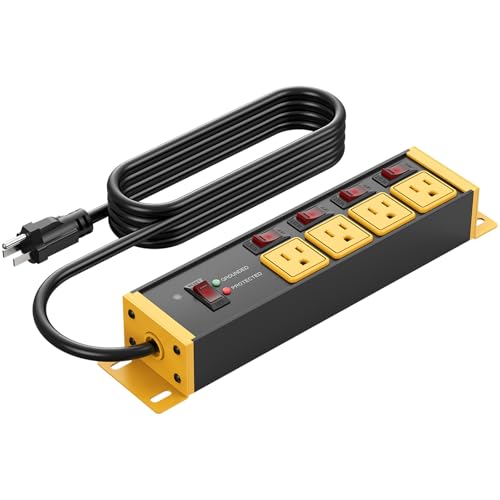
CCCEI 12 Gauge Heavy Duty Surge Protector, 6FT

CCCEI Magnetic Heavy Duty Surge Protector, Orange, 6FT

CCCEI Magnetic Heavy Duty Power Strip, 8 Ports, 6FT

CCCEI 12 Gauge Heavy Duty Power Strip, GFCI, 8 Ports

CCCEI 12 Gauge Long Extension Cord, Individual Switches, 50FT

RVMATE 25 Feet Welder Extension Cord, 10 AWG
A Closer Look At Each Pick
Running power across a two-car garage or out to a detached workshop is where a 50-foot cord earns its keep, and this CCCEI strip solves the problem of having only one or two outlets at the far end. The flat 12-gauge cable stays manageable on cold mornings, and the bright yellow jacket stays visible on a busy shop floor where tripping over a forgotten cord is a real hazard.
The head unit carries eight grounded outlets behind a single switch, plus a dedicated circuit breaker that lets you cut power to the whole strip without yanking the plug. That matters when you’re cycling between a miter saw and a vacuum and don’t want to walk back to the wall each time.
Bright Spots
- Eight outlets handle a full tool cluster without daisy-chaining another strip
- 12-gauge wire keeps voltage steady across the full 50-foot run
- High-visibility yellow jacket reduces trip-hazard surprises in a busy shop
- Flat plug profile slides behind workbenches and tight against baseboards
- Built-in breaker offers a single reset point instead of walking to the panel
Things To Consider
- 50 feet of heavy 12-gauge cable is genuinely heavy to coil and store
- Eight outlets in one block invites overloading if multiple high-draw tools share a circuit
- Yellow jacket can pick up scuffs and grease marks in a working garage over time
Feature Snapshot
Who Will Love This
Garage woodworkers and DIYers running multiple tools from one wall outlet appreciate the reach and outlet count combined.
Skip It When
Shoppers needing GFCI protection for damp environments should reach for the CCCEI 12 Gauge Heavy Duty Power Strip, GFCI, 8 Ports instead.
Where the first CCCEI is built for raw garage power, this one leans toward the desk. It mixes four traditional grounded outlets with two USB-C ports and a USB-A port, which is exactly the combo a home office or remote workstation usually needs for a laptop, a monitor, a phone, and a few peripherals.
Each of the four AC outlets gets its own switch, with a master switch on the end for one-touch shutdown. The 12-gauge, six-foot cord is shorter than the 50-foot workshop strip, but that’s the right call for behind a desk where extra length just becomes clutter.
Notable Gains
- USB-C and USB-A ports cut down on bulky charging bricks at the desk
- Individual switches let idle monitors and speakers stay dark without unplugging
- Master switch gives one-tap shutdown at the end of the workday
- 12-gauge cord handles the full 1875W rating without overheating
Worth Noting
- Only four AC outlets is a tight fit for setups with multiple printers or tower PCs
- USB ports share total output across connected devices, so fast charging may be limited when both ports are active
Best Suited To
Remote workers and home office users who want surge protection plus device charging in a single desk-side strip.
Consider Something Else When
Shoppers needing welder-grade 250V service should look at the RVMATE 25 Feet Welder Extension Cord, 10 AWG instead.
Not every extension cord needs to be fifty feet of yellow cable. Behind a TV, a nightstand, or a wall-mounted router, the goal is usually the opposite: get the bulky plug a few inches away from the wall so the furniture can sit flush. This five-pack of six-inch stubs handles that job for an entire entertainment setup or office cluster in one purchase.
Each stub is 16 AWG wire rated for 13 amps at 125 volts, which is fine for lamps, chargers, game consoles, and small appliances, though it isn’t built for high-draw shop tools. The pack format is the real win, since running out of these little helpers mid-project is a common annoyance.
Good Reasons To Consider
- Five-pack covers an entire room of tight-plug situations at once
- Six-inch length keeps cable slack from becoming visible mess
- Compact size fits behind furniture pushed flush against the wall
Minor Gripes
- 16 AWG wire is too light for shop tools, miter saws, or anything pulling near a 15-amp circuit’s edge
- Short length means zero room for repositioning once placed
Perfect Match For
Apartment dwellers and entertainment-center owners trying to push bulky plugs behind tight furniture benefit most from this format.
Look Elsewhere When
Anyone needing to reach across a garage or workshop should turn to the CCCEI 12 Gauge Long Extension Cord, Individual Switches, 50FT instead.
This is the only cord in the lineup that isn’t a multi-outlet strip, and that’s exactly why it earns its spot. The DEWALT is a single-outlet 50-footer built for outdoor abuse: rain, mud, sun, dragging across gravel, getting yanked off a spool at the start of every weekend project. The SJTW jacket resists water, oil, and abrasion, which is the language of cords that live outside a toolbox.
The click-to-lock connector keeps the male and female ends from separating under tension, which is genuinely useful when a tool snags the cord mid-cut. An amber LED in the male plug confirms at a glance that power is flowing, saving a lot of head-scratching when something won’t start.
A Few Strong Suits
- Click-to-lock ends prevent accidental disconnection during heavy pulls
- Lighted male plug gives instant power-status confirmation
- SJTW jacket handles rain, sun, and rough surfaces without cracking
- 12-gauge wire delivers full tool power at the far end of 50 feet
Points To Note
- Single outlet means you may still need a strip at the work site for multiple tools
- Heavier industrial jacket adds weight versus a basic vinyl cord
Feature Snapshot
Right Fit For
Outdoor DIYers and homeowners running chainsaws, pressure washers, or hedge trimmers far from any outlet will find this cord matched to their weekend.
Swap It Out When
Shoppers wanting multiple outlets at the far end should consider the CCCEI Magnetic Heavy Duty Power Strip, 8 Ports for a workshop setting.
This yellow 6-foot strip is the wall-mount version of the long workshop cord earlier in the list, and it leans into heavier 20-amp tool territory. The outlets use 5-20R and 6-20R receptacles behind individual switches, which means it accepts the larger plugs found on serious compressors, welders, and table saws.
Each outlet has its own 20-amp breaker, so a tripping tool only kills its own circuit instead of darkening the whole strip. The wall-mount design also gets the strip up off the floor, which is a quiet win for shop cleanliness and trip-hazard reduction.
Benefits That Matter
- Individual 20-amp breakers isolate faults to a single outlet
- 5-20R and 6-20R receptacles accept heavier tool plugs standard strips reject
- Wall-mount design keeps the cord off the shop floor
- 12-gauge 6-foot cord balances reach and storage
Trade Offs
- Only four outlets is limiting for mixed tool and charger setups
- Mounting hardware and placement require a bit more planning than a tabletop strip
Feature Snapshot
Whose Shelf It Belongs On
Mechanics and serious woodworkers running 20-amp tools in a fixed shop layout get the most from this strip’s outlet types and breakers.
Not Your Match When
Anyone needing GFCI protection for wet locations should look at the CCCEI 12 Gauge Heavy Duty Power Strip, GFCI, 8 Ports instead.
This orange CCCEI strip adds a feature the others in the lineup skip: a row of magnets on the back that grip any iron surface. Snap it onto a metal toolbox, the side of a steel workbench, or a breaker panel door, and the strip stays put without screws, brackets, or velcro. That’s the kind of detail that quietly changes how a shop gets used.
Beyond the magnets, you get four switched outlets with individual 20-amp breakers, plus a master switch that kills everything at once. The 12-gauge cord and 1875W rating match the rest of CCCEI’s heavy-duty lineup, so no power is sacrificed for the mounting trick.
Everyday Advantages
- Magnetic back panel mounts to any iron surface in seconds
- Individual outlet switches plus a master switch offer flexible control
- High-visibility orange jacket stands out on cluttered shop surfaces
- 12-gauge cord holds full rating without overheating
Softer Spots
- Magnets only work on ferrous metal, so wood or plastic benches need a different mounting approach
- Heavier weight on the magnets means vertical mounting may slip on thinner steel panels
Made For
Shop owners and metalworkers with steel workbenches who want a strip they can reposition in seconds rather than screw into place.
A Better Fit Elsewhere
Shoppers needing more outlets for a larger tool cluster should consider the CCCEI Magnetic Heavy Duty Power Strip, 8 Ports instead.
Take the magnetic mounting of the previous CCCEI strip and stretch it to eight outlets, and you get this yellow 14-gauge workhorse. The flat plug slides into tight spots behind a bench or a refrigerator, and the magnet array along the back keeps the whole strip locked to a steel surface once it’s placed.
Where this differs from the orange magnetic strip earlier is the outlet count and the wire gauge. 14 AWG is slightly lighter than 12, so for the heaviest table saws and air compressors, you’d want to step up. For chargers, work lights, routers, soldering irons, and small power tools, the 1875W rating gives plenty of headroom.
A Strong Showing
- Eight outlets cover a full bench of tools and chargers at once
- Magnetic back panel sticks firmly to steel surfaces without hardware
- Flat plug fits behind flush-mounted furniture and tight corners
- Wall-mount design keeps the strip up off the floor when magnets aren’t an option
Room For Improvement
- 14-gauge wire is lighter than the 12-gauge strips, so high-draw tools may run warmer
- Single 15-amp breaker trips the whole strip if any one outlet is overloaded
Feature Snapshot
Built With In Mind
Hobbyists and makers running multiple smaller tools on a busy workbench get the most value from the high outlet count and magnetic placement.
Another Choice May Suit
Anyone pulling serious amperage through table saws or compressors should reach for the CCCEI 12 Gauge Heavy Duty Surge Protector, 6FT instead.
GFCI (Ground Fault Circuit Interrupter) protection is the headline here, and for damp garages, basements, or outdoor-adjacent outlets it’s a meaningful safety layer. This grey CCCEI strip adds that protection to an eight-outlet, 12-gauge platform, so you get both the heavy wire for tool loads and the ground-fault cutoff that shuts things down fast if water is in the picture.
The strip keeps the same overload and grounding protection as the rest of the CCCEI line, with a 20-amp switch to control the whole head unit. It’s the right pick when the outlet you’re plugging into is the unprotected kind, or when local codes require GFCI coverage for certain garage and basement circuits.
A Favorable Mix
- GFCI protection adds a critical safety layer in damp environments
- Eight outlets handle a full tool and charger lineup
- 12-gauge wire stays cool under sustained loads
- 20-amp switch provides a single, easy-to-find cutoff
Honest Caveats
- GFCI adds bulk to the head unit versus a basic strip
- Some users report periodic GFCI test cycles that require a manual reset
Who Should Grab It
Garage and basement workshop owners dealing with moisture, concrete floors, or older wiring benefit most from the built-in GFCI protection.
Where Another Pick Suits Better
Shoppers wanting magnetic mounting on a steel bench should consider the CCCEI Magnetic Heavy Duty Surge Protector, Orange, 6FT instead.
This is the long-reach sibling of the eight-outlet strip from earlier, but with a more disciplined four-outlet, individually-switched head. For tool setups where each outlet pulls a different load (a saw, a vacuum, a work light, a sander), independent switching is a quiet luxury: you can kill the dust collector without walking back to the wall.
The 50-foot, 12-gauge yellow cable does the same job the first strip did, carrying full tool power to the back of a garage or outbuilding. The trade-off is fewer outlets at the far end, but for users who want control over each one, that’s a fair swap.
The Upside
- Per-outlet switches give precise control over mixed tool loads
- 50-foot reach covers long garages and detached shops
- 12-gauge wire maintains voltage at the far end
- Built-in circuit breaker protects the strip from overload
Points To Keep In Mind
- Only four outlets means a smaller tool cluster than the eight-outlet strip
- Long heavy cord takes up storage space and adds carrying weight
Who It Suits Best
Workshop owners with several high-draw tools who want to switch each one independently from the far end of a long cord.
Reach For A Different Pick When
Anyone needing welder-grade power at 250V should look at the RVMATE 25 Feet Welder Extension Cord, 10 AWG instead.
Every other cord in this lineup runs on standard 125-volt household current. This one doesn’t, and that’s the whole point. The RVMATE is a 250-volt, 30-amp extension cord built specifically for welders, with a NEMA 6-50 plug that fits the receptacles on most MIG and stick machines from brands like Miller and Lincoln.
The 10 AWG all-copper conductors and STW jacket handle oil and abrasion in a working shop, and lighted ends give instant power confirmation. The 25-foot length hits the common sweet spot: long enough to reach a wall outlet from the middle of a garage, short enough to stay manageable. This isn’t a general-purpose cord, and that’s exactly why it rounds out the list.
Useful Strengths
- 30-amp, 250V rating matches most home and light-commercial welders
- NEMA 6-50 plug fits Miller, Lincoln, and similar welder receptacles
- STW jacket resists oil and abrasion in working environments
- Lighted ends confirm live power without a meter
Some Limits To Know
- Not compatible with standard household 125V outlets
- 10 AWG cord is heavier and stiffer than the 12 and 14 gauge strips in this list
Feature Snapshot
Right Fit For
Hobbyist and professional welders needing a dedicated 250V lead for MIG or stick machines get the most from this specialty cord.
A Better Fit Elsewhere
Anyone working with standard 125V tools should pick the CCCEI 12 Gauge Long Extension Cord, 50FT instead.
Choosing The Right Heavy Duty Extension Cord For Your Setup
The first question to ask is what kind of current you’re actually moving. Household outlets in the US deliver 125V at 15 or 20 amps, which covers the multi-outlet strips and most outdoor cords in this list. Welding receptacles deliver 250V at 30 amps, which is its own category entirely. Mixing the two means the plug won’t even fit the outlet, but it’s worth confirming before assuming a “heavy duty” cord matches your tools.
Wire gauge is the next thing that genuinely matters. Lower gauge numbers mean thicker wire, and thicker wire loses less voltage across distance. A 12-gauge cord holds power steady over 50 feet for table saws and air compressors. A 14-gauge cord is fine for shorter runs and smaller tools, but starts to drop voltage under heavy load. For runs beyond 50 feet, stepping up to 10 AWG keeps your tools from bogging down mid-cut.
Outlet count and switching matter more than people expect. A single switched outlet is fine for a lamp or a vacuum, but a workshop usually wants at least four outlets with the option to control them independently. Magnetic mounting is a quiet upgrade for steel benches, and GFCI protection becomes important in any location that sees moisture, including damp basements and unconditioned garages.
Finally, think about the jacket and the connectors. SJTW and STW jackets are designed to resist water, oil, and abrasion, which matters for outdoor and shop use. Click-to-lock ends prevent annoying disconnections when a tool snags the cord. Lighted plugs save real troubleshooting time when something doesn’t start.
Key Considerations Across These Picks
Pitfalls Shoppers Hit
The most common mistake is reaching for the cheapest 16-gauge cord and expecting it to run a table saw. Lower gauges heat up fast under heavy load, and at the end of a long run the tool bogs down or the breaker trips. Match the gauge to the tool, not just to the price.
Another trap is ignoring the outlet environment. A basic strip on a damp concrete floor is a real safety issue. If the receptacle is anywhere near moisture, a GFCI-equipped strip or a GFCI receptacle upstream isn’t optional, it’s the responsible choice.
What The Higher Tier Buys
Spending up on a premium heavy-duty cord usually buys two things: thicker copper wire that holds voltage across distance, and better jacket materials that resist oil, water, and abrasion. For occasional light-duty use, a basic cord gets the job done. For daily shop work, outdoor projects, or welder service, the upgrade pays back in tool performance and cord longevity.
Frequently Asked Questions
What gauge extension cord do I need for heavy-duty tools?
For most household heavy-duty tools like table saws and air compressors, a 12-gauge cord is the right starting point. It stays cool under load and minimizes voltage drop across 50-foot runs. Shorter runs and lighter tools can get by on 14 gauge, but anything pulling near a 15-amp circuit’s edge benefits from the thicker wire.
Can I use an outdoor extension cord indoors?
Yes, outdoor cords work fine indoors. The reverse is the real concern: indoor cords often lack the water and abrasion resistance needed outside. For yard work, job sites, or damp basements, look for SJTW or STW jackets designed for outdoor conditions.
What is GFCI protection and when do I need it?
GFCI stands for Ground Fault Circuit Interrupter. It monitors the current going out and coming back, and cuts power quickly if it detects a difference, which usually means current is leaking through water or a person. Any outlet near moisture, including outdoor receptacles, garage floors, and basements, benefits from GFCI protection either at the receptacle or in the cord itself.
How long can a heavy-duty extension cord be without losing performance?
For 12-gauge wire at a 15-amp draw, 50 to 100 feet is generally fine without noticeable voltage drop. Beyond that, stepping up to 10 AWG keeps tools running at full strength. For 250V welder circuits, 25 feet is a common sweet spot that balances reach and voltage stability.
Are magnetic power strips safe to mount on toolboxes?
The magnets on strips like the CCCEI magnetic models are strong enough to hold the strip’s weight plus the weight of plugged-in cords on a steel surface. They are not designed for live electrical mounting on energized equipment, and they only adhere to ferrous metal. For wood, plastic, or composite benches, wall installation is the better route.
Closing Remarks
The right heavy duty extension cord turns a frustrating power setup into one that just works. Long outdoor runs call for a rugged, lighted 50-footer like the DEWALT. Workshop benches get the most from a magnetic or GFCI-equipped CCCEI strip. Welding service is its own world, and the RVMATE 10 AWG lead is the cord built specifically for it. Pick the one that matches your tools, your outlets, and your space, and the rest of the project gets easier from there.
