

Anyone working from a home office knows the sinking feeling of a brief flicker during a video call, or the worst-case scenario of a desktop PC losing power mid-write. I built this shortlist around the gear that genuinely keeps equipment alive when the grid wobbles, from heavy-duty shop strips to sine-wave UPS units that protect sensitive electronics and even a wall mount that stops a backup battery from collecting floor dust. There’s something here for home offices, garages, NAS owners, and anyone tired of one-too-few outlets.
How The Shortlist Stacks Up

CCCEI 12 Gauge Long Extension Cord, 50FT

CCCEI 12 Gauge Long Extension Cord, 100FT
CCCEI 12 Gauge Heavy Duty Surge Protector, 6FT

CCCEI Magnetic Heavy Duty Surge Protector, 6FT

CCCEI 12 Gauge Heavy Duty Power Strip, GFCI, 6FT
CCCEI Heavy Duty Surge Protector, 20A, GFCI

CyberPower CP1500PFCLCD PFC Sinewave UPS

UPS Mount 548 Steel Wall Bracket

APC BE600M1 and BE425M Backup Bundle
UGREEN NAS UPS US3000, 12000mAh
Taking A Closer Look At The Options
A 50-foot reach solves the classic shop problem: the outlet lives on one wall, the work lives on the other. The CCCEI 12 Gauge Long Extension Cord, 50FT pairs that reach with an eight-outlet head, so a single cord can feed a table saw, dust collector, and work light at once.
12-gauge wire is the right call for any tool drawing real current; thinner cords drop voltage under load and run hot. A built-in breaker and grounded 5-15P plug round out the safety side. For most garage and basement shops, this is a sensible mid-length workhorse.
Points In Its Favor
- 50 feet covers a typical two-car garage without a second cord.
- Eight outlets let you centralize shop tools on one switched head.
- 12-gauge conductor handles sustained high draw without noticeable voltage sag.
- Integrated breaker trips before the cord overheats under fault conditions.
- High-visibility yellow jacket stays obvious across a cluttered floor.
Things To Consider
- 50 feet is plenty for a shop, but anyone running to a detached building will want the longer 100-foot sibling instead.
- The bright yellow finish scuffs visibly on concrete after extended floor use.
Feature Snapshot
Built With In Mind
Garage and basement shop owners running multiple 15-amp tools from a single distant outlet.
Swap It Out When
Anyone needing to reach a detached shed or barn should grab the CCCEI 12 Gauge Long Extension Cord, 100FT for double the run.
Double the previous pick’s length and the use case shifts from shop to property. The CCCEI 12 Gauge Long Extension Cord, 100FT gives owners of long driveways, detached garages, and fenced yards a single cord that crosses the gap without splicing.
The same eight-outlet head, 12-gauge conductor, and integrated breaker carry over, so users aren’t trading safety for reach. For outdoor events or a temporary workshop in a barn, this is the cord that reaches the building the 50-foot version can’t.
Benefits That Matter
- 100-foot reach covers detached buildings and large yard projects.
- 12-gauge wire keeps tools at full power over the long run.
- Eight-outlet head avoids a chain of power strips at the work site.
Worth Noting
- Coiled, 100 feet of 12-gauge cord is heavy; expect real weight when reeling it in.
- For indoor rooms or small shops, the extra length just adds bulk.
- Owners commonly route the cord through high-traffic grass, where a cord cover pays for itself.
Right Fit For
Property owners powering tools, inflatables, or lighting in a yard or detached structure far from the house outlet.
Look Elsewhere When
Anyone working inside a single garage should pick the CCCEI 12 Gauge Long Extension Cord, 50FT to avoid hauling excess length.
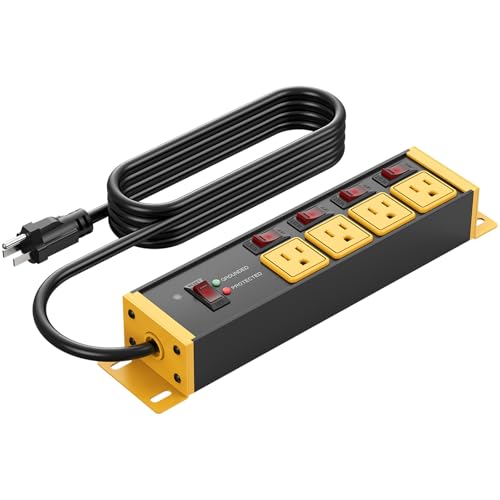
Where the previous two picks focused on reach, the CCCEI 12 Gauge Heavy Duty Surge Protector, 6FT focuses on control. Four outlets paired with 20-amp individual switches let users kill a dust collector without shutting off the radio.
The 20-amp rating across each outlet handles heavier shop loads that a residential 15-amp strip would balk at. Wall-mount tabs on the back also let the strip live above the bench instead of underfoot, which keeps cords tidy and out of the way.
What Makes Sense
- Individual switches mean one tool can be powered down while others keep running.
- 20-amp outlets support serious shop equipment without nuisance tripping.
- Wall-mount design clears floor space in tight workshops.
Trade Offs
- Only four outlets limits how many tools can live on one strip.
- The 6-foot cord assumes the bench sits reasonably close to an outlet.
Key Specs
Who Should Grab It
Shops running one or two hungry tools that need independent on/off control from a wall-mounted location.
Reach For A Different Pick When
Anyone needing more outlets in a damp garage should look at the CCCEI 12 Gauge Heavy Duty Power Strip, GFCI, 6FT with eight ports.
Most power strips live wherever gravity puts them. The CCCEI Magnetic Heavy Duty Surge Protector, 6FT sticks to a steel cabinet, tool chest, or rack leg, so the strip hangs at chest height instead of crawling across the floor.
Same four-outlet, 20-amp-switch layout as the wall-mount sibling above, but the magnetic back trades screw mounting for snap-on placement. A master switch on the head kills all four outlets at once for a clean end-of-day shutdown.
Why It Works Well
- Magnetic back attaches to any ferrous surface without tools.
- Master switch plus per-outlet switches offer layered control.
- 20-amp outlets handle shop tools without complaint.
- Orange jacket stands out on cluttered workbenches.
Honest Caveats
- Magnets have no grip on aluminum, plastic, or wood surfaces.
- A heavily loaded cord can sag over time on a vertical steel face.
Whose Shelf It Belongs On
Anyone with a steel tool chest or rack who wants the strip mounted at hand height instead of under the bench.
Where Another Pick Suits Better
Workshops without metal surfaces should default to the wall-mount CCCEI 12 Gauge Heavy Duty Surge Protector, 6FT instead.
Concrete floors and occasional puddles change the rules. The CCCEI 12 Gauge Heavy Duty Power Strip, GFCI, 6FT adds ground-fault protection (GFCI), which cuts power instantly if current leaks through a wet path or a frayed tool cable.
Eight outlets on a single head make it the highest-capacity strip in this roundup so far, while the 12-gauge cord and 20-amp switch keep heavy loads happy. The grey housing also blends into shop decor better than the bright yellow cords earlier on the list.
The Upside
- GFCI protection is genuinely important around damp garage floors.
- Eight outlets handle a full bench of tools and chargers.
- 12-gauge cord stays cool under sustained shop loads.
Less Ideal Details
- One master switch means every outlet powers down together.
- GFCI can nuisance-trip with some older motor tools on startup.
Best Suited To
Home mechanics and woodworkers with damp or partially open garage spaces where ground-fault safety matters.
Not Your Match When
Shop owners needing per-outlet switching should pick the CCCEI Heavy Duty Surge Protector, 20A, GFCI with four independently switched ports.
The CCCEI Heavy Duty Surge Protector, 20A, GFCI lands at the intersection of safety and control. GFCI protection guards against ground faults, while individual switches on each of the four outlets let users idle a tool without unplugging it.
The 12-gauge, 6-foot cord stays cool even under full load, and overload plus grounding protection add another layer of safety. For a kitchen island, garage workbench, or basement bar, this is the most flexible heavy-duty strip in the lineup.
Advantages To Know
- Individual switches plus GFCI safety in a single strip.
- Runs cool under sustained draw thanks to 12-gauge wire.
- Compact 4-outlet head fits on crowded countertops.
Possible Compromises
- Only four outlets limits how many devices share one strip.
- The yellow finish is louder visually than the grey GFCI sibling.
Made For
Household kitchens and garages where GFCI matters and users want independent on/off control of each device.
A Better Fit Elsewhere
Anyone needing eight outlets in one head should consider the CCCEI 12 Gauge Heavy Duty Power Strip, GFCI, 6FT instead.
Stepping up from power strips into actual uninterruptible power supplies, the CyberPower CP1500PFCLCD PFC Sinewave UPS offers what surge strips cannot: runtime. When utility power drops, this unit keeps a desktop PC, monitor, and modem alive long enough to save work and shut down cleanly.
The “PFC sinewave” label refers to its pure sine wave output (a smooth, utility-grade waveform), which matters for modern PCs with active PFC power supplies that can refuse to run on the stepped waveform cheaper UPS units produce. A color LCD on the front gives a quick read on load and battery status.
Practical Pluses
- Pure sine wave output works with active PFC power supplies without complaint.
- Line-interactive topology corrects small sags without dipping into battery.
- Multifunction LCD panel shows load, battery, and event logs at a glance.
- Mini-tower footprint fits beside or under a desk.
Points To Note
- Battery replacement becomes relevant after a few years of regular use.
- Runtime varies widely with the wattage of connected gear.
- Heavier than a plain power strip; plan a permanent home for it.
Spec Overview
Perfect Match For
Home-office workers and prosumers running modern desktops where a clean shutdown protects unsaved work.
Consider Something Else When
Owners of a small UGREEN NAS enclosure will find the UGREEN NAS UPS US3000, 12000mAh a more tailored match.
The UPS Mount 548 Steel Wall Bracket is the only item in this roundup that is not a power product, and that is exactly why it earns a spot. A UPS sitting on the floor collects dust, blocks outlet access, and trips wandering feet.
Fabricated from 16-gauge cold-rolled steel with a powder-coated flat black finish, this bracket lifts a compatible UPS off the floor and mounts it vertically to a wall, desk side, or cabinet. For anyone whose backup battery has been living under a desk since purchase, this is the tidy-up.
Strong Points
- 16-gauge steel construction supports a fully loaded UPS without flex.
- Powder-coat finish resists scuffs in workshop and garage environments.
- Vertical mounting frees floor space under desks and workbenches.
Some Limits To Know
- Only fits APC Back-UPS models in the specified size range; verify dimensions first.
- Mounting hardware and a stud-ready wall are not included implicitly.
Who Will Love This
Home-office owners who already own an APC Back-UPS and want to reclaim the floor space it currently occupies.
Skip It When
Anyone shopping for actual battery runtime should pick the CyberPower CP1500PFCLCD PFC Sinewave UPS instead.
The APC BE600M1 and BE425M Backup Bundle is two separate UPS units packaged together, which sounds odd until you picture the actual use case. One unit sits beside the desktop and protects the PC and monitor. The other lives next to the modem and router and keeps the internet alive during an outage.
The two units are designed to be used separately, not daisy-chained, so each handles the gear it sits closest to. For anyone working from home with a real internet dependency, this is a quietly smart configuration.
What Helps Most
- Two backups cover two failure points at once.
- APC brand has wide replacement-battery availability down the road.
- Each unit sits where its load lives, keeping cords short.
Practical Considerations
- Two UPS units means two eventual battery replacements.
- These are basic stepped-wave units, not pure sine wave, so they may not pair with every modern active PFC PSU.
Who It Suits Best
Remote workers who need both their PC and their network gear protected through short outages.
Where A Sibling Pick Shines
Anyone running an active PFC workstation should grab the CyberPower CP1500PFCLCD PFC Sinewave UPS for a clean sine-wave feed instead.
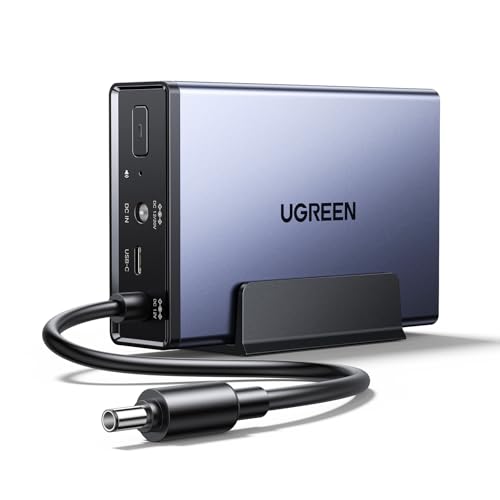
Most UPS units convert battery power to AC and back to DC inside a NAS, which is wasteful and noisy. The UGREEN NAS UPS US3000, 12000mAh skips the conversion by delivering 120W of DC power directly to compatible UGREEN NAS enclosures.
Compatibility is narrow on purpose: it works with specific 2-bay and 4-bay UGREEN models like the DXP2800, DXP4800, and DH4300Plus. Within that lane, it gives the NAS enough runtime to shut down cleanly and protect stored data when the lights blink.
A Favorable Mix
- DC-to-DC delivery avoids the efficiency loss of double conversion.
- Built-in protections cover surges, over-charge, and short circuits.
- Compact, quiet housing fits beside a NAS without adding hum.
- 12000mAh capacity gives a 2-bay NAS a graceful shutdown window.
Things To Weigh
- Only fits select UGREEN NAS models, not universal NAS hardware.
- Not compatible with DXP6800 or DXP8800 series, so model-check before ordering.
Product Snapshot
Made For
UGREEN NAS owners who want their enclosure to ride out brief outages without corrupting a RAID array.
Not Your Match When
Anyone running a Synology, QNAP, or desktop PC should look at the CyberPower CP1500PFCLCD PFC Sinewave UPS for broader compatibility.
What Matters Most Before Choosing Battery Backup And Surge Protectors
Match The Gear To The Load
The single biggest decision is whether you need a power strip with surge protection or a true UPS with battery backup. Surge strips (the CCCEI models earlier on the list) absorb voltage spikes and add outlets, but they cannot keep a device running when utility power drops. A UPS, like the CyberPower CP1500PFCLCD or APC BE600M1 bundle, actually stores energy and bridges short outages. For a desktop PC with unsaved work, a router that you cannot do without, or a NAS holding irreplaceable data, only a UPS will do.
Check The Waveform For Modern PCs
Active PFC (Power Factor Correction) power supplies, common in modern desktops and workstations, demand a clean sine wave output (a smooth, utility-grade alternating current waveform). Cheaper stepped-wave UPS units can cause these power supplies to refuse to run on battery or shut down unexpectedly. The CyberPower CP1500PFCLCD explicitly outputs pure sine wave for this reason. If you own a recent desktop, verify sine-wave compatibility before buying.
Right-Size The Capacity
A UPS rated in volt-amperes (VA) or watts covers only so much runtime. A 600VA unit might give a desktop PC and monitor ten minutes, while a 1500VA unit can stretch that past half an hour. Match the VA rating to the wattage of the gear you intend to plug in. Overloading a UPS triggers its own breaker and defeats the purpose entirely.
Pick GFCI Where Water Lives
Garages, basements, outdoor kitchens, and shop floors occasionally get wet. A GFCI-equipped strip (the CCCEI GFCI models) cuts power the moment current leaks through an unintended path, which can save a tool or a person. Inside a dry home office, GFCI is less critical, and a standard heavy-duty strip will do the job.
Key Considerations Across These Picks
Where Shoppers Go Wrong
A common trap is buying the cheapest surge strip and calling it a battery backup. Surge strips clamp voltage spikes; they do not store energy. Anyone whose work depends on a clean shutdown during an outage needs an actual UPS with internal batteries. The reverse mistake also happens: people buy a small UPS and then load it with a laser printer or space heater, which drains the battery in seconds and stresses the inverter. Size the UPS to the load.
Why Top Tier Costs More
The price gap between a basic 600VA UPS and a 1500VA pure-sine-wave unit covers real engineering. Higher-capacity batteries, sine-wave inverters, larger transformers, and informative LCD panels all add cost. For a workstation running an active PFC power supply, the upgrade to pure sine wave is genuinely worthwhile, since it prevents nuisance shutdowns. For a router or modem, the lower tier is usually enough.
Frequently Asked Questions
Do I really need a battery backup if I already have a surge protector?
Surge protectors absorb voltage spikes but cannot keep devices running when utility power cuts out. A battery backup stores energy to keep gear alive through short outages, which lets you save work or stay online. For a desktop PC, NAS, or network gear, a battery backup is the meaningful protection layer.
What is pure sine wave and why does it matter?
A pure sine wave is a smooth alternating current waveform that matches what the utility grid delivers. Sensitive electronics with active PFC power supplies expect that smooth waveform. Cheaper stepped-wave UPS outputs can confuse active PFC circuits, leading to random shutdowns on battery.
How long will a UPS keep my equipment running?
Runtime depends on the UPS capacity and the wattage of connected gear. A typical 1500VA unit can run a desktop PC and monitor for roughly 10 to 30 minutes. Modems and routers sip far less power, so a small UPS can keep network gear alive for an hour or more.
Can I plug one surge protector into another?
Daisy-chaining surge protectors is a code violation in most regions and creates a real fire risk. Run each strip directly into a wall outlet instead, and avoid stacking surge devices on top of one another.
Are GFCI power strips necessary indoors?
Inside a dry room, GFCI protection is rarely essential. In garages, basements, outdoor kitchens, or anywhere moisture shows up, GFCI cuts power fast enough to prevent a shock, and a GFCI-equipped heavy-duty strip is a sensible upgrade.
Closing Remarks
The right pick depends on what you are protecting and where it lives. Heavy-duty strips with 12-gauge cord and GFCI safety cover the garage and shop; sine-wave UPS units cover the home office and workstation; a DC NAS UPS covers the network-attached storage. Match the tool to the room, and the next time the grid blinks, nothing important will be lost.
