

Finding the right 48V battery for an electric bike, golf cart, or small EV build comes down to chemistry, BMS headroom, and how the pack fits your frame. I pulled together ten options that span deep-cycle LiFePO4 golf cart packs to lighter e-bike replacements, so you can match capacity and discharge to the way you actually ride.
A Closer Look At The Lineup

Cloudenergy 48V 105Ah LiFePO4 Golf Cart Battery 250A BMS

Cloudenergy 48V 105Ah LiFePO4 Golf Cart Battery 250A BMS

OGRPHY 48V 105Ah Lithium Golf Cart Battery 200A BMS
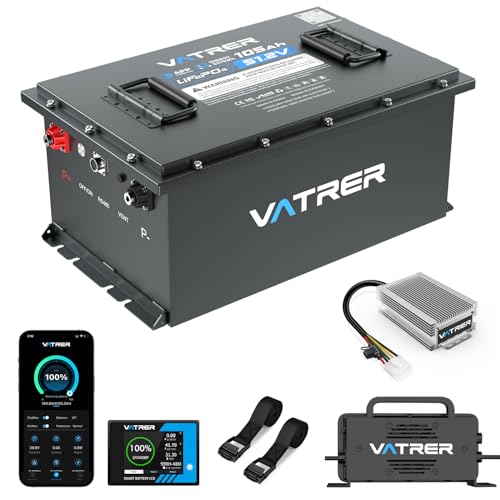
VATRER POWER 48V 105Ah Lithium Golf Cart Battery UL2271

VATRER POWER 48V 100Ah Lithium LiFePO4 Battery 100A BMS

XIONGRUIHENG 48V 105Ah LiFePO4 Golf Cart Battery 250A BMS

OGRPHY 48V 105Ah Lithium Golf Cart Battery 200A BMS

OGRPHY 48V 100Ah Lithium Golf Cart Battery Onboard 18A Charger

ZLSHELIBK 72V 20Ah Ebike Battery 80A BMS Triangle Pack

LOLRKO 48V 20Ah Ebike Battery 30A BMS Waterproof
Taking A Closer Look At The Options
Opening the list is a pack built for cart owners who put serious hours behind the wheel. The Cloudenergy 48V 105Ah LiFePO4 arrives as a 3-in-1 bundle with a 58.4V 20A fast charger, a 2.8-inch LCD touch screen for live status, and a 78.74-inch cabling harness. The 250A BMS (Battery Management System, the onboard board that guards against over-charge, over-discharge, and shorts) is generous for stock 48V cart motors.
For most weekend cart owners this means a drop-in upgrade from a tired lead-acid bank without rewiring the cart. Deep-cycle LiFePO4 chemistry (lithium iron phosphate, a safer and longer-lived lithium chemistry than older Li-ion) handles frequent discharges without the sulfation that kills flooded batteries over time.
What Stands Out
- 250A continuous BMS headroom suits most 48V motor controllers without tripping
- Bundle includes a fast 20A charger, so a full top-up takes a fraction of the lead-acid charging window
- Touch monitor gives at-a-glance state-of-charge without phone pairing
- LiFePO4 chemistry tolerates deeper discharges, useful for longer cart routes
Things To Consider
- Classified as non-returnable due to hazmat shipping rules, so verify dimensions against your battery tray before ordering
- Some owners find the LCD cable routing tight in compact carts, depending on the layout
Made For
Full-size 48V golf cart owners who want a long-cycle LiFePO4 replacement and don’t mind the hazmat shipping limits.
Look Elsewhere When
Riders who want phone-based monitoring should look at the Cloudenergy 48V 105Ah pack reviewed below, which adds a mobile app and 3C discharge.
Where the previous Cloudenergy model focuses on a wired LCD screen, this sibling adds Bluetooth and a mobile app for live state-of-charge. It carries the same 51.2V nominal / 105Ah LiFePO4 chemistry and the same 250A BMS rating, but supports a 3C discharge rate (3 times the rated capacity, used here as a measure of peak current capability) for short bursts.
For most cart owners that translates into more headroom when climbing steep paths or running a trolling motor accessory. You also get a 6000+ cycle rating claim, which puts this pack in the long-haul category for daily drivers.
Everyday Perks
- Mobile app removes the need to lean into a battery compartment to check status
- 3C discharge tolerance gives a margin for short surge events on hilly courses
- 6000+ cycle rating targets daily-use carts that rack up many charge cycles per year
- Cloudenergy support responds within 24 hours, helpful during installation questions
Trade Offs
- App pairing adds one more setup step compared with the simpler LCD version
- Like other LiFePO4 packs in this class, hazmat shipping rules apply and the item is non-returnable
Built With In Mind
Cart owners who want app visibility and don’t mind pairing Bluetooth during initial setup.
Swap It Out When
Riders chasing peak surge handling for steep terrain should look at the OGRPHY 48V 105Ah with the 200A BMS and 1000A peak rating reviewed further down.
OGRPHY’s 51.2V 105Ah pack leans hard into surge performance. The 200A BMS supports a 1000A peak for 3-5 seconds, which is the kind of spec that matters when a cart lugs four passengers up a hill or a trolling motor drives into a current. The bundled 18A charger is slower than the 20A units from the Cloudenergy kits, but trades charging speed for a smaller, lighter wall unit.
For most cart owners who mix flat cruising with steep grades, this pack feels overbuilt on purpose. The 10-year lifespan claim aligns with the deep-cycle LiFePO4 format, where most owners see capacity hold up across thousands of charge cycles.
Reasons It Performs
- 1000A peak current for 3-5 seconds covers the steep-incline, heavy-load case
- 10-year lifespan target matches typical cart ownership timelines
- Touch LCD monitor gives battery telemetry without pairing a phone
- Grade-A LiFePO4 prismatic cells are rated for stable long-term performance
Worth Noting
- The 18A charger takes longer than the 20A Cloudenergy unit on full recharges
- Premium surge specs come at a meaningful jump in pack weight, depending on configuration
Who It Suits Best
Cart owners with hilly courses, four-passenger loads, or paired trolling motors who value surge capacity over charging speed.
Not Your Match When
Riders who prioritize the fastest recharge time may prefer the OGRPHY onboard-charger 100Ah pack reviewed later, which trades some capacity for a built-in charger.
The first battery on this list to lead with a third-party safety certification, this VATRER POWER 48V 105Ah pack carries UL2271 (the Underwriters Laboratories standard covering electrical, mechanical, and environmental safety for light electric vehicle batteries) testing through Intertek. That covers overcharge, short circuit, thermal runaway, vibration, and impact, which matters when a battery lives in a vibration-heavy cart chassis.
For most safety-conscious shoppers, that certification is the deciding factor, especially for UTVs and carts used on uneven terrain. The pack is also tagged for 48V 105Ah UTV applications, which widens the use case beyond golf carts.
Where It Helps
- UL2271 certification by Intertek covers the full LEV battery safety checklist
- UVT-compatible footprint for off-road and utility vehicle conversions
- LiFePO4 chemistry resists thermal runaway better than older Li-ion formats
- Packaged with the safety documentation some insurance carriers request
A Few Limitations
- Hazmat shipping rules apply, so plan logistics rather than expecting quick freight
- Documentation depth varies by region, which can complicate warranty filings
Key Specs
Best Suited To
Shoppers who want third-party safety certification on a deep-cycle cart or UTV battery, especially for insurance or commercial use.
A Better Fit Elsewhere
Cart owners who care more about peak surge handling than certification paperwork may find the OGRPHY 48V 105Ah with 1000A peak more appealing.
The second VATRER POWER entry shifts focus to a more modular 51.2V 100Ah format. Built from 16 prismatic cells (rectangular, hard-cased cells that stack efficiently inside a pack) in automotive-grade format, this pack offers 5.12kWh of usable energy, which equals roughly four 12V 100Ah LiFePO4 batteries in series. The 100A BMS is more conservative than the 250A units above, but is plenty for solar storage, RV house banks, and mid-power cart conversions.
For most DIY solar and off-grid users, this is the format that plays nicely with common 48V inverter chargers. The compliance note against UL1973 (the stationary storage standard) gives it a documented safety baseline for stationary installations.
What Works In Its Favor
- 16-cell prismatic layout matches common 48V solar inverter charging profiles
- 5.12kWh capacity fits typical small off-grid storage designs
- Documented UL1973 compliance helps with permitting in stationary installs
- Automotive-grade cell format tends to age more gracefully than cylindrical cells in heat
Room For Improvement
- 100A BMS limits peak surge compared with the 200A and 250A cart-focused packs
- Lower continuous current means it’s less ideal for high-torque cart motors with passengers
Perfect Match For
Off-grid and solar DIY users who want a stationary-form 48V LiFePO4 pack with documented compliance, rather than a cart-specific drop-in.
Skip It When
Cart owners needing high continuous current should look at the Cloudenergy 48V 105Ah with 250A BMS reviewed earlier.
Most of the packs on this list arrive with hazmat shipping restrictions and non-returnable policies, which can make first-time buyers nervous. This XIONGRUIHENG 48V 105Ah option bucks that trend with a 30-day return window through Amazon, alongside the same 250A BMS, Grade-A LiFePO4 cells, and 3C discharge rate found in the higher-profile picks.
For most first-time lithium cart upgraders, that return policy matters as much as the spec sheet. The kit bundles a 48V 20A charger, a touch monitor, mobile app support, port plug, and retention strap.
Points In Its Favor
- 30-day return policy lowers the risk for first-time lithium cart upgraders
- Full kit includes charger, monitor, app support, port plug, and retention strap
- 3C discharge rate handles short bursts well in hilly terrain
- 250A BMS gives healthy headroom for stock 48V controllers
Possible Compromises
- Brand is less established than the bigger names, which can mean thinner long-term warranty support
- Documentation depth may vary compared with the leading cloudenergy and OGRPHY kits
The Right Fit
First-time cart upgraders who want a returnable, fully bundled kit and don’t need a long warranty trail.
Where Another Pick Suits Better
Riders who want stronger brand-recognition and third-party certification should look at the VATRER POWER 48V 105Ah UL2271 pack reviewed earlier.
The second OGRPHY 48V 105Ah on this list pairs the same 200A BMS with a touch monitor and mobile app, but is rated at 4000+ cycles. That cycle count is lower than the 6000+ claim on the first OGRPHY entry reviewed earlier, yet remains competitive for daily-use carts. The 18A charger keeps recharge times moderate, and the pack is compatible with major 48V cart controllers.
For most solar-tied cart owners, this is the format that fits an off-grid charging station without complicated wiring. Owners commonly report that the prismatic LiFePO4 cells hold voltage well under partial-state-of-charge conditions, which suits variable solar input.
A Few Strong Suits
- Bluetooth app readout complements the wired touch monitor
- Compatible with major 48V golf cart controllers for drop-in retrofits
- Stable voltage under partial state-of-charge suits solar charging patterns
- 5kWh-class capacity replaces a bank of lead-acid batteries cleanly
Where It Is Less Suited
- 18A charger is slower than the 20A Cloudenergy kits
- 4000+ cycle rating trails the 6000+ claim on some competing packs
Who Will Love This
Cart owners running solar charging who want app monitoring and a stable partial-state discharge profile.
Reach For A Different Pick When
Riders chasing maximum cycle life should consider the Cloudenergy 48V 105Ah pack with the 6000+ cycle claim reviewed earlier.
The third OGRPHY entry in this list leans on convenience: an onboard 18A charger built into the pack. That means no separate charger brick to plug in; you wire the pack’s built-in charging port to a standard AC outlet and the cycle starts. The 200A BMS, 10.24kW output, and 1000A peak current keep the performance story intact.
For most plug-and-forget cart owners, the onboard charger is a real upgrade. It removes the need to lug a 20A brick in and out of a garage and reduces connector wear on the charging port over time.
What Helps Most
- Onboard 18A charger simplifies the wall-side setup
- 200A BMS supports 1000A peak current for short surge demands
- 5.12kWh capacity matches common 48V inverter expectations
- 10.24kW continuous output covers high-torque cart motors cleanly
Trade-Offs To Consider
- Onboard charging generates heat inside the battery enclosure, which matters in hot climates
- 100Ah capacity is slightly less runtime than the 105Ah OGRPHY options earlier
Best Suited To
Cart owners who want minimal wall-side hardware and don’t operate the pack in consistently high ambient heat.
Consider Something Else When
Riders running carts in hot climates should look at the Cloudenergy 250A BMS pack reviewed first, where the charger lives outside the battery case.
Stepping away from cart packs, this 72V 20Ah triangle-format battery targets DIY e-bike and light e-motorcycle builds using 2000W to 5000W motors. The 80A BMS supplies continuous current for those high-wattage kits, and the 4A fast charger tops up the pack in roughly five hours. UL2271 ACT certification adds a third-party safety stamp.
For most high-power builders, the dimension check is the first task. The triangle housing measures roughly 13.8 x 8.8 x 15.75 inches, so the build only fits diamond-frame bikes with at least 17 inches of top tube clearance.
Features That Help
- 80A continuous BMS supports high-power 2000W to 5000W motors
- Samsung cells favor consistent discharge under heavy load
- UL2271 ACT certification covers the safety baseline for high-power builds
- Triangle format lowers center of gravity on diamond-frame bikes
What To Weigh
- 72V platform is incompatible with 48V controllers, so plan the motor kit carefully
- Triangle housing limits compatibility to frames with specific top tube, seat tube, and down tube clearances
Key Specs
Made For
DIY builders running 2000W to 5000W motor kits who own a frame with the right triangle clearance.
A Better Fit Elsewhere
Commuter e-bike riders on 48V 250W to 1000W systems should look at the LOLRKO 48V 20Ah pack reviewed last.
Closing the list is a commuter-oriented 48V 20Ah pack with a 30A BMS, waterproof housing, and compatibility with 250W to 1000W motors. It fits electric bikes, tricycles, electric motorcycles, and scooters, which gives it the broadest vehicle coverage on this roundup. The lighter weight and higher energy density claim make it easier to mount on smaller frames.
For most commuters running standard 48V controllers, the 30A BMS is appropriately matched to motor draw, and the waterproof casing protects against rain and puddle spray. Owners commonly note that the lighter weight makes carrying the pack indoors for charging less of a chore.
The Practical Payoff
- Waterproof casing protects against rain and road spray
- Lighter weight makes indoor charging less of a chore
- 30A BMS suits 250W to 1000W commuter motor platforms cleanly
- Fits e-bikes, trikes, electric motorcycles, and scooters
Details To Watch
- 30A continuous current caps peak power, so it isn’t built for high-wattage motor kits
- Documentation depth varies, so verify connector type matches your existing wiring
Who Should Grab It
Commuter riders with 250W to 1000W 48V systems who want a lighter, waterproof replacement pack.
Where Another Pick Suits Better
High-power builders running 2000W-plus motors need the ZLSHELIBK 72V 20Ah triangle pack reviewed just above.
What To Weigh Before Choosing A 48V Battery Pack
Match Voltage And BMS To Your Motor
A 48V motor controller expects a pack that sits close to the 51.2V nominal of a fully charged 48V LiFePO4 bank. Riders running higher-voltage systems, like the 72V pack reviewed above, need a matching 72V controller to avoid under- or over-voltage faults. The BMS rating matters just as much: a 250A BMS gives headroom for stock cart controllers, while a 30A BMS suits lighter e-bike motors. Most stock 48V golf carts draw 200A to 300A under load, so the BMS current rating should match or exceed that figure.
Capacity Vs. Weight Trade-Off
A 105Ah LiFePO4 pack gives roughly 5.3kWh of usable energy, which translates into several days of light cart use or a long e-bike commute. The trade-off is weight: heavier packs require solid mounting trays and two-person installation. Smaller-capacity packs in the 20Ah range weigh far less but trade runtime, which fits daily commuters more than utility cart owners.
Certifications And Safety Standards
Third-party safety standards like UL2271 (light electric vehicles) and UL1973 (stationary storage) document that a pack has been tested for overcharge, short circuit, thermal runaway, vibration, and impact. For carts used on rough terrain or for stationary solar banks, those certifications often matter more than minor spec differences. Riders in commercial settings may find those documents required by insurance carriers.
Charger Format And Cycle Life
Built-in onboard chargers remove the need for a separate wall brick, while external 18A to 20A chargers tend to dissipate heat outside the battery case. Cycle life claims vary from 4000+ to 6000+ on this list, which translates into roughly a decade of daily cycling before capacity noticeably drops. Riders who plug in after every ride benefit most from higher cycle counts, while seasonal cart owners may not need the top tier.
Quick Considerations Across These Picks
Where Shoppers Go Wrong
Buyers often focus on capacity alone and overlook the BMS continuous current rating. A 105Ah pack with a 100A BMS may sound generous, but it can trip during a steep climb when a 48V cart motor momentarily draws more than the rating. Measure motor controller draw first, then size the BMS around it.
The Upgrade Payoff
The jump from a basic 100A BMS pack to a 250A unit buys surge headroom, more accurate monitoring, and often a bundled fast charger. For carts used on hilly courses or with multiple passengers, that upgrade pays back in fewer voltage-drop moments and faster top-ups. For flat-terrain commuters on light e-bike motors, the basic tier handles daily use just fine.
Frequently Asked Questions
What does the BMS actually protect against?
The BMS guards against over-charge, over-discharge, short circuits, and temperature extremes. It also balances cell voltage across the pack so no single cell drifts higher or lower than the rest, which extends overall lifespan.
Can I swap a 48V lead-acid pack for LiFePO4 directly?
In most cases, yes, as long as the charger is replaced with a LiFePO4-compatible unit and the pack dimensions fit the existing tray. Voltage profiles differ, so a leftover lead-acid charger will undercharge a lithium pack at best and damage the BMS at worst.
How long does a 48V LiFePO4 battery actually last?
Cycle life claims of 4000+ to 6000+ on this list assume depth-of-discharge stays under 80 percent and ambient temperatures remain moderate. With those conditions, most owners see roughly a decade of daily cycling before capacity drops noticeably.
Are these packs safe to ship?
Most LiFePO4 packs ship under hazmat regulations, which means ground-only freight and non-returnable policies in many cases. Plan logistics in advance rather than expecting quick air freight, especially for the larger 105Ah cart packs.
Is higher Ah always better?
Not necessarily. A higher Ah rating gives more runtime but adds weight and often increases recharge time. Riders should match Ah to their typical daily distance, with a small margin for unexpected detours.
Closing Remarks
A solid 48V battery for an electric bike, golf cart, or small EV comes down to matching the BMS current, capacity, and physical format to your specific motor and frame. The picks above cover everything from commuter e-bike replacements to deep-cycle cart banks, so the right fit depends less on which is “best” overall and more on which lines up with how you actually ride. Pick the one that matches your motor draw and your charging routine, and the rest tends to fall into place.
