

A basic rack PDU is one of those unglamorous purchases that quietly holds an entire rack together. The right strip keeps switches, NAS boxes, and small servers humming; the wrong one leaves you scrambling for outlets or worrying about tripped breakers. I put together this list for home-lab builders, small-office IT folks, and AV installers who just want reliable power distribution without overthinking it.
An Overview Of The Picks

10 inch 2U Rack Mount Fan Panel

StarTech 20-Outlet 1U PDU C13/C19

StarTech 13-Outlet 1U PDU 120V

StarTech 10-Outlet 1U PDU 125V
CyberPower CPS1215RMS Surge Protector
StarTech 8-Outlet 1U PDU with Surge

Eaton Tripp Lite RS1215-RA Power Strip

ElecVoztile 10in Rack PDU 8 Outlets

ElecVoztile 10in Rack PDU 4 Rear Outlets
ElecVoztile 10in Rack PDU 8 Rear Outlets
More Details On Our Top Picks
Strictly speaking, this ElecVoztile panel isn’t a PDU at all, but it belongs in the same rack conversation. It pulls hot air out of a cabinet with two 80mm ball-bearing fans, a category of fan that uses small metal spheres to reduce friction and extend service life. Owners of 10-inch mini racks, where airflow is always a problem, often discover that adding a basic rack PDU alone isn’t enough to keep gear cool.
The 2U form factor leaves room above or below for any of the 1U strips reviewed here. For most small labs and AV closets, that pairing tends to solve the heat problem without resorting to noisy industrial fans.
Everyday Advantages
- Dual 80mm fans push 34.4 CFM, which is genuinely enough airflow for a 6U to 10U mini rack.
- Ball-bearing design runs quieter and lasts longer than sleeve-bearing alternatives in most home labs.
- Integrated on/off switch lets you kill the fans without unplugging the rack.
- Metal case matches the rugged feel of the ElecVoztile PDUs reviewed below.
Worth Noting
- It doesn’t supply power to anything, so plan to pair it with a separate PDU.
- Owners commonly report that dust collects on the fan grilles over time, so quarterly cleaning helps maintain airflow.
At A Glance
Whose Shelf It Belongs On
Home-lab builders running hot mini racks who want to add cooling without buying a full-size AC unit.
Where Another Pick Suits Better
The ElecVoztile 8-Outlet PDU is a smarter match when the priority is actually distributing power rather than moving air.
For IT closets and AV racks running a mix of small switches plus a few heavier UPS-fed devices, this StarTech unit handles both. It ships with sixteen IEC C13 outlets (the small cloverleaf-style connectors common on servers and switches) and four C19 outlets (the larger rectangular variant used on higher-draw equipment), split across the front and rear panels for sensible patching.
Compared with the 13-outlet StarTech below, this model doubles down on capacity. You may find that the 30A/240V rating is overkill for a home lab but ideal for a small business rack.
A Favorable Mix
- Twenty mixed outlets cover dense loads without needing a second strip.
- User-resettable breakers trip individually per C19 and per four-outlet C13 bank, isolating problems instead of killing the whole rack.
- TAA compliance (Trade Agreements Act, meaning it meets U.S. government procurement rules) suits regulated or government-adjacent deployments.
Trade Offs
- 30A input requires a matching receptacle and heavier gauge cord, which not every closet offers.
- Owners commonly mention that the body runs warm under sustained heavy load, so leave space around it.
Best Suited To
Mid-size server rooms and AV racks running a mix of network switches and heavier-draw gear.
Not Your Match When
The StarTech 13-Outlet 1U PDU is a smarter pick for standard 120V home or office racks that don’t need C19 capacity.
This 13-outlet StarTech strip is the kind of unit I think of as a baseline for serious small-rack work. One front outlet gives you a quick-access plug for a laptop or diagnostic tool, while the twelve rear outlets handle the always-on gear in the back. The NEMA 5-15 outlets (the standard three-prong plugs found in most North American homes) make it a drop-in for any 120V circuit.
Compared with the ElecVoztile units later in this list, the StarTech feels more like professional infrastructure. TAA compliance also makes it acceptable for federal or education deployments.
Useful Highlights
- Front-and-rear outlet split keeps the cable mess behind the rack where it belongs.
- Built-in circuit breaker protects every outlet from overloads.
- Mounts horizontally in any standard 1U opening in racks at least four inches deep.
- TAA compliance opens doors in regulated environments.
Some Limits To Know
- 120V only, so it won’t suit anyone running 240V servers.
- No surge protection, meaning a nearby strike could reach your gear. Pair it with a UPS or surge unit for sensitive electronics.
Built With In Mind
AV racks, network closets, and small IT rooms that need a clean front-and-rear power layout.
Look Elsewhere When
The CyberPower CPS1215RMS is a stronger match when surge suppression matters as much as outlet count.
The RKPW101920 sits in a comfortable middle spot. It carries a 16A rating at 125V (with a 12A UL derating, meaning Underwriters Laboratories certifies a slightly lower continuous current for safety margin), which is more headroom than the typical 15A office strip. The 8-foot cord is generous enough to reach a wall outlet without strain.
For most small business racks, this is the Goldilocks option: more capacity than the 8-outlet StarTech, less commitment than the 20-outlet C13/C19 model above.
The Upside
- UL listing offers a recognized safety certification for insurance and compliance audits.
- Ten outlets in a 1U body fit shallow racks that can’t take a 0U vertical strip.
- 8-foot cord reduces the need for extension cords.
- TAA compliance extends its reach into government-style installations.
Trade-Offs To Consider
- No surge protection built in, so a UPS upstream is wise.
- 16A capacity is wasted if everything you plug in draws under 12A combined.
Who Should Grab It
Small business racks and AV closets that want a balance of capacity, certification, and cord length.
Reach For A Different Pick When
The StarTech 13-Outlet 1U PDU makes more sense for deployments that need more outlets on a 120V-only circuit.
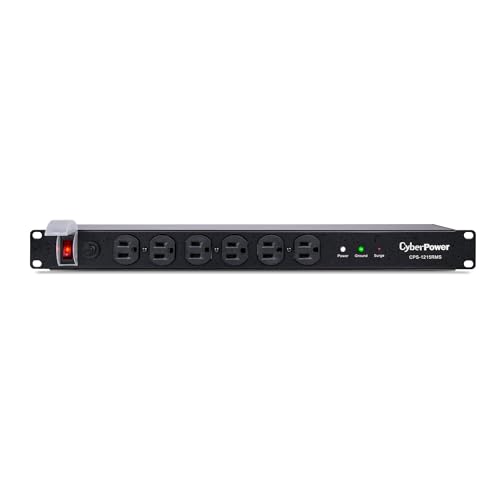
CyberPower has been in the surge-protection game long enough that I trust their rack-mounted units for closets with flaky power. The CPS1215RMS combines 12 outlets with 1800 joules of surge absorption, which is the energy rating measuring how much electrical abuse the MOVs (metal oxide varistors, the small components that absorb voltage spikes) inside can take before they’re spent.
Unlike the StarTech PDUs above, this one actively defends downstream gear from spikes. For data closets and VoIP systems, that distinction matters more than extra outlets.
A Few Strong Suits
- 1800-joule rating handles the kind of surges that follow thunderstorms and grid switching.
- Integrated 15A circuit breaker trips before the surge protection itself is overwhelmed.
- Rackmount form factor fits right into a 1U opening beside any of the PDUs in this list.
- Suitable for VoIP and PBX gear where power quality affects call reliability.
Points To Keep In Mind
- After a major surge event, the MOVs may need replacement, a maintenance step that’s not always obvious.
- 120V only, so it won’t help in a 240V European-style installation.
Who It Suits Best
Data closets, home offices, and VoIP deployments where power quality is unpredictable.
A Better Fit Elsewhere
The Eaton Tripp Lite RS1215-RA is worth a look when you want a longer 15-foot cord for distant outlets.
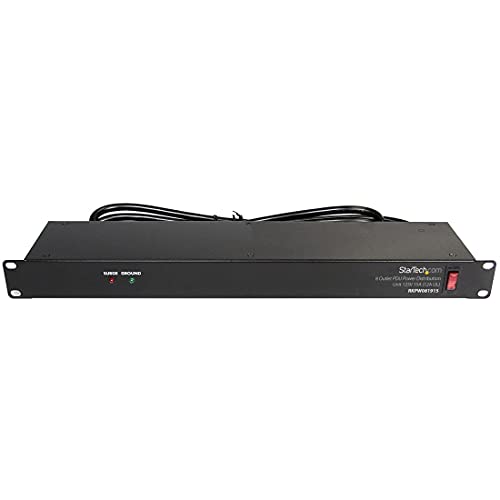
The RKPW081915 is a tight little strip for shallow racks. With eight ports, integrated surge protection, and a rugged steel casing, it covers the basics without crowding the front of the cabinet. The 6-foot cord is shorter than the 10-outlet sibling above, but plenty for most wall-adjacent racks.
For most AV carts and small wall-mount cabinets, this is exactly the right size. More outlets would mean a longer chassis that simply won’t fit.
Practical Pluses
- Surge protection plus outlet distribution in a single 1U strip.
- Fits racks as shallow as four inches deep, which excludes many full-size PDUs.
- Steel chassis holds up to repeated plugging and unplugging.
- TAA compliance broadens where it can be deployed.
Details To Watch
- Eight outlets fill up fast in a busy rack.
- 120V/15A caps total draw; users with hungry gear may need to spread the load across two strips.
Perfect Match For
Shallow 4-inch racks, AV carts, and small cabinets where depth is the limiting factor.
Swap It Out When
The ElecVoztile 10-Inch 8-Outlet PDU is a stronger fit when the rack itself is a 10-inch mini cabinet.
The Tripp Lite RS1215-RA has been on IT floors for decades, and the recipe still works. Twelve NEMA 5-20R outlets (the slightly higher-rated version of a standard outlet, accepting both 5-15P and 5-20P plugs) split six in front and six in back, plus a 15-foot cord that reaches across server rooms without an extension.
Compared with the 13-outlet StarTech above, this one trades a little outlet density for build quality and cord length.
What Works In Its Favor
- 15-foot cord reaches distant wall outlets in larger rooms.
- Lighted on/off switch with locking safety covers prevents accidental power-offs.
- Right-angle plug sits flush against the wall, which keeps the rack closer to the surface.
- Heavy-duty metal chassis handles years of plugging cycles.
Honest Caveats
- No built-in surge protection, which means it pairs best with an upstream UPS.
- Locking outlet covers add a step to every plug-in, slowing frequent gear swaps.
Made For
IT installations where the rack sits far from the nearest wall outlet and build quality matters more than surge suppression.
Consider Something Else When
The CyberPower CPS1215RMS is the smarter choice when surge protection is part of the requirement.
The 8-outlet ElecVoztile PDU is built specifically for the growing 10-inch mini rack category, the smaller half-width form factor that’s become popular for home labs and small AV closets. Four outlets on the front, four on the back, all on a 15A circuit with an iron housing that resists rust and scratches.
For most home-lab owners stepping up from a desktop power strip, this is the right starting point.
Good Reasons To Consider
- Split front-and-rear layout simplifies cable routing in a 10-inch rack.
- 1875W capacity handles a full complement of small switches and a NAS.
- Electrophoretic coating on the iron housing resists rust in closets with shifting humidity.
- Built-in 15A overload switch trips before downstream gear is damaged.
Less Ideal Details
- It’s a 10-inch form factor, so it won’t fit a standard 19-inch rack without an adapter shelf.
- No surge protection, meaning a nearby strike could reach connected gear.
Right Fit For
Home-lab and small-office owners building out a 10-inch mini rack who want front-and-rear flexibility.
Skip It When
The StarTech 8-Outlet PDU makes more sense for owners of standard 19-inch server racks needing TAA compliance.
Sometimes four outlets are enough, especially in a half-rack or compact cabinet where every inch of cable clutter shows. ElecVoztile’s minimalist PDU routes everything out the back, with the on/off switch up front and the cord exiting rearward so nothing dangles across the front of the rack.
Compared with the 8-outlet sibling directly above, this one trades outlet count for tidiness. For most ultra-small mini racks, four well-placed outlets beat eight messy ones.
The Helpful Details
- Rear-exit cord keeps the front of the rack clean for display or access.
- Rear-only outlet design hides cables where they belong.
- Built-in overload switch adds a layer of safety for the connected gear.
- Compact 10-inch form factor fits mini racks and half-cabinets.
Where It May Fall Short
- Only four outlets fill up quickly in a busy rack.
- Like its siblings, no surge protection is included.
Who Will Love This
Owners of small half-rack cabinets who value clean cable management over maximum outlet count.
Another Choice May Suit
The ElecVoztile 10-Inch 8-Outlet PDU is a better match when more outlets outweigh the tidy rear-only design.
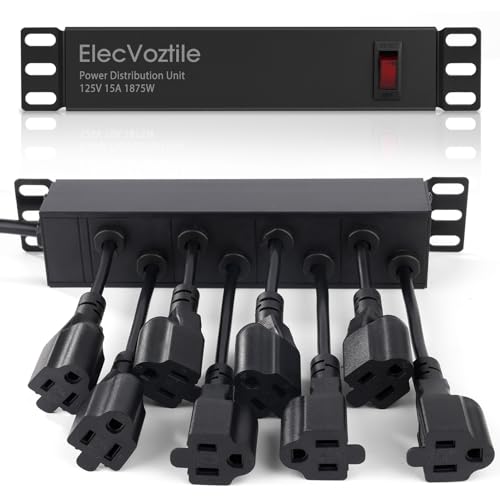
The 8-rear-outlet ElecVoztile fills a specific gap for 6U and larger mini racks. All eight outlets sit on the back panel, which is the same tidy-cable philosophy as the 4-rear sibling above, but with double the capacity. Aluminum-alloy housing keeps the weight low, which matters in any rack mounted on a wall or under a desk.
For most 6U+ mini rack builds with several always-on devices, this is the right balance of capacity and clean routing.
Useful Strengths
- Eight rear outlets support a full complement of switches, NAS, and small servers.
- Aluminum-alloy housing sheds heat and resists corrosion in enclosed cabinets.
- 15A overload switch trips before damage reaches connected gear.
- Designed for 6U and bigger, matching the most common mini rack size.
Less-Strong Areas
- No front outlets, so diagnostic tools require reaching behind the rack.
- 10-inch form factor excludes it from standard 19-inch cabinets.
Who It Suits Best
Owners of 6U and larger 10-inch mini racks who want all cabling hidden in the rear.
Where Another Pick Suits Better
The StarTech 8-Outlet 1U PDU with surge protection fits better for standard 19-inch rack owners needing surge defense.
What To Weigh Before Picking A Rack PDU
Match The Form Factor First
Standard 19-inch racks (the most common data-center width) accept any 1U horizontal strip. The 10-inch mini racks covered by the ElecVoztile units need PDUs built for that narrower footprint, or an adapter shelf. Picking the wrong form factor is the most common frustration I see, since a strip that doesn’t physically fit is useless regardless of features.
Voltage And Outlet Type Matter More Than Brand
North American 120V installations need NEMA 5-15 outlets (the standard three-prong plug). Higher-draw or international racks usually need IEC C13 and C19 outlets. Mismatched plugs mean adapter cables that add clutter and resistance, which isn’t what anyone wants in a clean rack.
Surge Protection Versus Pure Distribution
Basic rack PDUs handle distribution only. Surge-protected units like the CyberPower CPS1215RMS or StarTech RKPW081915 add MOVs that absorb voltage spikes before they reach gear. In regions with frequent storms or older wiring, that protection is well worth the modest upcharge.
Cord Length And Plug Style
A 6-foot cord works for wall-adjacent racks. Anything farther needs an 8-foot or longer cord (like the Tripp Lite RS1215-RA’s 15 feet). Right-angle plugs sit closer to the wall, which keeps the rack flush against the surface and prevents accidental knocks.
Key Considerations Across These Picks
Pitfalls Shoppers Hit
Buying a 19-inch strip for a 10-inch cabinet, or vice versa, is the most common trap. Equally common is ignoring total amperage, which means the strip looks fine until a power-hungry server joins the rack and trips the breaker mid-task.
What The Higher Tier Buys
Premium models like the StarTech 20-outlet C13/C19 unit add per-outlet or per-bank breakers, TAA compliance, and beefier internal wiring. The upgrade payoff shows up most clearly in regulated environments, dense mixed-load racks, and any installation where downtime costs more than the upcharge.
Frequently Asked Questions
What Does A Rack PDU Actually Do?
A rack PDU distributes power from a single wall outlet to multiple devices inside a rack. It adds circuit protection, organized outlet placement, and in some cases surge suppression.
Do All Rack PDUs Fit In Any Rack?
No. Standard 19-inch racks accept most 1U horizontal strips, but 10-inch mini racks need PDUs built for that narrower footprint.
Is Surge Protection Necessary On A PDU?
It depends on your power quality. Sensitive electronics in areas with storms or older wiring benefit from MOVs inside the PDU; stable circuits may only need a good UPS upstream.
Can I Daisy-Chain Rack PDUs?
It’s generally discouraged. Daisy-chained strips can exceed the circuit’s amperage rating and create hidden fire risks. Most electricians recommend one PDU per circuit.
What’s The Difference Between A PDU And A Power Strip?
A basic power strip is designed for temporary or office use, while a rack PDU mounts in a rack, uses heavier internal components, and typically supports higher duty cycles.
Bottom Line
Start with the form factor, then match outlets and voltage to your gear. Home-lab builders running 10-inch mini racks will find the ElecVoztile trio covers most needs, while standard 19-inch IT racks benefit from the StarTech lineup. The right basic rack PDU fades into the background and just works.
