

Air conditioner transformers come in two very different flavors, and mixing them up is the fastest way to waste money. The first kind steps household voltage up or down so a window unit bought overseas can actually run on your wall outlet. The second kind drops line voltage down to a low 24V AC signal that powers thermostats, control boards, and relay circuits inside the HVAC equipment itself. Knowing which problem you are solving matters before anything else.
That difference shapes everything in the picks below. Some options here are heavy step-up/step-down converters built for portable ACs, mini-splits, or imported appliances. Others are small control transformers meant to sit inside a furnace cabinet or feed a thermostat. Each one earns its place for a specific scenario, and the short write-ups spell out which job each one handles best.
A Fast Comparison Of The Options

LVYUAN 3000W Step Up & Down Voltage Transformer

Fiada 2-Pack 24V 40VA Multi-Tap Control Transformer

ANTOBLE TRR01729 115V to 24V Transformer 35VA

Criditpid S1-02518452700 Replacement Transformer 40VA

Hotop 24V 40VA Plug-In Transformer (No Screw Holes)
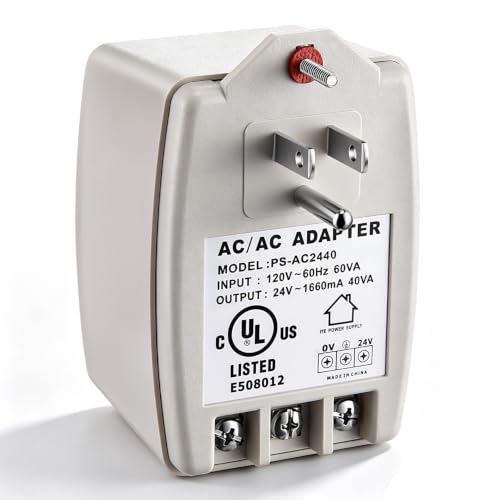
Hotop 24V 40VA Plug-In Transformer (With Screw Holes)

Packard PF40224 Replacement Transformer 208/240V to 24V

Gdrasuya10 3000W Heavy Duty Step Up/Down Converter
More Details On Our Top Picks
The LVYUAN 3000W converter lives in the heavyweight category, built for situations where a small travel adapter simply will not do. It handles the kind of continuous load that comes from running a window AC, a refrigerator, or a countertop appliance purchased overseas but used in a North American home, and it goes the other direction just as easily. The casing is a substantial metal box with carrying handles, which feels reassuring when you are pulling it out of a closet for seasonal use.
For anyone who imported a 220V mini-split or bought a 110V unit abroad and is now relocating back to the States, this unit bridges the gap without requiring rewiring the appliance. The hard-wired terminal option on the back panel adds flexibility for permanent installs, which is a real plus if the converter is going to live in a basement utility area. Compared to the lightweight plug-in transformers later in this list, the LVYUAN trades portability for raw power capacity.
Positive Points
- 3000W continuous rating covers most mid-size portable ACs, heaters, and kitchen appliances in one box.
- Bidirectional design lets a single unit handle both 110V to 220V and 220V to 110V conversions.
- Hard-wired terminal block supports permanent installations for stationary equipment.
- Metal chassis with carrying handles stays cool under load and is easy to position.
Things To Consider
- Heating appliances can pull two to three times their rated wattage at startup, which may push the unit past its limit.
- Size and weight make this a stationary piece rather than something you toss in luggage.
- Hum from the core is noticeable in quiet rooms, so placement away from living areas matters.
Key Specs
Who It Suits Best
Expats, frequent travelers, and homeowners running a single imported high-draw appliance who want a single converter that handles most residential loads.
Where Another Pick Suits Better
Homeowners wiring a whole-house solution or needing extra safety circuitry should look at the Gdrasuya10 3000W Heavy Duty converter for its built-in breaker protection.
The Fiada multi-tap control transformer sits in a completely different world from the LVYUAN above. Instead of stepping wall voltage up or down for appliances, it drops line voltage to the 24V AC that HVAC control boards and thermostats actually use to switch relays and signal components. The multi-tap primary accepts 120, 208, or 240V input, which means a single SKU can cover residential and light-commercial installations.
What makes the two-pack format interesting is the spare. Keep one on the truck and one in the shop, and you almost never wait on a replacement part again. The compact footprint (around 3.7 by 2 by 2.2 inches) tucks neatly inside a furnace cabinet or a control panel, and foot-mount holes speed up bench installation. For technicians who swap control transformers across multiple brands of equipment, this flexibility is the whole point.
The Case For It
- Multi-tap primary (120/208/240V) means one transformer covers most residential and light-commercial control circuits.
- Two-pack pricing lowers the per-unit cost and keeps a spare on hand for callbacks.
- Foot-mount design with clear wiring diagram shortens bench installation time.
- 40VA rating handles most standard HVAC control boards without strain.
Worth Noting
- Hard-wired connections only, so plan on basic wiring skills or hiring a tech.
- Generic branding means documentation is thin, so label your wiring during install.
Feature Snapshot
Built With In Mind
HVAC technicians and serious DIYers maintaining mixed-brand residential or light-commercial heating and cooling systems.
Skip It When
Homeowners needing a simple plug-in thermostat power supply should reach for the Hotop 24V 40VA plug-in unit instead.
The ANTOBLE TRR01729 is purpose-built for one specific job: replacing a Trane furnace control transformer. It steps 115V line voltage down to a stable 24V AC output, matching the OEM Trane footprint so it drops into the existing mounting holes without adapters. Owners of older Trane furnaces with a humming but failing transformer will recognize the symptom immediately, and this is the aftermarket part most service techs reach for.
The 35VA rating is intentionally lower than the 40VA options elsewhere in this list, which reflects the typical Trane furnace load profile. That keeps the transformer running cooler and quieter inside a sealed cabinet. For homeowners with a non-Trane system, the Criditpid unit below is the broader multi-OEM alternative worth considering.
What It Does Well
- Direct replacement for the Trane TRR01729 part, matching physical and electrical specs.
- 35VA rating suits typical Trane furnace control board loads without excess waste heat.
- Stable 24V AC output keeps thermostats and relay coils operating within spec.
Trade Offs
- Single-brand focus means cross-compatibility with non-Trane equipment is narrow.
- Lower VA ceiling than the Criditpid 40VA option, which can matter on accessory-heavy systems.
Technical Reference
Made For
Homeowners and techs replacing a failed transformer on a Trane furnace system that originally shipped with the TRR01729 part.
Not Your Match When
Shoppers working across multiple brands should pick the Criditpid S1-02518452700 replacement transformer for its broader compatibility.
The Criditpid replacement transformer targets the S1-02518452700 part number used across Luxaire, York, and Coleman equipment, which makes it a popular pick for service techs juggling mixed-brand service calls. It accepts 208 or 240V primary input and delivers the standard 24V AC secondary at 40VA, giving it a little more headroom than the 35VA Trane-focused ANTOBLE above.
For homeowners staring at a dead furnace in winter, the practical value here is availability and breadth. One part covers three major brand families, and the terminals are laid out for straightforward wiring. The Class 2 rating matches the original spec, so inspectors and warranty reviewers have nothing to flag.
The Practical Payoff
- Cross-compatible with Luxaire, York, and Coleman equipment using the S1-02518452700 part.
- 40VA capacity supports accessories and dampers that the smaller 35VA Trane unit may struggle with.
- Class 2 rating matches OEM specification for safe residential control circuits.
Small Caveats
- Documentation is minimal, so cross-check the wiring diagram against the original transformer before powering up.
- Hard-wired install requires basic electrical comfort or a service call.
Spec Overview
Best Suited To
Service technicians and homeowners maintaining Luxaire, York, or Coleman HVAC equipment that uses the S1-02518452700 transformer.
Look Elsewhere When
Those running Trane equipment should pick the ANTOBLE TRR01729, which is built specifically for that brand’s wiring layout.
The Hotop plug-in transformer solves the everyday problem of a 24V AC device that needs more power than the existing transformer can deliver, without pulling out a screwdriver. It plugs straight into a standard 120V wall outlet and exposes screw terminals on the low-voltage side for connecting thermostats, doorbells, or HVAC accessories. The auto-resetting PTC fuse and green LED power indicator add a layer of protection and confidence that older hardwired transformers usually lack.
This is the unit to grab when a smart thermostat complains about insufficient C-wire power, or when a doorbell transformer has finally given up. The compact housing fits behind furniture or inside a closet, and there are no mounting holes, so it just rests on the outlet. For more permanent mounting, the screw-hole version below is the obvious sibling.
A Few Strong Suits
- Plug-in form factor means no wiring into the line-voltage side, which most homeowners can handle.
- Auto-resetting PTC fuse protects downstream equipment from short circuits without a service call.
- Green LED power indicator confirms at a glance that the transformer is energized.
- 40VA output comfortably powers smart thermostats and most residential doorbell setups.
Possible Compromises
- No mounting holes means it relies on the wall plug for support and may get bumped loose.
- Not suitable for equipment that needs more than 40VA sustained draw.
Perfect Match For
Homeowners upgrading to a smart thermostat or replacing an underpowered doorbell transformer without touching the main electrical panel.
A Better Fit Elsewhere
Anyone needing a permanent mount behind a thermostat or chime should pick the Hotop 24V 40VA screw-hole version for a tidier install.
This Hotop variant is the same 24V 40VA circuit as the unit above, but the housing adds screw holes so it can be mounted to a junction box, stud, or backplate instead of dangling from the wall outlet. For permanent installs behind a thermostat or near a furnace, that small change matters a lot, and the grounded middle terminal on the low-voltage side gives installers the wiring options they need.
The PTC fuse and LED indicator carry over, so the safety and convenience story stays consistent. Compared to the Fiada control transformer reviewed earlier, this one targets low-voltage accessory loads rather than dedicated HVAC control boards.
Strong Points
- Mounting holes let the transformer sit securely inside a junction box or on a backplate.
- Grounded middle terminal adds flexibility for thermostats and doorbells that need a common reference.
- PTC fuse and LED indicator are inherited from the proven plug-in sibling.
Points To Keep In Mind
- Installation notes matter; the middle terminal must be wired correctly to avoid damage.
Whose Shelf It Belongs On
Installers and handy homeowners who want a permanently mounted 24V supply for thermostats, doorbells, or similar accessories.
Swap It Out When
Anyone needing higher VA capacity or a true multi-tap primary should pick the Fiada 2-Pack control transformer instead.
The Packard PF40224 is the aftermarket answer to the Coleman S1-02518452700 transformer, which is one of the more commonly replaced control transformers in residential HVAC service fleets. It accepts 208 or 240V primary input and delivers 24V AC at 40VA on the secondary, matching the original spec closely enough that techs can swap it in without recalculating loads.
Packard has been around the aftermarket HVAC parts space for a long time, which gives this pick a familiarity advantage for anyone who has worked on older Coleman equipment. Compared to the Criditpid unit reviewed earlier, this one focuses squarely on Coleman compatibility while sharing the same broad 40VA capacity.
What Makes Sense
- Aftermarket match for the Coleman S1-02518452700 part keeps existing wiring and mounts intact.
- 40VA rating supports typical Coleman control board loads with margin.
- Terminal layout simplifies the swap for anyone familiar with the original part.
A Few Limitations
- Narrow cross-brand fit compared to the Criditpid multi-OEM alternative.
- Documentation tends to lean on technician experience rather than step-by-step instructions.
Who Should Grab It
Technicians and homeowners specifically maintaining Coleman HVAC equipment that uses the S1-02518452700 transformer.
Reach For A Different Pick When
Anyone servicing Luxaire or York equipment alongside Coleman should pick the Criditpid S1-02518452700 for its broader coverage.
The Gdrasuya10 3000W converter takes the same high-wattage step-up/step-down concept as the LVYUAN covered earlier and adds a built-in circuit breaker and dual-row heat dissipation vents for a more safety-focused package. For owners running heavier appliances continuously, or anyone wiring a converter into a permanent install, that breaker is the difference between a nuisance reset and a fried component.
The cooling vents are sized for sustained operation rather than short bursts, so this is the better choice for a mini-split that runs all summer or a refrigeration unit that rarely powers down. Like the LVYUAN, it handles both directions of voltage conversion, which keeps the toolbox simpler for expats or short-term relocations.
Noteworthy Benefits
- Built-in circuit breaker protects the unit and downstream appliance from overload conditions.
- Dual-row large-diameter vents support sustained heavy loads without thermal shutdown.
- Bidirectional 110V to 220V and 220V to 110V conversion covers both inbound and outbound relocation scenarios.
Points To Note
- Floor-space footprint and weight match other 3000W units, so portability is limited.
- Heat-vent design means surrounding clearance is needed for safe continuous operation.
Feature Card
Right Fit For
Homeowners and small-business operators running a single imported high-load appliance continuously, especially mini-splits and refrigeration.
Where A Sibling Pick Shines
Anyone needing a simpler step-up/down unit without the breaker protection should look at the LVYUAN 3000W converter instead.
Picking The Right Transformer For Your Setup
Voltage conversion and HVAC control transformers solve completely different problems, and the first decision is figuring out which problem is actually in front of you. Step-up/step-down converters, like the LVYUAN and Gdrasuya10 units, exist to bridge the gap between 110V North American outlets and 220V appliances bought abroad or vice versa. Control transformers, like the Fiada, ANTOBLE, Criditpid, and Packard picks, exist to feed the 24V AC circuits that thermostats, relay coils, and HVAC control boards rely on. The plug-in Hotop units sit in a third lane, providing 24V power to accessories like smart thermostats and doorbells without rewiring anything. Sorting out which lane the install lives in is half the work.
Match VA Capacity To The Load
For control transformers, VA (volt-ampere) rating describes how much current the secondary side can deliver continuously. A 40VA transformer is the residential standard for most modern control boards, while older systems may have run on 35VA. Going up in VA is rarely a problem, but going down can leave thermostats dropping off or relays chattering. For step-up/step-down converters, the wattage rating has to clear the appliance’s running wattage with comfortable margin, and heating or motor-driven appliances can pull two to three times their rated wattage at startup.
Confirm Primary Voltage Before Wiring
Residential control transformers usually accept 120V primary, but equipment-specific replacements like the Criditpid and Packard units are built for 208 or 240V primary. Wiring a 240V transformer into a 120V line will simply produce half the expected secondary voltage, and the equipment downstream will misbehave in confusing ways. The multi-tap Fiada exists precisely to remove that worry across multiple supply voltages.
Physical Fit And Wiring Layout
Even when the electrical specs line up, the mounting footprint and terminal layout matter. Drop-in replacements like the ANTOBLE TRR01729 are designed to mimic the OEM dimensions exactly, while generic 40VA control transformers can vary enough to need bracket adjustments. Plug-in transformers trade wiring for outlet access, and the screw-hole variant of the Hotop adds mounting flexibility that the basic plug-in version lacks.
Key Considerations Across These Picks
Where Shoppers Go Wrong
The most common mistake is buying a step-up/step-down converter when the real problem is a failing HVAC control transformer, or vice versa. They look superficially similar in product listings, but they do entirely different jobs. Another trap is underrating wattage for the appliance: a 1500W space heater and a 1500W induction cooktop both look like 1500W on paper, but startup surges can blow past the transformer’s rated capacity. Cross-check the appliance label, including any startup multiplier the manufacturer lists.
What Separates Premium From Basic
In the step-up/down category, the upgrade story is mostly safety and thermal management. A built-in circuit breaker, larger heat vents, and a heavier gauge chassis all add cost but reduce the chance of nuisance trips or thermal shutdowns during long runs. In the control-transformer category, the upgrade story is brand-specific tuning and documentation. OEM-matched replacements fit the original wiring layout exactly, while generic units may require minor rework. The right pick depends on whether convenience or budget drives the install.
Frequently Asked Questions
What Is A 24V Transformer Used For In An Air Conditioner?
It powers the low-voltage control circuit that runs the thermostat, relay coils, and the brains of the indoor unit. Without it, the system has no way to switch the high-voltage components on and off safely.
Can I Use A Step-Up/Step-Down Converter For A Window AC?
Yes, as long as the wattage rating of the converter clears the running wattage of the air conditioner with margin. Most mid-size window units need at least a 1500W continuous rating, and full-size units benefit from 3000W converters like the LVYUAN or Gdrasuya10.
How Do I Know If My HVAC Transformer Is Bad?
Common symptoms include a thermostat that loses power, a furnace that will not ignite, a buzzing sound from inside the cabinet, or visible scorching on the transformer itself. A multimeter on the 24V secondary terminals confirms the diagnosis quickly.
Is A Higher VA Rating Always Better?
Higher VA gives more headroom, but it does not improve a system that is already working within spec. For most residential control boards, 40VA is the right size, and going much higher just adds cost without practical benefit.
Can I Install An Air Conditioner Transformer Myself?
Plug-in 24V transformers like the Hotop units are a reasonable DIY project for anyone comfortable with basic wiring. Hard-wired control transformers and step-up/down converters should be installed by someone familiar with line-voltage work, especially since mistakes at 240V can be dangerous.
Closing Remarks
The right transformer depends entirely on the job in front of you, and matching the unit to the actual problem is more important than chasing the biggest wattage or the smallest box. Run through the voltage, VA, primary supply, and mounting requirements first, then choose the pick that clears them with a sensible margin.
