

I’ve lived in apartments where the only outlet sat behind the couch and homes where the garage outlet was a full sprint from the workbench. AC extension cords solve both problems, and the right one quietly becomes part of your daily routine. The picks below cover everything from short appliance extenders to full power-strip combos, so you’re likely to find a match for your setup. I focused on wire gauge, plug shape, length, and the small details like indicator switches and surge protection that actually matter day to day.
An Overview Of The Picks

ADCAUDX 6FT Heavy Duty 15Amp Right-Angle Extension Cable
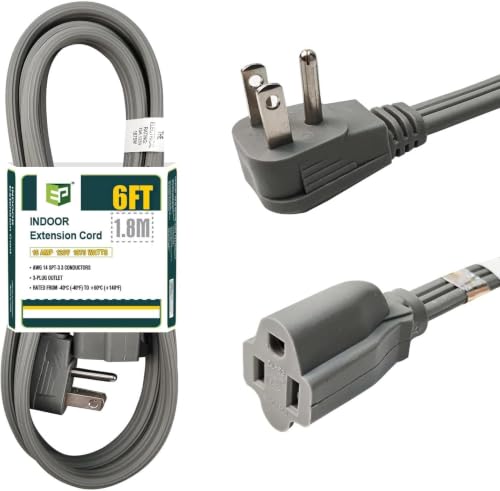
EP 6 Ft Heavy Duty Appliance Extension Cord (Gray)

EP 15 Ft Heavy Duty Appliance Extension Cord (White)

EP 3 Ft Heavy Duty Appliance Extension Cord (Black)

SPARKING 6 Inch Short Power Extension Cord

FSTSN 3 ft Heavy Duty Extension Cord (12/3 SJTW)

JouleLoom 6 FT Flat Plug Surge Protector with 11 Outlets

JouleLoom 6 FT Surge Protector with 14 Outlets

FILSHU 6Ft White Extension Power Cord with Inline Switch

JouleLoom 6 FT Surge Protector with 10 Outlets
The Picks, Examined More Closely
When the outlet lives right behind a refrigerator, washer, or entertainment console, a straight-plug cord either won’t reach or forces the appliance forward. The 90-degree NEMA 5-15P plug on this ADCAUDX cable drops the body of the cord straight down along the wall, which keeps furniture and machines flush. At 6 feet, it bridges most tight setups without leaving extra coil to manage.
It carries a 12 AWG SJTW jacket rated to 1875 watts at 15 amps, 125V, which is the heavy-duty class most room appliances can pull from. The yellow sheath is easy to spot if it ends up running across a doorway. Homeowners running T-blade or 20A outlets on a separate circuit may also find the wide receptacle compatible, since the female end accepts both 15-amp and 20-amp plugs.
Noteworthy Benefits
- Right-angle plug sits flush against walls and furniture backs.
- 12 AWG conductor handles sustained loads from heavier appliances.
- Yellow jacket improves visibility across floors and workspaces.
- Six-foot length clears most indoor outlet gaps without leftover slack.
- Wide female receptacle accepts both 15A and 20A appliance plugs.
Points To Note
- Shorter than dedicated appliance cords, so long room spans still need a longer run.
- Yellow color may stand out visually against neutral decor.
Feature Snapshot
Right Fit For
Anyone with an outlet buried behind a fridge, sofa, or entertainment center who wants a clean flush-mount setup without pulling the appliance away from the wall.
Skip It When
Runners needing more than 6 feet should grab the EP 15 Ft Heavy Duty Appliance Extension Cord (White) instead, since its flat plug and longer reach solve across-room routing.
A washing machine pushed against the wall and a dryer outlet that sits just out of reach is the kind of puzzle apartment dwellers run into constantly. The EP 6-footer uses a flat 3-prong plug that hugs the baseboard instead of jutting straight out. The 14 AWG copper handles the draw of most large household appliances up to 15 amps without complaint.
The gray jacket blends into laundry-room flooring and doesn’t scream for attention in a hallway. ETL-listed construction adds a layer of safety recognition that apartment insurance policies often appreciate. Where the right-angle ADCAUDX cable shines behind furniture, this one is better for plugging into the side of an appliance that lives near a baseboard.
The Good Stuff
- Flat plug keeps appliances pushed fully back against the wall.
- 14 AWG wire handles large appliances up to 15 amps.
- Gray color hides dust and scuffs in utility spaces.
- ETL-listed for recognized safety standards.
Less Ideal Details
- Lacks surge protection, so sensitive electronics need a separate strip.
- Six feet may not reach across wider laundry rooms.
Built With In Mind
Renters with washers, dryers, or refrigerators parked tight against a wall who want a slim plug profile that won’t push their machines outward.
Look Elsewhere When
Longer laundry-room spans call for the EP 15 Ft Heavy Duty Appliance Extension Cord (White), which keeps the same flat plug while adding reach.
Older homes often place the dryer or window-unit outlet halfway across the room from where the appliance actually needs to sit. The 15-foot EP cord solves that gap while keeping the same low-profile flat plug as the shorter 6-foot version. The white jacket looks at home against baseboards and trim, so it disappears in living areas rather than shouting utility.
It shares the 14 AWG build, 15-amp rating, and ETL safety listing with its gray sibling. When a longer run is necessary and aesthetics matter, white tends to win over yellow or black in finished spaces. For most users the extra length also means tidier routing along walls instead of across open floor space.
Real Benefits
- Fifteen-foot reach handles across-room appliance placement.
- Flat plug fits behind tight baseboards and trim.
- White finish blends into finished living spaces.
- Same 14 AWG, 15-amp capacity as shorter EP cords.
Points To Keep In Mind
- Extra length can tangle or coil if not routed along a wall.
- Still no surge protection built in.
Best Suited To
Older homes and apartments where the only available outlet sits far from the appliance location, and the user wants the cord to disappear against white trim.
Swap It Out When
Outlets tucked behind tight furniture call for the ADCAUDX 6FT Heavy Duty 15Amp Right-Angle Extension Cable, whose 90-degree plug handles confined clearances far better.
Sometimes the only thing wrong with a setup is a few missing inches between the appliance plug and the wall outlet. The EP 3-foot cord bridges that narrow gap without leaving a coil of cable to manage. The black jacket looks discreet behind dark appliances and entertainment centers, and the flat plug keeps everything flush.
It runs the same 14 AWG conductor and 15-amp rating as the longer EP cords, meaning short length doesn’t mean skimped capacity. ETL-listed construction matches the rest of the EP family. It functions almost like an outlet-saver, but with the wire gauge to support a full-size appliance rather than just a wall wart.
A Few Strong Suits
- Three-foot length clears small outlet gaps without excess slack.
- Flat plug design keeps appliances flush to the wall.
- Black finish hides behind dark electronics and appliances.
- 14 AWG wire supports full-size appliances.
Honest Caveats
- Too short for any cross-room runs.
- No surge protection for connected electronics.
- Lacks an indicator switch like the FILSHU inline-switch option.
Whose Shelf It Belongs On
Anyone whose fridge, freezer, or microwave plug is just slightly too short to reach the nearest wall outlet, and who values a tidy, low-coil setup.
Reach For A Different Pick When
Workshop and garage tools needing a 12-gauge build are a better match for the FSTSN 3 ft Heavy Duty Extension Cord (12/3 SJTW), which is rated for heavier sustained loads.
Most outlet-strip hassles come from oversized plugs blocking adjacent outlets, leaving half a power strip useless. The SPARKING 6-inch cord acts as a tiny bridge between a wall wart and the strip, freeing up neighboring sockets. It’s the kind of accessory that feels minor until you stop fighting to plug in two things at once.
The 16 AWG wire is rated to 13 amps at 125 volts, which covers phones, laptops, lamps, and small appliances. It also works behind a UPS, where bulky transformer plugs crowd the back panel. Three-prong grounded ends handle grounded plugs on either side. Owners commonly tuck it into cable-management trays to keep desk wiring flat.
The Practical Payoff
- Six-inch body frees up adjacent outlet-strip sockets.
- Compact form fits behind desks and entertainment centers.
- Grounded 3-prong ends on both sides handle standard plugs.
- Useful bridge for UPS and surge-protector panels.
Some Limits To Know
- 16 AWG is lighter than appliance-rated cords.
- Not intended for high-draw heaters or kitchen appliances.
Made For
Home-office and entertainment-center setups where wall-wart plugs and oversized adapters waste every other outlet on the strip, and a tidy desk matters.
A Better Fit Elsewhere
Homeowners who want a full surge-protected hub instead of a single bridge should look at the JouleLoom 6 FT Surge Protector with 14 Outlets for a more complete charging station.
Workshop and garage tools pull more current than indoor appliance cords are built to handle. The FSTSN cord uses a 12/3 SJTW jacket with pure copper wire, rated for 15 amps, 125 volts, and 1875 watts. That puts it in the same league as cords found on professional job sites. Reinforced blades on the grounded plug resist bending when the cord gets tugged.
The temperature range runs from -40°F to 140°F, so the jacket stays flexible in cold garages and unheated sheds. It’s labeled as water-resistant, which is a comfort when the cord runs across a damp workshop floor. Three feet is short, but that suits a bench-mounted tool where the outlet is close by.
Good Reasons To Consider
- 12/3 SJTW jacket handles sustained 1875W tool loads.
- Reinforced plug blades resist bending and damage.
- Cold-weather jacket stays flexible down to -40°F.
- Water-resistant construction suits workshop floors.
- Pure copper wiring supports tool-grade electrical demands.
Practical Considerations
- White sheath shows scuffs more easily than darker cords.
- Three-foot length is restrictive for any cross-room garage work.
Key Specs
Perfect Match For
Garage and workshop users running power tools, air compressors, or high-draw bench equipment that needs a thicker cord than typical indoor appliance cables.
Consider Something Else When
Anyone wanting multi-outlet charging should consider the JouleLoom 6 FT Surge Protector Power Strip with 10 Outlets, which trades raw tool capacity for outlet count.
A typical desk rig needs power for a monitor, laptop, phone, tablet, lamp, speakers, and maybe a printer. The JouleLoom surge strip handles 11 grounded AC outlets plus 6 USB ports in a footprint roughly 6.5 by 4.3 inches. Outlets sit 1.2 inches apart, which is generous enough to fit oversized plugs without blocking neighbors.
The flat plug at the end of the 6-foot cord disappears behind desks and bookshelves. Built-in surge protection guards laptops and displays from grid spikes. Unlike the EP appliance cords, this is the kind of strip that consolidates an entire workstation’s power needs into one wall connection.
Why It Works Well
- 11 AC outlets plus 6 USB ports handle an entire workstation.
- Flat wall plug keeps the cord flush against baseboards.
- 1.2-inch outlet spacing fits bulky plugs side by side.
- Built-in surge protection covers sensitive electronics.
- Compact footprint fits under monitor stands.
Where It May Fall Short
- More ports than some small nightstands need.
- USB ports lack fast-charge specs.
Best Suited To
Home-office and remote-work setups where multiple devices need charging and a single wall outlet currently struggles to keep up.
Another Choice May Suit
Users wanting even more capacity for a family hub should consider the JouleLoom 6 FT Surge Protector with 14 Outlets, which adds USB-C ports and wider spacing.
The flagship of the JouleLoom trio adds 14 AC outlets, including two wider-spaced sockets designed for oversized adapters, plus 6 USB ports with USB-C included. The 6-foot heavy-duty cord uses 14 AWG wire, rated to 1850 watts and 15 amps. Built-in surge protection at 1850 joules plus overload safety handles the spikes that can damage displays and laptops.
It serves shared family spaces well, where phones, tablets, game controllers, smart-home hubs, and laptops all compete for sockets. The combination of wide spacing on two outlets and a generous USB bank means most households can stop hunting for an open wall socket. Compared to the 11-outlet JouleLoom, this version trades a little compactness for capacity.
The Helpful Details
- 14 AC outlets handle large household device loads.
- Two USB-C ports cover modern phones and tablets.
- 1850-joule surge protection shields electronics from spikes.
- Wide-spaced outlets accept large wall-wart plugs.
- Overload safety switch protects against high-draw incidents.
Where It Is Less Suited
- Bulkier than smaller 10-outlet siblings.
- Six USB ports share total amperage across all connections.
Feature Card
Best Suited To
Shared family workstations, entertainment centers, or home offices where everyone in the household charges multiple devices at once.
Not Your Match When
Compact nightstand setups may find the JouleLoom 6 FT Surge Protector with 10 Outlets a better size, since the smaller port count fits tighter bedside tables.
Most lamps and seasonal lights end up with their switch on the cord itself, which usually lives behind furniture. The FILSHU extension cord relocates an inline on/off switch to 50 centimeters from the plug, so it lands somewhere easy to reach. A small indicator light glows when power flows, so you always know whether the far-end device is live.
The 18 AWG SJTW cable is rated for 10 amps at 125 volts, which covers lamps, decorative lighting, fans, and small electronics. The opposite end ships as open wiring, meaning it’s designed for installation into a hardwired device rather than as a plug-and-play extension. Owners commonly use it to repair a worn-out lamp cord or to add a switch to a fixture that lacks one.
Bright Spots
- Inline switch within easy reach of the wall outlet.
- Indicator light shows power status at a glance.
- White jacket blends with most interior walls and trim.
- SJTW jacket rated to 300V for steady household use.
Where It May Fall Short
- Open wiring end requires basic electrical comfort to install.
- 10-amp rating is light for kitchen or shop appliances.
- No surge protection built into the cord.
Made For
DIY-minded folks who want to repair a worn lamp cord, add a switch to a fixture, or wire seasonal lighting with an accessible cutoff.
Swap It Out When
Plug-and-play lamp use without rewiring is better served by the JouleLoom 6 FT Flat Plug Surge Protector with 11 Outlets, which adds outlets without requiring any electrical work.
The 10-outlet JouleLoom sits in the middle of the lineup, with enough ports for most living rooms and bedrooms without dominating the space. It carries the same 6-foot 14 AWG cord, 1850-watt rating, and 1850-joule surge protection as its siblings, plus a wide voltage range of 100V to 240V for international compatibility.
Six USB ports, including two USB-C, cover phones, tablets, and e-readers from a single hub. Owners commonly place this strip behind a TV stand or bedside table to centralize power for game consoles, streaming boxes, lamps, and overnight charging. It feels like the most flexible size for a typical family rather than a dedicated workstation.
What Makes Sense
- 10 AC outlets suit most living-room and bedroom setups.
- 100V to 240V range covers international circuits.
- USB-C ports included for modern phone charging.
- 1850-joule surge protection covers TVs and consoles.
- 6-foot cord reaches behind most furniture arrangements.
Practical Considerations
- Outlets share total amperage across all USB ports.
- Not as compact as smaller 6-outlet strips.
Core Details
Best Suited To
Living rooms, bedrooms, and entertainment centers with a moderate device count that want surge protection and USB charging without a bulky hub.
A Better Fit Elsewhere
Heavy workshops and tool setups are better served by the FSTSN 3 ft Heavy Duty Extension Cord (12/3 SJTW), which is built for sustained high-draw loads.
What Matters When Picking AC Extension Cords
Wire gauge is the first number worth checking. A lower AWG number, like 12 AWG, means thicker copper wire and a heavier load capacity, while 16 or 18 AWG suits lighter electronics and lamps. For large appliances, tools, or anything pulling sustained current, 12 or 14 AWG is the safer choice. Mismatched gauge is one of the most common causes of overheating cords.
Plug shape decides whether the cord disappears behind furniture or juts outward. Flat plugs hug baseboards and keep machines flush against the wall. Right-angle plugs drop straight down, which works well behind entertainment centers and refrigerators. Straight plugs still make sense for open outlets and outdoor use, where the cable drapes naturally.
Length should match the real distance plus a little slack. Too short leaves the cord strained, while too long leaves a coil to manage or hide. Short 3-foot and 6-inch cords are great for tight indoor setups, while 15-foot versions bridge across-room outlet gaps. Indoor cords rated SJTW handle a moderate temperature range, while outdoor-rated jackets resist water and cracking.
Surge protection matters most when the cord powers a TV, computer, or anything with a sensitive circuit board. Basic appliance cords don’t include surge components. If a strip will live behind an entertainment center or a workstation, the joule rating and overload switch earn their keep. For simple lamp and appliance runs, surge protection is optional.
Key Considerations Across These Picks
Common Buying Slip Ups
The most common mistake is grabbing the cheapest cord for a high-draw appliance. A 16 AWG lamp cord on a freezer or microwave can run hot and shorten cable life. Match the cord’s wire gauge and amp rating to the appliance it powers. Skipping this step is one of the leading causes of household electrical issues.
Another trap is underestimating length. A cord stretched across an open walkway is a trip hazard, and the strain on the plug ends shortens cord life. Measure from outlet to appliance with a few feet of slack before ordering. Overshooting by 3 to 5 feet usually beats guessing too short.
When Paying More Pays Off
Higher-tier cords in this category typically offer thicker jackets, surge protection, or built-in switches that budget cords skip. The JouleLoom surge strips add overload safety and 1850-joule protection that a plain extension cord cannot match. For electronics that store data or cost hundreds to replace, that upgrade is genuinely worth it. For a one-off lamp or appliance, a basic EP cord delivers plenty of value.
Frequently Asked Questions
What gauge extension cord should I use for a refrigerator or window AC unit? A 14 or 12 AWG cord is the safer pick for sustained appliance loads. Refrigerators and window units cycle on and off, but their startup draw can spike above their rated wattage, and thinner cords heat up under that pattern. Anything pulling over 1,000 watts deserves a heavy-duty cord.
Can I plug one extension cord into another? Daisy-chaining cords is generally discouraged because each connection adds resistance and a potential failure point. A single cord rated for the full load is the safer choice. If a longer run is required, a single cord of the right length is the better move.
Do flat plugs reduce power capacity? No, flat plugs carry the same current rating as straight plugs. The flat shape only changes the orientation, not the electrical capacity. A 15-amp flat plug still supports a 15-amp appliance load.
How long can an extension cord safely run? For 14 or 12 AWG cords under a 15-amp load, runs up to about 100 feet stay within safe voltage drop for most household uses. Longer runs of 14 AWG may cause noticeable dimming or tool slowdown. For longer distances, stepping up to a thicker gauge preserves performance.
Is surge protection necessary on a basic extension cord? For lamps, fans, and small appliances, surge protection is optional. For TVs, computers, gaming consoles, or any device with a circuit board, surge protection is worth having. A single strike can cost more than a quality surge strip.
The Takeaway
AC extension cords earn their place in every home, but the right one depends on the job. Heavy-duty 12 AWG cords handle tools and large appliances, flat-plug 14 AWG cords disappear behind furniture, and surge-protected strips bring order to crowded workstations. Match the cord to the device, leave a little slack, and you stop thinking about it the day after you install it.
