

The humble 9-volt battery powers more of your life than you’d think. Smoke alarms chirping at 3 a.m., a multimeter during a weekend electronics fix, a walkie-talkie on a camping trip, a guitar pedal mid-set, a handheld mic in a small venue. The frustration hits when you keep buying disposables, the charge dies mid-use, or you discover the battery leaked inside your favorite device. Rechargeable options solve that, but the chemistry, capacity, and connector type vary more than most people expect. The picks below cover the formats shoppers actually need, from a compact two-pack for occasional use to a larger bundle for whole-house smoke alarm rotations.
An Overview Of The Picks

Quzmo 2-Pack Rechargeable 9 Volt Lithium-ion Batteries USB-C

Quzmo 3-Pack Rechargeable 9 Volt Lithium-ion Batteries USB-C
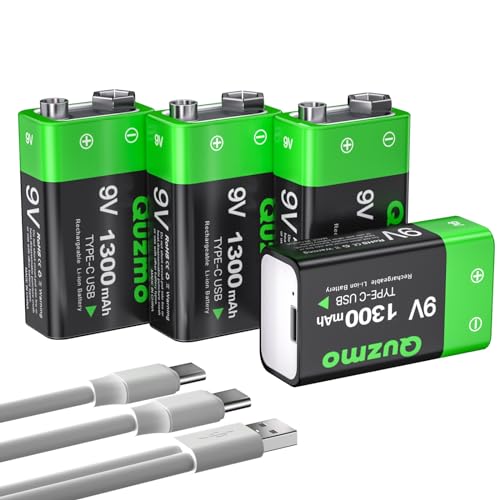
Quzmo 4-Pack Rechargeable 9V Batteries 1300mAh Lithium-ion USB-C

Quzmo 5-Pack Rechargeable 9 Volt Lithium-ion Batteries USB-C

Quzmo 6-Pack Rechargeable 9 Volt Lithium-ion Batteries USB-C

Quzmo 8-Pack Rechargeable 9V Batteries 1300mAh Lithium-ion USB-C

HW 9V Rechargeable Batteries 4 Pack, NiMH 200mAh
What Each Pick Brings To The Table
The 2-pack from Quzmo is the friendliest entry point for anyone who’s never owned rechargeable 9-volt cells before. Each unit ships with a built-in USB-C port on the side, so there’s no separate charger to buy or store. You simply plug the included 2-in-1 cable into a wall adapter or a laptop and watch the small LED indicator confirm charging progress.
At a 1300mAh rated capacity, these lithium-ion cells (a battery chemistry that holds more energy per gram than older NiMH types) suit low-to-medium draw devices like a single smoke alarm, a household multimeter, or the occasional walkie-talkie. The pair format works nicely for someone who just wants to test the waters and confirm the batteries perform in their device before committing to a bigger pack.
What Earns Its Place
- Built-in USB-C port means no separate charger clutter
- LED status light confirms charge progress at a glance
- 1300mAh capacity covers typical smoke alarm and meter duty
- Two-cell format keeps cost low for first-time experimentation
Things To Consider
- Only two cells means you’ll need to recharge often for whole-house alarm rotations
- Lithium-ion cells tend to slowly lose capacity if stored fully discharged for long stretches
Who It Suits Best
First-time shoppers curious about rechargeable 9V cells who only need one or two replacements at a time.
Skip It When
Households running four or more smoke alarms should jump to the Quzmo 4-Pack Rechargeable 9V Batteries 1300mAh Lithium-ion USB-C for better rotation coverage.
The 3-pack mirrors the design language of the smaller pair but adds a third cell for slightly broader coverage. The same integrated USB-C charging and small status LED carry over, so the experience stays consistent if someone owns multiple Quzmo packs across different devices. For most small homes, three cells cover the typical mix of a smoke alarm, a multimeter, and a microphone or radio.
Compared to the 2-pack, the extra cell is less about capacity and more about rotation flexibility. You can keep two cells deployed while the third charges, which is a quiet but real quality-of-life improvement for anyone who doesn’t want to wait hours with a critical device offline.
Advantages To Know
- Allows basic rotation: two in use, one charging
- Same 1300mAh lithium-ion chemistry as the 2-pack for predictable runtime
- Charges via the included 2-in-1 cable, no wall charger required
- Suits a mix of low and medium-draw devices in one household
Worth Noting
- Still limited for larger homes where alarms alone can number five or more
- Lithium-ion cells prefer partial top-ups over full discharges, which can feel unfamiliar to people used to disposable batteries
Key Specs
Made For
Small households with a mix of alarms, meters, or audio gear that want a simple rotation without buying a bigger bundle.
Consider Something Else When
Anyone running a multi-room alarm setup should compare this against the Quzmo 4-Pack Rechargeable 9V Batteries 1300mAh Lithium-ion USB-C for less downtime during recharging.
Four cells feels like the sweet spot for many households, and Quzmo’s 4-pack leans into that. With a typical American home running three to four smoke alarms on a single floor, four cells give you just enough to swap out the oldest alarm battery without leaving a critical sensor offline overnight.
Like the smaller Quzmo packs, each battery charges directly through its own USB-C port. That means no bulky charger taking up counter space, and you can charge all four at once if you own a multi-port USB hub. The 1300mAh capacity is consistent across the line, so runtime expectations stay predictable if you mix and match Quzmo packs later.
Real-World Strengths
- Four cells cover a full-floor smoke alarm rotation
- Each cell charges independently via its own USB-C port
- LED indicators give visible confirmation across multiple batteries
- Lithium-ion chemistry keeps standby loss very low
Trade Offs
- Requires enough free USB ports (or a hub) to charge four cells simultaneously
- Like other lithium-ion packs, these perform best when topped up regularly rather than fully drained
Best Suited To
Owners of mid-size homes or apartments with multiple smoke alarms who want a tidy one-time swap and rotation set.
Look Elsewhere When
Anyone needing cells for a home studio or workshop should consider the Quzmo 5-Pack Rechargeable 9 Volt Lithium-ion Batteries USB-C for the extra spare.
Stepping up to five cells is where this line shifts from basic household coverage toward hobbyist or small-business use. A workshop with a multimeter, a soldering iron, a portable radio, and a couple of stand-alone sensors eats through 9V cells surprisingly fast. The 5-pack gives breathing room without jumping to the larger bundles.
The charging experience remains identical to the rest of the Quzmo family, which is genuinely helpful for anyone who already owns a smaller pack. You use the same 2-in-1 cable, watch the same LED, and top up at the same pace. For most workshops or home studios, you’ll want to charge via a powered USB hub so all five ports can run at once.
What Makes Sense
- Extra cell handles a typical workshop’s mix of tools and meters
- Consistent charging experience with smaller Quzmo packs
- 1300mAh capacity handles short bursts of higher draw tools
- Lithium-ion cells stay close to full charge for months between uses
Honest Caveats
- Higher cell count makes organization harder if you don’t label them
- Not all older multimeters or radios accept lithium-ion 9V replacements, so check device compatibility first
Who Will Love This
Hobbyists, technicians, and small-studio users who keep several 9V devices in regular rotation and want spares on hand.
Where Another Pick Suits Better
Whole-home smoke alarm rotations with six or more sensors may be better served by the Quzmo 8-Pack Rechargeable 9V Batteries 1300mAh Lithium-ion USB-C.
Six cells is an unusual but useful count. It lands between a typical household rotation and the very large eight-cell bundle, which makes sense for a small two-floor home or a household that mixes alarms with audio gear, kids’ toys, and a couple of meters. The chemistry is the same 1300mAh lithium-ion you’ll find across the line, so runtime in any single device stays predictable.
One practical note with this size: charging six cells in one go really does demand a multi-port USB hub. Plugging them in one at a time through a single laptop port works but stretches out the wait considerably. Owners commonly report that a dedicated charging hub makes the whole Quzmo lineup easier to live with at this scale.
A Favorable Mix
- Six cells suit a typical two-floor home with a mix of alarm and audio devices
- Same USB-C charging and LED feedback as the smaller packs
- Lithium-ion chemistry keeps cells ready between uses
- Lower per-cell cost than the 2-pack, better for stocking up
Points To Note
- Charging all six simultaneously requires a multi-port USB hub
- Storage and labeling becomes important if cells live across multiple rooms
Feature Snapshot
Perfect Match For
Two-floor homes or mixed-use households running alarms, toys, and audio gear off the same rechargeable format.
Swap It Out When
Anyone who simply needs fewer cells should compare against the Quzmo 4-Pack Rechargeable 9V Batteries 1300mAh Lithium-ion USB-C to avoid paying for spares they won’t use.
The 8-pack is the largest Quzmo offering in this lineup, and it’s aimed at households that want one bulk purchase to cover alarms, toys, walkie-talkies, and any other 9V device for the foreseeable future. Buying in this quantity typically lowers the per-cell cost, which matters over years of recharging.
Real-world ownership at this scale does require some planning. Eight cells means you’ll need either a generous USB hub or a habit of charging in two batches. Owners commonly report that labeling cells by device (kitchen alarm, hallway alarm, basement alarm, and so on) makes rotation much smoother.
Everyday Perks
- Largest Quzmo count covers whole-house alarm rotations and extras
- Lower per-cell cost than smaller packs in this line
- Lithium-ion cells stay close to charge during long idle periods
- Single USB-C charging experience across every cell
Where It May Fall Short
- Charging eight cells at once demands a multi-port powered hub
- More cells to keep track of, so a small storage organizer helps
Technical Highlights
Right Fit For
Whole-house alarm owners and device-heavy households who want a single bulk purchase with rotation built in.
Not Your Match When
Anyone only running one or two 9V devices should compare this against the Quzmo 2-Pack Rechargeable 9 Volt Lithium-ion Batteries USB-C to avoid over-buying.
The HW 4-pack is the odd one out in this roundup, and that is genuinely the point. It uses NiMH chemistry (nickel-metal hydride, an older but very stable rechargeable format) rather than lithium-ion, and it relies on an external charger instead of a built-in USB port. That trade-off matters for the right shopper.
The payoff is a much slower self-discharge rate (meaning the battery loses its stored charge more slowly when sitting unused), so cells left in a drawer or an emergency radio tend to hold useful charge for months rather than weeks. For anyone who cares more about long shelf life than peak capacity, the NiMH approach is often the smarter pick.
Why It Works Well
- Slow self-discharge suits emergency radios and rarely-used meters
- NiMH chemistry is generally stable and widely compatible with older devices
- Often arrives pre-charged and ready to drop into a device
Points To Keep In Mind
- 200mAh capacity is far lower than the 1300mAh lithium-ion options, so runtime per charge is shorter
- Requires an external NiMH-compatible charger, adding to the total setup cost
Whose Shelf It Belongs On
Emergency-preparedness households and radio or meter owners who want long-lasting standby charge over maximum runtime per cycle.
Reach For A Different Pick When
Anyone running alarms or audio gear that draws steady current should compare this against the Quzmo 4-Pack Rechargeable 9V Batteries 1300mAh Lithium-ion USB-C for much longer per-charge runtime.
Choosing A 9 Volt Rechargeable Battery That Fits Your Devices
Chemistry And Capacity
The two big decisions are chemistry and capacity. Lithium-ion packs like the Quzmo line offer higher capacity and very low standby drain, which is ideal for smoke alarms, microphones, and toys that get regular use. NiMH packs like the HW option trade raw capacity for slower long-term self-discharge, which suits emergency radios, multimeters, and other devices that sit unused for weeks or months between uses. In our view, the right pick depends on whether your devices see daily or occasional use.
Charging Style
Built-in USB-C charging has become the more convenient format. Each cell plugs directly into a wall adapter, power bank, or laptop with no external cradle to track down. The trade-off is that you need enough free USB ports to charge multiple cells at once, so households using a four-pack or larger usually benefit from a powered USB hub. NiMH packs still rely on a separate charger, which is fine if you already own one but adds cost for first-time shoppers.
Pack Size And Rotation
Pack size is mostly a math problem. Count every 9V device in your home, then add at least one spare for rotation. Two cells cover a single smoke alarm plus an emergency spare. Four cells handle a small home’s full alarm rotation. Six or eight cells suit multi-floor homes, home studios, or anyone who wants to refresh the whole fleet in a single purchase. The per-cell cost typically drops as pack size grows, which can matter over years of recharging.
Practical Compatibility Notes
Before buying in bulk, check that your devices accept the chemistry you’ve chosen. Most modern alarms, meters, and audio gear work fine with both lithium-ion and NiMH 9V replacements, but some older or specialty devices may list compatibility restrictions. A quick look at the device manual or battery compartment label usually clears this up.
Things Worth Knowing Before You Commit
Pitfalls Shoppers Hit
The most common mistake is treating a rechargeable 9V cell exactly like a disposable one. Lithium-ion cells prefer partial top-ups over deep discharges, so leaving a smoke alarm chirping at zero percent for weeks can shorten the cell’s overall lifespan. Another slip-up is buying a huge pack when only one or two devices need batteries, leaving spares unused for years. Match the pack size to your actual device count, then add one spare for rotation.
When Paying More Pays Off
Higher-tier rechargeable 9V batteries typically earn their keep through longer cycle life (how many times a battery can be recharged before its capacity drops significantly) and better build quality. Premium cells often handle more recharge cycles before noticeable capacity loss, and well-sealed construction reduces the risk of leakage inside expensive meters or microphones. The upgrade pays off most in devices that draw steady current daily, where a slightly more efficient cell keeps runtime longer per charge.
Frequently Asked Questions
How long does a rechargeable 9-volt battery typically last per charge?
A 1300mAh lithium-ion 9V cell typically runs between several months and about a year in a standard smoke alarm, depending on how often the alarm self-tests. In a higher-draw device like a microphone or walkie-talkie, expect several hours of active use before a recharge is needed.
Can rechargeable 9V batteries be used in smoke alarms?
Yes, most modern photoelectric and ionization smoke alarms accept rechargeable 9V lithium-ion replacements. The key thing to check is that the alarm’s low-battery warning still triggers correctly, since some very old alarms were designed around the slightly different discharge curve of alkaline batteries.
What is the difference between lithium-ion and NiMH 9V rechargeable batteries?
Lithium-ion cells offer higher capacity and very low self-discharge, making them suited to regular-use devices. NiMH cells have lower capacity but lose charge more slowly during long storage, which helps in emergency gear that sits idle for months.
Do rechargeable 9V batteries need a special charger?
The Quzmo line in this roundup charges directly through a built-in USB-C port using any standard USB-C cable and power source. The HW NiMH pack uses standard NiMH 9V chargers, which most electronics owners already have.
How many times can a rechargeable 9V battery be recharged?
Lithium-ion 9V cells in this category are typically rated for several hundred recharge cycles before noticeable capacity loss. NiMH cells often manage a similar cycle count, though actual lifespan depends heavily on storage conditions and depth of discharge.
Closing Thoughts
The right rechargeable 9V battery depends less on the cell itself and more on what you’re powering and how often. For smoke alarms, audio gear, and toys in daily rotation, a lithium-ion pack with built-in USB-C charging keeps the routine simple. For emergency gear and meters that sit idle, NiMH chemistry with its slower discharge is the calmer choice. Match pack size to your device count, and you’ll spend less time recharging and more time using what matters.
