

Camping in a rig means plugging into power you don’t control, and that’s the part most people underestimate. A bad pedestal at a crowded RV park can send voltage spikes through your air conditioner, microwave, and electronics in a single heartbeat. A solid 50 amp surge protector sits between your coach and that pedestal, catching faults before they fry expensive components. I pulled together seven options worth your attention if you tow or drive a 50 amp rig and want dependable power monitoring at every site.
The Choices Worth Comparing

GEARGO 50 Amp RV Surge Protector 15000J IP68 (Orange)

GEARit 50 Amp RV Surge Protector 14-50P/R 4100J

50 Amp RV Surge Protector 15000J Waterproof Cover

MILLIONHOME 50 Amp RV Surge Protector Waterproof

GEARGO 3rd-Gen 50 Amp RV Surge Protector 18000J
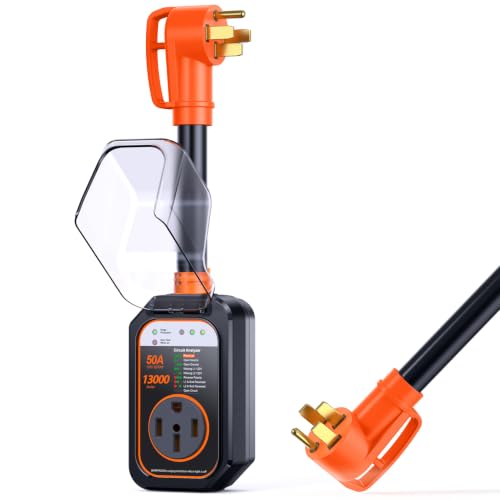
GEARGO 50 Amp RV Surge Protector 9500J Waterproof

SIPIDEAUT 15A to 50A RV Adapter NEMA 5-15P
GEARGO’s orange 50 amp unit earns its place at the top of the list because it tackles two worries at once: power surges and weather. The IP68 rating means full dust sealing plus protection against extended water immersion, which matters more than people think when a thunderstorm rolls across the campsite at midnight. For anyone who runs dual AC units or a residential fridge in their rig, that 15000 joule buffer gives genuine breathing room against unstable park power.
It’s a chunky plug-and-play style device, so installation means nothing more than plugging into the pedestal, checking the indicator lights, then connecting your shore cord. Owners commonly report the diagnostic chart on the unit is clear enough to interpret without the manual.
Practical Advantages
- IP68 sealing handles heavy rain and accidental drops in puddles
- 15000 joule capacity covers most campground surge events
- Integrated circuit analyzer flags wiring faults before you energize
- Visible orange housing is hard to misplace or forget at the pedestal
Worth Noting
- Bulkier than basic models, which can be awkward on tight pedestal boxes
- No hardwired remote display; you read status at the unit itself
Feature Snapshot
Who It Suits Best
Full-time RVers and storm-region travelers who plug in often and want maximum weather protection.
Consider Something Else When
RVers wanting the highest joule buffer should look at the GEARGO 3rd-Gen 50 Amp RV Surge Protector 18000J instead.
GEARit keeps things lighter and tighter with a 14-50P/R configuration and an outdoor-rated housing. The 4100 joule rating is modest compared to the larger orange options above, but it still handles everyday campground surges comfortably. For weekend warriors who move often and don’t want a brick hanging off the pedestal, this one travels well in a storage bay without dominating the space.
The plug-and-play setup keeps first-timers happy, and the integrated analyzer reads common pedestal faults without requiring a separate tool. I think of it as the practical middle ground between rugged duty and casual weekend protection.
Strengths Worth Knowing
- Compact form factor is easy to stow between trips
- Outdoor waterproof housing handles rain and splashes
- Voltage monitor provides at-a-glance status during your stay
- Compatible with standard 50 amp 14-50P/R shore cords
Honest Caveats
- 4100J is on the lower end for severe storm regions
- Heavy sustained overvoltage events can still tax the protection circuit
Made For
Road-trip RV owners who plug in at a mix of parks and want lightweight, weather-tolerant protection.
Skip It When
Storm-heavy full-timers should reach for the GEARGO 3rd-Gen 50 Amp RV Surge Protector 18000J instead, since its joule rating is much higher.
The GutterWord entry keeps the feature set simple: 15000 joules, a circuit analyzer, and a waterproof cover wrapped around a plug-and-play body. It’s the kind of protector I point newer RVers toward because there’s almost nothing to misconfigure. Plug it in, read the lights, and the diagnostic chart tells you whether the pedestal is safe to use.
Compared with the heavier GEARGO IP68 unit above, this one trades industrial sealing for a friendlier cover design that still sheds rain. For most campground stays in temperate weather, that tradeoff feels reasonable.
Standout Benefits
- 15000J capacity handles typical pedestal surges with margin
- Waterproof cover shields the connector from rain splash
- Circuit analyzer detects common wiring faults automatically
- No app pairing or configuration required
Less Ideal Details
- Cover fit can vary in extreme heat, so store out of direct sun when stowed
- Lacks a remote display panel for inside-the-rig reading
Quick Facts
Right Fit For
First-time RV owners who want an easy-to-read protector without extra setup steps.
Not Your Match When
People who camp mostly in dry climates can save money with the GEARGO 50 Amp RV Surge Protector 9500J Waterproof instead.
MILLIONHOME keeps the experience unfussy, with 12000 joules of protection wrapped in a waterproof housing and a circuit analyzer on board. That’s a useful step down from the 15000J options earlier on the list, and it makes sense for people who camp at well-maintained parks with stable power grids. I appreciate that the design stays close to a standard plug-and-play format, so there’s no learning curve when you arrive at a new site.
For travelers who only deal with brief weekend trips and don’t push heavy electrical loads, the rating is enough headroom for the occasional brownout spike.
Why It Works Well
- 12000J buffer handles small to moderate pedestal surges
- Waterproof housing protects internal components in rain
- Circuit analyzer confirms pedestal wiring before use
- Compact size fits easily in exterior storage compartments
Trade Offs
- Lower joule capacity than 15000J or 18000J alternatives
- No remote display option for inside-the-coach monitoring
Best Suited To
Casual weekend campers at reliable parks who want solid basic protection without overspending.
Look Elsewhere When
Full-time RVers facing unstable shore power should consider the GutterWord 50 Amp RV Surge Protector 15000J Waterproof Cover instead.
GEARGO’s 3rd-Gen flagship pushes the joule rating to 18000, the highest on this list, which makes it the right choice for anyone worried about lightning-prone regions or aging campground infrastructure. The orange housing has been updated with indicator lights that read wiring faults clearly, so even in low light at an unfamiliar park you can confirm the pedestal is safe before you connect.
Where the earlier 15000J GEARGO model offered solid general protection, this 3rd-Gen version trades a slightly higher cost for noticeably stronger surge absorption. If your route includes southern summers and afternoon thunderstorms, that extra buffer can pay for itself in one bad storm.
Notable Upsides
- 18000J capacity is the strongest in this roundup
- Updated indicator lights read pedestal faults at a glance
- Waterproof cover shields the body during heavy weather
- Plug-and-play format keeps setup under a minute
A Few Limitations
- Bulkier than lower-rated options, takes more storage space
- Premium positioning means it costs more than entry models
Feature Card
Who Should Grab It
Storm-region full-timers and owners of high-end rigs running residential fridges or dual AC systems.
A Better Fit Elsewhere
Casual weekend campers not facing frequent storms can save with the GEARGO 50 Amp RV Surge Protector 9500J Waterproof.
This older GEARGO 50 amp model sits at 9500 joules, which is a noticeable step down from the brand’s higher-capacity units earlier in this list. It’s still a legitimate protector, just one sized for the milder end of the spectrum. Travelers who camp at well-kept resort parks and rarely see electrical storms will find this rating adequate for everyday use.
The waterproof build and integrated analyzer match the rest of GEARGO’s lineup, so the user experience stays consistent if you upgrade later.
Practical Pluses
- Lower joule rating keeps the cost approachable
- Waterproof housing handles standard rain exposure
- Circuit analyzer confirms pedestal polarity and grounding
- Same form factor as higher-rated GEARGO units
Things To Weigh
- 9500J may be insufficient for serious lightning-prone regions
- No advanced remote-monitoring features
Perfect Match For
Mild-weather travelers and seasonal campers who mostly stay at established parks with reliable grids.
Reach For A Different Pick When
RVers facing frequent storms should consider the GEARGO 3rd-Gen 50 Amp RV Surge Protector 18000J, which offers nearly double the joule capacity.
The SIPIDEAUT adapter isn’t a surge protector in the strict sense, but it earns a place on this list because it solves a common storage problem. It bridges a standard 15 amp household outlet (NEMA 5-15P) to a 50 amp locking RV receptacle (SS2-50R), so you can keep your batteries topped off or run small loads while the rig sits in the driveway. The LED power indicator confirms at a glance that you have a live connection.
This is a niche tool, not a daily campground protector, so don’t expect it to absorb serious surges. It’s the right shape for what it does, though, and many owners use one alongside a separate protector at the campground.
The Case For It
- NEMA 5-15P to SS2-50R matches common household and RV sockets
- LED power indicator confirms connection status instantly
- Locking receptacle keeps the shore cord seated during storage
- Useful for off-season battery maintenance at home
Practical Considerations
- Not a primary surge protector; pairs with a separate unit
- Household 15 amp circuits limit the appliances you can run
Whose Shelf It Belongs On
RV owners who store their rig at home and want a tidy way to charge batteries without rewiring.
Swap It Out When
Campground protection is the priority, so reach for the GEARGO 50 Amp RV Surge Protector 15000J IP68 instead.
What Matters Most Before Choosing 50 Amp Surge Protectors
Joule Rating and What It Really Means
Joules measure how much energy a surge protector can absorb before failing. A joule is a unit of energy, so a higher joule rating means the device can soak up more surges over its life. Most RVers do fine with 4000 to 9500 joules at well-maintained parks, but anyone in lightning-heavy regions or running residential refrigerators should look at 15000 joules or more. The GEARGO 3rd-Gen 18000J sits at the top of the scale here, while the GEARit at 4100J serves lighter needs.
Circuit Analyzer Versus Basic Surge Protection
A circuit analyzer checks the pedestal for wiring problems like open ground, reverse polarity, or missing neutral before you energize your rig. Surge protection absorbs voltage spikes after the connection. Both functions matter, but the analyzer is what prevents you from discovering a wiring fault the hard way. Every option in this roundup includes some form of analyzer, which is the right baseline for any 50 amp setup.
Weather Sealing and Outdoor Use
RVers plug in outside in all conditions, so look for waterproof or IP-rated housing. IP68 (like the GEARGO 15000J) means full dust sealing plus immersion protection, which is more than most people need but useful in heavy weather. A waterproof cover is the lighter option and still handles typical rain.
Joule vs Frequency Trade-Off
Lower joule protectors cost less but need replacement sooner if they absorb repeated moderate surges. Higher joule units cost more upfront but last longer through storm seasons. For full-timers, the math usually favors a higher joule unit because replacement frequency drops noticeably.
Key Considerations Across These Picks
Common Shopping Slip Ups
First-timers often skip the circuit analyzer feature and grab the cheapest surge-only device, which means a bad pedestal can still damage electronics before a single spike happens. Another mistake is assuming all 50 amp protectors handle 240V appliances; most do, but always confirm. People also tend to forget that surge protectors wear out, so picking a unit with higher joules means longer service life.
Why Top Tier Costs More
The jump from 9500 to 18000 joules typically reflects higher-grade MOV (metal oxide varistor) components, which are the parts that actually absorb surges. Premium units also tend to use better sealing gaskets and clearer indicator displays. For someone who camps a few weekends a year, the basic tier is fine. For full-timers or storm-region travelers, the upgrade usually pays back through fewer replacements and better protection of expensive appliances.
Frequently Asked Questions
How many joules do I really need in a 50 amp surge protector?
For most RVers camping at established parks, 4000 to 10000 joules handles routine spikes comfortably. Storm-heavy routes and full-time use push that target toward 15000 joules or more for longer service life and stronger lightning protection.
Will a surge protector catch every wiring fault at the pedestal?
A circuit analyzer catches the most common faults like open ground, open neutral, and reverse polarity. It won’t fix the pedestal, only tell you not to plug in until the park addresses the issue.
Can I leave my surge protector outside in the rain?
Look for a waterproof cover or IP-rated housing if the unit lives at the pedestal during your stay. Most options in this roundup handle rain, but submerging them isn’t recommended unless the unit is rated IP68 or higher.
Is a hardwired protector better than a plug-and-play model?
Hardwired units stay installed inside the rig and offer cleaner cable management, but they require professional installation. Plug-and-play models like the ones in this list work at any pedestal and need zero tools.
Do I need a separate adapter if I have a 50 amp surge protector?
Only for home storage situations where you want to draw power from a standard household outlet. A 15A-to-50A adapter like the SIPIDEAUT handles that specific job, but it isn’t a substitute for surge protection at campgrounds.
Final Take
A 50 amp surge protector is one of the cheapest insurance policies you can buy for an RV, and the seven options above cover the main ways people actually use them. Match the joule rating to your climate, the weather sealing to your travel style, and the analyzer to your comfort with electrical troubleshooting. For most weekend campers, the 9500J to 12000J range is plenty. For full-timers and storm-region travelers, stepping up to 15000J or 18000J brings real peace of mind without much extra hassle.
