

Hooking up a generator, transfer switch, or heavy-duty power tool means dealing with twist-lock connectors that most people never see in their daily lives. The right receptacle keeps the plug seated through vibration and weather, while the wrong one drifts loose, overheats, or simply won’t fit. I put together this roundup to help anyone shopping for a NEMA L-series 20-amp or 30-amp locking receptacle pick the option that actually matches their setup.
The Essentials At A Glance

ENERLITES L14-20P & L14-20R Locking Plug & Receptacle

ENERLITES L5-20P & L5-20R Locking Plug & Receptacle

ENERLITES L14-30P & L14-30R Locking Plug & Receptacle

ENERLITES L7-15P & L7-15R Locking Plug & Receptacle
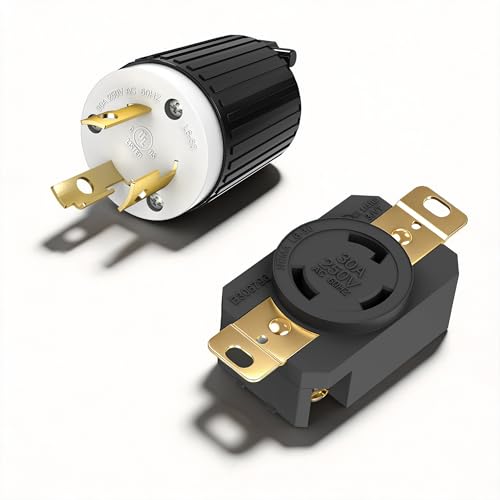
ENERLITES L6-30P & L6-30R Locking Plug & Receptacle

ENERLITES L5-30P & L5-30R Locking Plug & Receptacle
Inside Each Recommended Option
The L14-20 sits in a useful middle ground for homeowners running a portable generator that needs both 125V and 250V capability from one outlet. It’s a 20-amp, four-wire configuration, which means it can feed a transfer switch subpanel without forcing an upgrade to a 30-amp inlet. Most people I talk to land here when their generator output is right around 5,000 watts and they want a single twist-lock inlet on the outside wall.
The polycarbonate thermoplastic body takes drops and scrapes better than older bakelite designs, and the markings stay legible after years in a garage. Compared to the L5-20 covered next, this one adds the neutral leg you need for 125/250V loads, so it’s worth the step up for whole-home backup plans.
Well-Handled Touches
- Handles 20 amps at 125/250V, a versatile rating for mixed generator loads.
- Four-wire grounding setup suits transfer switch subpanels out of the box.
- Polycarbonate housing resists impacts in cold weather and resists cracking during installation.
- UL listing and clearly molded NEMA markings make inspection straightforward.
Things To Consider
- Wiring requires both hot legs plus neutral, so DIYers with only basic electrical experience should loop in an electrician for first-time installs.
- The 20-amp ceiling means it won’t feed larger 30-amp generator setups, which is where the L14-30 below takes the stage.
Built With In Mind
Homeowners wiring a small-to-mid portable generator into a transfer switch, where 125/250V flexibility matters more than raw amperage.
A Better Fit Elsewhere
Anyone running a 30-amp standby generator should skip ahead to the ENERLITES L14-30P & L14-30R, which handles the heavier load without rewiring.
The L5-20 is the workhorse single-phase 125V twist-lock you see on jobsites powering table saws, air compressors, and concrete mixers. It runs 20 amps at 125 volts with the classic two-pole, three-wire grounded layout, which lines up with most portable tools that already ship with L5-20 plugs. For a garage workshop or a contractor feeding corded equipment, this is the everyday pick.
Where the L14-20 above handles transfer switches, this one stays simpler. It’s strictly single-phase 125V, so I usually point people here when they just need a twist-lock outlet for one or two heavy tools and nothing more.
Real-World Strengths
- 20 amps at 125V matches most heavy-duty corded tools without forcing a step up to a 30-amp circuit.
- Polycarbonate body shrugs off drops from a workbench or truck bed.
- UL listing and molded rating markings help it pass inspection in shop fit-outs.
- Twist-lock action keeps compressor cords from vibrating loose during long runs.
Worth Noting
- Single-phase 125V only, so it can’t feed 240V equipment like a small welder.
- Requires a dedicated 20-amp breaker; tying into an existing 15-amp circuit will trip under load.
Right Fit For
DIYers and contractors who just need a rugged single-phase 125V twist-lock outlet for power tools and portable equipment.
Consider Something Else When
Anyone needing 250V single-phase power should jump to the ENERLITES L6-30P & L6-30R for welders and similar gear.
The L14-30 steps up to 30 amps at 125/250V, which is the rating most modern standby and large portable generators ship with. The reinforced nylon housing and solid brass blades are designed for repeated plug/ unplug cycles and the kind of heat that comes with sustained heavy loads. For whole-home backup plans, this is the inlet most electricians reach for.
It uses the same four-wire configuration as the smaller L14-20 reviewed above, just with thicker conductors and a 30-amp contact set. Compared to the L14-20, the difference shows up in how much runtime you can hand off to the transfer switch during an outage.
A Strong Showing
- 30-amp capacity handles larger generators in the 7,500-watt range and up.
- Reinforced nylon housing resists cracking in cold weather and jobsite drops.
- Solid brass blades keep resistance low under continuous load.
- Twist-lock design resists vibration-induced disconnection during storms.
Trade Offs
- Bulkier body takes more wall space than the 20-amp versions, so plan enclosure depth accordingly.
- Heavier gauge wiring is required, which raises install cost for first-timers.
Who Should Grab It
Homeowners installing a transfer switch for a 7,500W+ portable or mid-size standby generator.
Skip It When
Anyone only needs 125V single-phase should stay with the ENERLITES L5-30P & L5-30R and skip the four-wire complexity.
The L7-15 plays in a different sandbox, with a 277 VAC rating instead of the usual 125V. That makes it the right call for commercial lighting circuits and certain HVAC gear, rather than the typical residential generator hookup. It carries 277 volts at 15 amps in a two-pole, three-wire grounded configuration, and the internal dust shield helps keep the contacts clean in ceiling-mounted fixtures.
Most homeowners don’t need this one. I mention it for completeness because the NEMA L7-15 spec keeps showing up in industrial specs and people sometimes confuse it with the more common L5-15. If your equipment genuinely runs on 277V, this is the lockout-safe choice.
Reasons It Performs
- 277V rating suits commercial lighting and selected HVAC equipment.
- Internal dust shield keeps contacts cleaner in overhead installations.
- Industrial-grade nylon body resists impact and chemicals in shop environments.
- Molded NEMA markings simplify troubleshooting years down the road.
A Few Limitations
- 15-amp ceiling means it can’t replace a 20- or 30-amp circuit when you need more headroom.
- Not a fit for standard residential 125/250V loads, so it can be confusing to stock alongside home generator gear.
Best Suited To
Facility maintenance teams and commercial electricians wiring 277V lighting or HVAC disconnects.
Look Elsewhere When
Residential users should default to the ENERLITES L14-20P & L14-20R for generator backup at standard household voltages.
The L6-30 brings 30 amps at 250 volts to the table in a single-phase, three-wire grounded package. That’s the spec you see on welders, larger air compressors, and some Level 2 EV charging circuits. If you’ve got a 240V tool that draws serious current and a plug that drifts loose under vibration, this is the receptacle built to keep that connection solid.
Where the L14-30 above is the generator person’s pick with its neutral leg, the L6-30 trims that out and goes all-in on two hot legs. The polycarbonate housing matches the rest of the ENERLITES locking family covered here.
Practical Pluses
- 30 amps at 250V handles welders, EV chargers, and large compressors in one outlet.
- Two-pole, three-wire grounded design keeps wiring straightforward for 240V-only loads.
- Twist-lock action prevents the kind of arcing damage you get from loose standard plugs.
- UL listed with rating markings molded into the face for easy inspection.
Minor Gripes
- No neutral conductor means it can’t power 125/250V mixed appliances in a single cord.
- Dedicated 30-amp breaker required; piggybacking onto a smaller circuit will trip instantly.
Whose Shelf It Belongs On
Home shops and small fabrication spaces running welders or 240V compressors that demand a twist-lock feed.
Reach For A Different Pick When
Anyone powering a transfer switch for whole-home backup should use the ENERLITES L14-30P & L14-30R instead, since that one carries the neutral leg.
The L5-30 delivers 30 amps at 125V, which lines up with the shore power cord on most RVs and the inlet you’ll find at older campground pedestals. It’s also a common sight on portable generators in the 3,500-watt class that want a heavier twist-lock outlet instead of a household 15-amp socket. The polycarbonate body and UL listing match the rest of this lineup.
Versus the L5-20 covered earlier, this one trades lower amperage for a 50% jump in capacity at the same 125V. For RV owners and contractors feeding larger inverters, that’s usually the difference between nuisance tripping and a comfortable margin.
Key Advantages
- 30 amps at 125V matches most RV shore-power inlets without an adapter.
- Twist-lock design keeps the cord seated over rough roads and bumpy terrain.
- Polycarbonate housing shrugs off weather exposure when mounted in an exterior inlet box.
- UL listing helps it pass code in permanent outdoor and vehicle-side installations.
Points To Note
- Single-phase 125V only, so it can’t feed 240V appliances on its own.
- Needs a 30-amp breaker; underrating the breaker is a common misstep for first-time installers.
Made For
RVers and contractors who need a rugged 125V, 30-amp twist-lock inlet for shore power or jobsite distribution.
Swap It Out When
Whole-home backup at 125/250V should go to the ENERLITES L14-30P & L14-30R, which handles mixed-load panels.
What Matters Most Before Choosing 5 20r Receptacles
Match The NEMA Code To Your Equipment
NEMA locking receptacles use a specific code for voltage, amperage, and pole configuration, and mixing them up is the fastest way to buy the wrong part. The “L” prefix means locking, the number that follows is the amperage, and the digit after the dash tells you the voltage and wiring layout. A tool or generator spec sheet should list the exact NEMA code it expects, and the receptacle should match it letter for letter. Reading those codes correctly saves a return trip and keeps the installation safe.
Plan For Amperage Headroom
The amp rating on the receptacle is the maximum it can carry continuously, not the running load you should aim for. For long-duration loads like a transfer switch feeding household circuits, picking the next size up gives a buffer for motor startup surges. Most electricians recommend sizing for about 80% of the rated capacity as a practical ceiling. That margin keeps the contacts cool and extends the life of the plug and receptacle.
Think About The Environment
Indoor shop installs usually get away with a standard thermoplastic body. Outdoor generator inlets need a weatherproof enclosure, gasketed cover, and ideally a slight downward drip loop on the cord. For workshops with sawdust or chemical exposure, look for nylon or polycarbonate housings rated for impact and chemical resistance. The right housing keeps the contacts clean and the connection reliable for years.
Confirm The Right Breaker And Wire Gauge
Every receptacle in this list pairs with a specific breaker size and copper wire gauge, and getting that trio right is non-negotiable. A 30-amp receptacle on a 20-amp breaker will nuisance trip; a 20-amp receptacle on a 30-amp breaker creates a fire hazard. The spec sheet that ships with the receptacle usually lists the matching wire gauge, and following that guidance keeps the install code-compliant.
Key Considerations Across These Picks
Where Shoppers Go Wrong
The most common mistake I see is grabbing a receptacle that almost matches the plug, like an L5-30 when the cord is actually an L6-30. The bodies look similar, but the voltage and ground orientation don’t match, and forcing a partial fit damages the plug. Another pitfall is treating all locking receptacles as interchangeable when they handle different voltages, which can turn a 125V mistake into a 277V surprise.
Where The Extra Money Goes
Stepping up from a 20-amp to a 30-amp locking receptacle usually means thicker brass contacts, a heavier housing, and UL listing for industrial use. The premium tier adds features like dust shields, reinforced nylon bodies, and better strain relief for repeated plug cycles. For a one-time weekend install, the value tier covers the basics. For a standby generator that needs to work the first time after sitting in the weather for years, the upgrade tier earns its keep.
