

I spend a lot of time in garages, boat docks, and off-grid setups, and one thing keeps showing up: the wrong battery cable turns a clean install into a headache. A solid 4 gauge run carries serious current without overheating, and the lugs, strand count, and insulation decide whether your setup feels pro or amateur. The seven options below cover most needs, from a tidy one-foot patch to long amplifier runs and full marine installs.
The Lineup, Simplified
TUELETFU 4 AWG Battery Cable 1ft Red/Black Pair

Sanuke 10pcs 4 Gauge-3/8 (M10) Ring Terminals

KnuKonceptz Kolossus Flex Kable OFC 4 Gauge 10ft

TUELETFU 4 AWG Battery Cable 2ft Red/Black Pair
TUELETFU 4 AWG Battery Cable 3ft Red/Black Pair
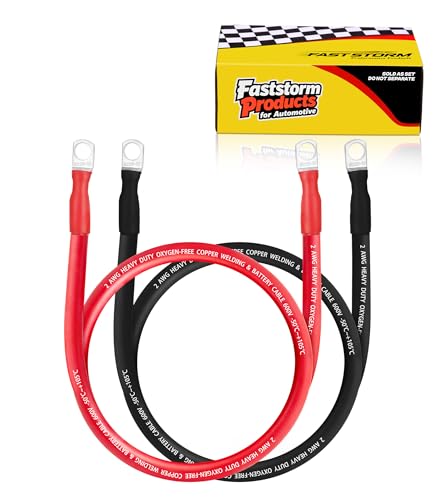
FASTSTORM 2 AWG Battery Cable 2ft Pair

MOOKEERF 4 Gauge Battery Cable 3ft Red + 3ft Black
Why These Options Stand Out
One foot is short on paper, but it solves a surprisingly common problem: bridging a battery post to a neighboring fuse block, isolator, or distribution bar where the factory lead is just too long and you want a clean right-sized path. The pure copper conductor helps here because every fraction of a volt matters across short jumps to sensitive electronics.
TUELEFETF sends both colors in the same box, which keeps polarity honest and saves a second trip to the parts drawer. The 3/8 inch ring terminals are pre-crimped at both ends, which removes the tool requirement for anyone who doesn’t own a hydraulic lug crimper yet. Compared to bulk roll cable later in this list, this is the ready-to-install option.
What Stands Out
- Pre-terminated on both ends, so a beginner can swap a battery lead without buying or renting crimpers.
- Pure copper conductor keeps voltage drop low across the short run.
- 3/8 inch ring terminals match most automotive and marine battery post studs.
- One-foot length works as a tidy post-to-distribution patch without excess cable to bundle.
Things To Consider
- One foot only suits very compact setups; longer installs need a different option.
- Pre-crimped terminals cannot be repositioned once they leave the factory.
Key Specs
Made For
Shed installers and car audio newcomers who want a tidy, pre-terminated patch between a battery post and a nearby fuse holder.
A Better Fit Elsewhere
Anyone running a longer amplifier or inverter cable should step up to the KnuKonceptz Kolossus Flex Kable instead.
Sanuke skips the cable entirely and ships the hardware. Ten ring terminals and ten pieces of color-coded heat shrink cover the messy middle of a custom install: cutting your own cable to length, then finishing it cleanly with a properly sized lug. For a tinkerer who already owns a spool of 4 gauge wire, that’s the missing puzzle piece.
Each lug uses annealed electrolytic copper rather than copper-clad aluminum, which is the difference between a lug that grips the cable firmly after crimping and one that slowly loosens with heat cycles. The 3:1 dual-wall heat shrink in both red and black finishes the polarity story without you reaching for electrical tape.
Key Advantages
- Pure copper lugs grip firmly and survive repeated thermal cycling better than plated aluminum.
- Color-matched 3:1 heat shrink removes the guesswork from polarity labeling.
- Ten lugs per pack supports multiple projects without reordering mid-install.
Worth Noting
- A proper hydraulic or hammer crimper is required; pliers will not seat these correctly.
- No cable is included, so this only suits people sourcing wire separately.
- Heat shrink needs a heat gun; a hair dryer may not shrink it tightly enough.
Best Suited To
DIYers building custom-length 4 gauge runs for solar banks, marine panels, or off-road lighting who already have a crimper and heat gun on the bench.
Consider Something Else When
Anyone who would rather skip the crimping step should grab the TUELETFU 1ft pre-terminated pair instead.
KnuKonceptz built this for car audio installers who treat a subwoofer amplifier like a small appliance. Ten feet gives enough slack to route from a trunk-mounted amp back to the battery in most sedans and coupes, and the matte soft-touch jacket slides through tight grommets without fighting you. Tinned oxygen-free copper (OFC) strands mean each of those 2058 conductors resists corrosion better than bare copper, which matters in engine bays that breathe moisture.
It exceeds AWG standards, which is a quiet claim that translates to a thicker actual conductor than some competitors label as 4 gauge. In real listening terms, that means less voltage drop between the alternator and the amp at high volume. Where the Sanuke kit earlier asks you to bring your own lugs, this spool is just cable: terminations are still on you.
A Few Strong Suits
- High strand count keeps the cable flexible for routing around sharp chassis corners.
- Tinned copper coating slows corrosion in humid engine bay and marine environments.
- Exceeds AWG thickness, supporting cleaner power delivery at high current draws.
Honest Caveats
- Single-color cable means you’ll need red and black runs, doubling the buy for a complete install.
- No included lugs or heat shrink; this is raw wire for experienced installers.
Who Will Love This
Car audio enthusiasts and serious DIYers running amplifier kits who want a flexible, corrosion-resistant cable in longer lengths.
Skip It When
Anyone who wants a finished cable ready to bolt in should reach for the MOOKEERF 3ft pair further down this list.
Two feet hits the sweet spot for compact inverter installs where the battery sits next to the unit, or for moving a battery forward in a race-car-style relocation. The same pre-terminated format as the 1ft pair means no extra tooling, and the longer length bridges a chassis mount to an interior fuse panel without splices.
This is also a handy pair to keep in the shop for diagnosing ground issues: when a strange electrical gremlin shows up, swapping in a known-good short cable rules out the factory ground strap in minutes. Pure copper conductors carry the load cleanly, and the 3/8 inch lugs fit the common M10 stud pattern on most automotive and marine batteries.
Useful Strengths
- Two-foot length handles small inverter or relocated-battery setups with room to spare.
- Pre-crimped 3/8 inch terminals install with basic hand tools only.
- Both red and black included, so a complete polarity-matched run arrives in one box.
Trade Offs
- Excess length must be coiled neatly; loose loops can trap heat under high loads.
- Fixed terminal positions mean you can’t fine-tune the routing without cutting and re-terminating.
Feature Snapshot
Right Fit For
Van-lifers and hobby mechanics wiring compact 12V systems where the battery and inverter sit close together.
Another Choice May Suit
Anyone running a long trunk-to-battery amplifier run should grab the KnuKonceptz Kolossus Flex Kable instead.
Three feet extends the same ready-to-bolt pair into more realistic battery-to-tray or battery-to-cabin runs. For boat owners, that often means bridging a battery box to a switch panel mounted a foot or two away. For truck owners, it’s enough to reach from an under-hood battery to a grille-mounted winch contactor without splicing.
The 3/8 inch terminals are sealed at the factory, and pure copper cabling means the run holds its conductivity across years of vibration and temperature swings. Owners commonly report that the insulation stays flexible even after cold winter starts, which matters more in northern climates than the spec sheet suggests.
Good Reasons To Consider
- Three-foot length reaches typical accessory mounting points without splicing.
- Pure copper core stays conductive across temperature swings and vibration.
- Pre-crimped ends make it a true plug-and-play replacement for tired factory leads.
Less Ideal Details
- Longer than needed for very tight engine bays, which can leave slack to manage.
- Insulation color cannot be changed if you want non-standard polarity coding.
Perfect Match For
Boat owners and truck upfitters who need a slightly longer factory-style replacement cable without custom termination.
Look Elsewhere When
Anyone wiring a high-amperage inverter pulling serious current should consider the heavier FASTSTORM 2 AWG pair.
Stepping from 4 AWG to 2 AWG roughly doubles the cross-sectional copper area, which is exactly what high-draw setups need. FASTSTORM’s pair is built for parallel battery banks, large inverters, and any rig where the original 4 gauge cable would feel underbuilt. The tin-plated copper terminals resist oxidation at the joint, which is the most common failure point on heavy cable.
The 2-foot length keeps the install tidy when batteries sit close together, like dual battery trays in a truck bed or a marine house bank. Pure OFC copper means current flows with minimal resistance, and the welding-cable-grade stranding keeps the cable flexible enough to route around corners despite the heavier gauge. For most setups, 4 gauge is plenty. For the ones that aren’t, this is the upgrade path.
What Makes Sense
- 2 AWG cross-section supports large inverters and dual-battery banks without voltage drop concerns.
- Tin-plated terminals slow corrosion at the most failure-prone connection point.
- Welding-grade stranding remains flexible despite the heavier gauge.
Small Caveats
- Heavier and stiffer than 4 gauge, which can challenge routing in very tight spaces.
- Overkill for small accessory loads, adding cost and weight without a real benefit.
Built With In Mind
Overlanders, marine electricians, and off-grid solar users running inverters above 1000W who need a step up from standard 4 gauge cabling.
Swap It Out When
A simple battery replacement or small accessory install only needs the lighter TUELETFU 4 gauge pairs.
MOOKEERF lands at the end of the list, but it pulls double duty across the most common use cases: automotive, solar, marine, generator, and inverter wiring. The 469-strand pure OFC conductor stays flexible at low temperatures, which matters when working outdoors in winter or in unheated sheds. A 600V rating and a working range from -40°F to +221°F covers the realistic extremes most weekend installers face.
Three feet of red and three feet of black arrives in the same package, so a small solar combiner, a portable generator tie-in, or a boat accessory circuit can be wired end to end without a second order. Where the FASTSTORM pick steps up to 2 AWG for heavy current, this stays at 4 gauge with the flexibility of welding cable construction.
Useful Highlights
- Wide temperature tolerance suits outdoor, marine, and cold-weather installations.
- High strand count keeps the cable flexible for tight routing in cabinets and panels.
- Both colors included in matched lengths for complete polarity-correct wiring.
- Welding-cable construction resists abrasion and most common solvents.
Points To Note
- Unterminated cable, so a crimper and lugs are required to finish the install.
- No included heat shrink, which means buying finishing supplies separately.
Quick Facts
Whose Shelf It Belongs On
Solar installers, marine electricians, and generator owners who want one flexible cable rated for varied environments.
Reach For A Different Pick When
Anyone wanting a pre-crimped, bolt-on replacement should choose the TUELETFU 3ft pair instead.
Choosing 4 Ga Battery Cables That Actually Fit Your Project
Gauge alone doesn’t decide the right cable. The real decision sits at the intersection of current draw, run length, and the environment the cable lives in. A car audio amp pulling 60A over a 15-foot run needs every bit of that 4 gauge cross-section, while a battery relocation two feet from the original tray could run lighter wire without breaking a sweat. Always measure the distance between connection points first, then match the cable to the load rather than guessing from the spec sheet.
Strand count shapes the real-world experience. A high-strand welding-style cable like the KnuKonceptz and MOOKEERF picks flexes around corners without kinking, which matters more in cramped engine bays than the spec table suggests. Lower-strand cables feel stiffer and can crack the insulation after years of vibration. For mobile installs that see temperature swings, OFC (oxygen-free copper) and tinned copper both slow corrosion, with tinned strands holding up better near saltwater and road salt.
Lugs and terminations quietly decide how long the install lasts. Pure copper lugs grip the cable firmly after a proper crimp, while copper-clad aluminum lugs work loose over time as the joint heats and cools. Pre-terminated pairs (TUELETFU) suit quick repairs and shorter runs, but custom builds with the Sanuke lug kit let you cut exact lengths and route cleanly. Always pair the lug stud size with the hardware on the battery post or bus bar.
Key Considerations Across These Picks
Common Shopping Slip Ups
The most frequent mistake is buying cable by length alone, without checking the stud size on the battery post. A 3/8 inch lug won’t seat on a 5/16 inch post, and adapters are an extra cost and another joint to fail. Measure the hardware before ordering, and confirm the cable gauge matches the fuse rating downstream.
Another trap is underestimating run length. Coiled excess cable traps heat under high load, and a cable that’s too short forces a splice that adds resistance. The right move is to measure twice, order a half-foot more than needed, and route the cable along existing harnesses to avoid sharp edges.
What The Higher Tier Buys
Spending more in this category usually buys tinned oxygen-free copper strands, higher strand counts, and thicker jackets. The real-world return is corrosion resistance in marine and winter environments, plus flexibility that survives cold bending. For a battery that lives in a garage-temperate car, the base tier is plenty. For boats, off-road rigs, and solar arrays exposed to weather year-round, the upgrade pays back in longer service life and fewer re-crimps.
Frequently Asked Questions
What does 4 AWG actually mean for my battery install?
4 AWG means the cross-sectional area of the copper conductor, which determines how much current the cable can carry safely. For most 12V automotive, marine, and small inverter setups up to about 100A, 4 gauge is a practical size that balances cost and current capacity.
Can I use 4 gauge cable for both positive and negative runs?
Yes, and you should keep both runs the same length and gauge to balance the circuit. Mismatched positive and negative cable lengths can create small voltage differences that affect sensitive electronics.
How do I know if I need 2 AWG instead of 4 AWG?
Step up to 2 AWG when the inverter or load draws sustained current above what 4 gauge handles comfortably over the planned cable length, or when voltage drop across the run exceeds a few percent. Long runs and high-amperage loads are the usual triggers.
Are the included lugs reusable if I cut the cable?
No, factory-crimped lugs cannot be reliably removed and re-crimped without specialized tools. Cutting a pre-terminated cable shortens it permanently; if you need a different length, buy the Sanuke lug kit and a separate cable spool.
Does tinned copper really matter for a daily-driven car?
For a daily driver in a dry climate, bare copper works fine. Tinned copper earns its keep in humid, salty, or off-road environments where moisture reaches the conductors, slowing the green corrosion that builds resistance over time.
The Takeaway
Seven picks, seven slightly different jobs. For quick bolt-on repairs, the pre-terminated TUELETFU pairs save a trip to the tool drawer. Custom builds call for the Sanuke lug kit paired with a quality cable like the KnuKonceptz or MOOKEERF spools. Heavy dual-battery rigs step up to the FASTSTORM 2 AWG pair. Match the cable to the load, the run, and the environment, and the install will feel as solid years later as the day you finished it.
