

Choosing the right low-voltage wire for a thermostat replacement, doorbell run, or HVAC control project usually comes down to conductor count, jacket quality, and how cleanly it pulls through walls. I’ve spent enough time around control wiring to know that a 50-foot spool of true-gauge solid copper can save a Saturday afternoon, while a flimsy spool turns a simple swap into a frustrating afternoon of stripped insulation and weak connections. This roundup walks through seven solid options across different conductor counts and lengths, so you can match the cable to the job at hand without overbuying.
The Leading Options At A Glance

Voltic Stone 18/2 Thermostat HVAC Wire 50FT

Voltic Stone 18/2 Thermostat HVAC Wire 20FT

Voltic Stone 18/3 Thermostat HVAC Wire 20FT

Voltic Stone 18/4 Thermostat HVAC Wire 50FT

Voltic Stone 18/5 Thermostat HVAC Wire 20FT
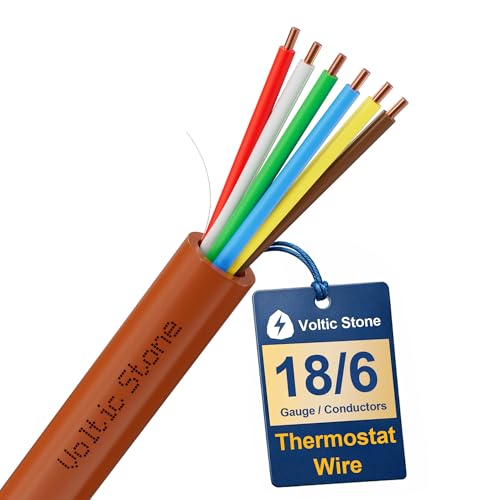
Voltic Stone 18/6 Thermostat HVAC Wire 100FT

Voltic Stone 18/8 Thermostat HVAC Wire 20FT
Taking A Closer Look At The Options
For a standard thermostat swap or a basic doorbell run, a two-conductor 18 AWG cable covers most residential needs. This 50-foot spool from Voltic Stone uses 99.97% oxygen-free solid copper at a true 1.02mm conductor diameter, which translates to lower voltage drop across longer pulls. In a typical hallway run from furnace to thermostat, the extra length over a 20-foot option means you won’t come up short mid-installation.
The ETL listing to CL3R riser-rated standards (CL3R means the cable is rated for vertical runs between floors with flame-retardant properties) makes it suitable for in-wall residential work. A built-in rip cord speeds up jacket removal, and the round PVC jacket slides through drilled studs without snagging. For anyone replacing an aging thermostat or running a new doorbell circuit, this length hits the sweet spot between having enough wire and not leaving a giant coil in the wall cavity.
The Helpful Details
- True 18 AWG solid copper at 1.02mm diameter keeps resistance low across longer thermostat pulls.
- 50-foot length suits most single-story homes and gives margin for routing mistakes.
- CL3R riser-rated jacket allows vertical in-wall runs where building code requires it.
- Built-in rip cord strips the jacket cleanly without scoring the conductor insulation underneath.
- Bonus kit of 10 wire nuts and electrical tape means no extra trip to the hardware store.
Points To Keep In Mind
- Two conductors only, so it won’t support smart thermostats that need a common wire (the “C” wire that completes the 24V circuit).
- Solid copper is stiffer than stranded, which can be noticeable in tight bends behind a wall plate.
Key Specs
Who It Suits Best
Homeowners handling a straightforward thermostat replacement or doorbell installation who want one reliable spool without overspending on extra conductors.
Look Elsewhere When
Anyone installing a smart thermostat that requires a common wire should reach for the Voltic Stone 18/4 Thermostat HVAC Wire 50FT instead, which adds the conductors needed for modern controls.
Short thermostat and doorbell jobs don’t need a 50-foot spool. This 20-foot version of the same 18/2 cable keeps things tidy for apartment dwellers or anyone patching a single damaged run. The conductor spec matches the longer option, so there’s no quality drop when you buy less wire.
For a quick doorbell repair where the existing cable has been chewed by a pet or nicked by a drywall saw, 20 feet is usually plenty. The UV-resistant PVC jacket (resistant to sunlight degradation) handles attic runs where sun leaks through vents, and the ETL listing to UL 13 standards gives inspectors the paperwork they want. Compared to the 50-foot spool, this saves you from coiling excess wire behind the thermostat baseplate where it can interfere with mounting.
What Earns Its Place
- Compact 20-foot length avoids waste on single-room repairs.
- Same 99.97% oxygen-free copper construction as the longer sibling.
- ETL listed to UL 13 with a flame-retardant jacket for safe in-wall use.
- Includes the same wire nut and tape bonus kit for a complete install.
Less Ideal Details
- Limited reach on multi-story homes or long basement-to-attic pulls.
- Solid copper conductors require careful bending to avoid fatigue cracks at tight corners.
Made For
Renters and apartment owners handling a one-off thermostat or doorbell repair who don’t need industrial-length cable.
Reach For A Different Pick When
Anyone wiring across a basement or attic with multiple turns should grab the Voltic Stone 18/6 Thermostat HVAC Wire 100FT for its longer reach and extra conductors.
Step up from basic 18/2 and you land at three conductors, which covers most conventional heating and cooling systems that need separate wires for heating, cooling, and fan control. This 20-foot spool suits a single-room retrofit where the existing cable has gone bad or where an older two-wire system is being upgraded to support a multi-stage thermostat.
The third conductor opens up compatibility with thermostats that require dedicated lines for each function. For a homeowner replacing decades-old two-wire cable in a tight utility closet, the 20-foot length keeps things manageable. The UV-resistant jacket and RoHS-compliant (Restriction of Hazardous Substances, meaning the materials meet European environmental safety limits) construction match the rest of the Voltic Stone line, so the build quality stays consistent as you move up in conductor count.
The Upside
- Three conductors handle conventional heat-cool thermostat systems without rewiring tricks.
- 20-foot length is enough for a single-room retrofit with slack to spare.
- Class 3 300V insulation rating provides safety headroom for control circuits.
- Rip cord and flexible jacket speed up installation in tight wall cavities.
Honest Caveats
- Still falls short for smart thermostats that demand a common “C” wire.
- Three conductors can feel limiting if the system later expands to multi-stage heating.
Best Suited To
Homeowners upgrading from a basic two-wire setup to a conventional programmable thermostat that needs separate heating, cooling, and fan signals.
Swap It Out When
Anyone installing a Wi-Fi thermostat that requires continuous power should pick the Voltic Stone 18/4 Thermostat HVAC Wire 50FT, which carries the common wire those units demand.
Four conductors is where most modern smart thermostats land, because they typically need R, W, Y, G, and C terminals, and a 4-conductor cable covers the essentials without running out of wires. This 50-foot spool gives a homeowner or light-commercial installer enough length for a full basement-to-attic pull while leaving room for routing around obstacles.
Compared to the 18/2 and 18/3 options earlier in this list, this cable adds the conductor flexibility that Wi-Fi thermostats and multi-stage systems need. The CL3R/CMR (CMR is the higher riser rating, suitable for riser shafts in commercial buildings) jacket is approved for in-wall residential work and vertical commercial runs, and the included wire nuts meet UL 486C standards for secure terminations. For a typical smart thermostat retrofit in a two-story home, this is the length that keeps you from running short at the furnace end.
Useful Highlights
- Four conductors support common-wire smart thermostat installations.
- 50-foot length covers most two-story residential thermostat pulls with margin.
- UL 486C-rated wire nuts in the bonus kit ensure solid terminations.
- True 18 AWG copper conductors minimize voltage drop on longer runs.
Practical Considerations
- Heavier and stiffer than 18/2 due to the extra conductor count.
- Color-coded conductor insulation varies by batch, requiring a continuity check before termination.
Key Specs
Who Should Grab It
Anyone installing a Wi-Fi or learning thermostat in a multi-story home where a common wire is required for continuous power.
Consider Something Else When
Installers running heat pump control wiring with multiple reversing valve signals should look at the Voltic Stone 18/5 Thermostat HVAC Wire 20FT for the extra conductor.
Heat pumps, multi-stage systems, and certain commercial controls need five conductors to handle separate signals for heating, cooling, fan, common, and an auxiliary function. This 20-foot spool suits compact equipment rooms or short cable tray runs where the control panel sits within sight of the thermostat.
The 20-foot length keeps the bundle manageable inside a crowded mechanical room, and the fifth conductor eliminates the need to double up on a wire for the reversing valve or auxiliary heat signal. For a mini-split heat pump retrofit or a packaged unit with auxiliary electric strips, this cable carries every control line in one jacket. The same ETL listing and RoHS-compliant materials apply as the rest of the line.
What Makes Sense
- Five conductors handle heat pump control with separate reversing valve wiring.
- Compact 20-foot spool fits tight equipment room layouts.
- CL3R/CMR jacket rated for both residential and commercial riser applications.
- Consistent conductor diameter across the family of cables for predictable performance.
Trade Offs
- Overkill for basic thermostat-only installs that don’t use the extra conductors.
- Shorter length limits use to single-room or compact mechanical room setups.
The Right Fit
Light-commercial technicians and homeowners with heat pump systems that need a dedicated auxiliary heat signal wire.
A Better Fit Elsewhere
Residential homeowners running a simple four-wire smart thermostat setup will find the Voltic Stone 18/4 Thermostat HVAC Wire 50FT a more practical match without the unused conductor.
When the run covers a basement mechanical room, across an attic, and back down to a second-floor thermostat, a 100-foot spool removes the anxiety of coming up short. Six conductors also leave room for systems with extra control points, including economizer controls, damper actuators, or multi-zone heating setups.
This is the spool I reach for when an HVAC contractor needs a single cable that covers most residential and small-commercial control jobs without pre-cutting. The 100-foot length is bulky to coil, but it gives a generous working margin. For anyone wiring a new construction home where the cable path isn’t fully scoped yet, having extra wire and extra conductors is far better than a mid-project shortage.
Features That Help
- 100-foot length covers full-basement-to-attic pulls with slack for service loops.
- Six conductors support advanced zoning and economizer controls.
- Same UL 13 listing and CL3R/CMR jacket as the rest of the family.
- Oxygen-free copper conductors hold up under repeated terminations during service work.
Where It May Fall Short
- Bulky 100-foot spool is awkward to transport and store in a small van.
- More cable than needed for a single thermostat swap in a compact apartment.
Whose Shelf It Belongs On
Professional HVAC installers and serious DIYers who handle whole-home rewires or multi-zone control system upgrades on a regular basis.
Where Another Pick Suits Better
For a one-off thermostat swap in a small home, the Voltic Stone 18/2 Thermostat HVAC Wire 50FT keeps the project simple without the extra spool weight.
Eight conductors cover the long tail of control wiring scenarios: large commercial thermostats, building automation panels, and zoned systems with multiple dampers or sensors. The 20-foot length is intentional, since most commercial control panels sit close to the equipment they manage and don’t need long runs.
For an installer building out a control panel for a small commercial rooftop unit, having eight individually insulated conductors inside one jacket simplifies the wireway and keeps the termination panel tidy. The trade-off is stiffness; eight solid copper conductors bundled together resist tight bends, so this cable wants a generous bend radius and proper cable management.
Why It Works Well
- Eight conductors handle multi-zone commercial thermostat panels in one jacket.
- CL3R/CMR rated for vertical commercial riser applications.
- UV-resistant jacket tolerates rooftop equipment room environments.
- True 18 AWG across all eight conductors for uniform signal quality.
Small Caveats
- Stiffer bundle than lower-conductor cables, requiring careful bend radius planning.
- Short 20-foot length restricts use to compact panel-to-equipment runs.
Built With In Mind
Commercial HVAC technicians wiring building automation panels and multi-zone rooftop unit controls where multiple signal lines converge.
Not Your Match When
Residential DIYers running a single thermostat cable will find the Voltic Stone 18/4 Thermostat HVAC Wire 50FT a far more practical and easier-to-handle option.
What Matters Most Before Choosing 3 Wire Cable Single Phases
Conductor Count And System Compatibility
The number of conductors inside the jacket is the single biggest decision. A standard two-wire thermostat only needs heating and cooling signals, but anything smarter demands a common wire for continuous 24V power. Before picking a cable, open the existing thermostat and count the wires landed at the terminals; matching or exceeding that count avoids creative rewiring tricks that often cause warranty headaches.
Conductor Gauge And Material Quality
True 18 AWG solid copper at the proper 1.02mm diameter keeps resistance low across longer pulls. Lower-quality cable sometimes ships undersized, which raises voltage drop and weakens signal strength at the thermostat. For runs over 30 feet, the gauge matters more than most shoppers realize, since voltage drop scales with length.
Jacket Rating And Building Code
CL3R and CMR ratings (both indicate the cable is flame-retardant and approved for vertical runs in walls and riser shafts) cover most residential and light-commercial in-wall installations. Working in a multi-story home with vertical cable runs between floors means these ratings aren’t optional. Local inspectors will look for the listing mark on the jacket before signing off on the work.
Length And Conduit Realities
Measure the actual run, including drops into the basement and up into the attic, before choosing a spool length. Buying a 50-foot cable for a 15-foot run creates excess coil that has to hide somewhere. Buying too short means mid-project splices or a second trip to the store. A 10-15% slack margin above the measured run keeps the project moving.
Key Considerations Across These Picks
Pitfalls Shoppers Hit
The most common slip-up is choosing conductor count based on the old cable rather than the new thermostat. Smart thermostats almost always need a common wire that older two-wire systems lack. Underestimating total run length is the next mistake; what looks like a 20-foot pull on paper often doubles once you add vertical drops and routing around joists. Finally, ignoring jacket ratings can lead to failed inspections, especially in multi-story homes where riser-rated cable is required by code.
Where The Extra Money Goes
Higher conductor counts cost more because each extra insulated copper strand adds material and manufacturing complexity. Longer spools cost more for the same reason, plus the extra copper weight. The real question isn’t whether to spend more, but whether the extra conductors or length actually serve the system being installed. For most modern smart thermostats, jumping to 18/4 is worth the small step up; for legacy two-wire systems, a 50-foot 18/2 spool is all the budget needs to cover.
Frequently Asked Questions
What does 18/2 or 18/4 mean in thermostat wire?
The first number is the American Wire Gauge (a standardized thickness rating where lower numbers mean thicker wire), and the second number is the conductor count. An 18/2 cable has two 18-gauge wires, while 18/4 has four.
Can I use thermostat wire for doorbell circuits?
Yes, as long as the doorbell system operates below 30V, which most standard doorbell transformers do. The gauge and jacket rating carry over cleanly for that use case.
How long can I run 18 AWG thermostat wire?
For 24V control circuits, runs up to about 100 feet generally work without significant voltage drop. Beyond that, thicker gauge or a closer transformer location becomes important to maintain reliable signal strength.
Is solid copper better than stranded for thermostat wire?
Solid copper is standard for in-wall low-voltage control wiring because it terminates cleanly under screw terminals and holds its shape inside junction boxes. Stranded is more flexible but tends to fray under repeated re-termination.
Do I need CL3R-rated cable for in-wall runs?
Most residential building codes require CL3R or CMR rating for low-voltage cable run inside walls, especially for vertical runs between floors. Check local code before skipping the rating to save a few dollars.
The Takeaway
A spool of 18 AWG solid copper thermostat cable with the right conductor count and a CL3R jacket covers the majority of residential and light-commercial control wiring jobs. Match the conductor count to the thermostat’s terminal needs, measure the run before choosing length, and don’t skip the jacket rating if the cable runs inside walls. For a typical smart thermostat retrofit, a 50-foot 18/4 cable hits the practical sweet spot without overbuying.
