

Anyone who has tried to install landscape lights knows the awkward moment of staring at a 120V household outlet and a string of low-voltage fixtures that simply refuse to talk to each other. A 120V to 12V transformer bridges that gap, stepping household current down to the safer, gentler voltage that LEDs and halogen landscape lights actually need to run cool and last. The trick is matching wattage headroom, weather resistance, and control style to the yard you have, not the yard on the box. I pulled together seven solid options that cover everything from a small front path to a full backyard lighting layout.
How The Shortlist Stacks Up
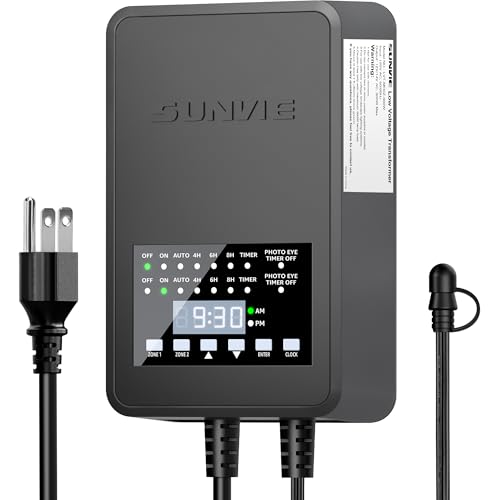
SUNVIE 300W Low Voltage Landscape Transformer with Timer & Photocell

VOLT 300W Slim Line Low Voltage Transformer (12V/15V)

DEWENWILS 200W Low Voltage Landscape Transformer for LED Lighting

SUNVIE 100W Low Voltage Transformer Outdoor, 120V to 12V DC

LED Driver 100W Waterproof IP67 Power Supply AC120-277V to 12V DC
Low Voltage Landscape Transformer 300W Outdoor Waterproof Dusk to Dawn

SUNVIE 200W Low Voltage Landscape Transformer with Timer & Photocell
The Strengths Of Each Pick
Big yards with separate lighting zones tend to overwhelm single-output transformers, and that is exactly where this SUNVIE 300W unit earns its place. It steps 120V household AC down to 12V or 14V AC and splits the load across two independently controlled outputs, so the front path can run on a different schedule than the backyard trees. For most homeowners splitting a property into a couple of lighting moods, that dual-zone layout removes the need for a second transformer.
The removable photocell sensor with its 6.8-foot cord lets me tuck the light-sensing element out of shadow while mounting the box wherever wiring is convenient. For larger properties, that flexibility usually pays off the first time a tree branch or eave would have shaded a fixed sensor.
What It Does Well
- Two independent outputs let me run separate zones without buying a second transformer
- 300W capacity covers medium to large lighting layouts with headroom to spare
- Removable photocell on a long cord avoids shade-related false triggers
- Weatherproof housing rated for outdoor mounting
- Timer plus sensor gives me dusk-on automation without extra parts
Points To Note
- Two-zone design is more than a small front walkway needs
- Larger physical size than compact 100W options on this list
Key Product Details
Who Will Love This
Homeowners with a medium-to-large yard who want two separately scheduled lighting zones on a single transformer.
Consider Something Else When
The DEWENWILS 200W Low Voltage Landscape Transformer suits smaller layouts where multi-mode scheduling matters more than dual-zone output.
The first thing anyone notices about this VOLT unit is how thin it looks for a 300W magnetic transformer. The designers stripped out extra voltage taps, leaving 12V and 15V as the only options, which keeps the internals simple and the housing narrow enough to hide behind shrubs or mount on a fence post. For properties with long wire runs, the 15V tap is genuinely useful, since it compensates for the voltage drop that dims fixtures far from the transformer.
Voltage drop is the silent killer of landscape lighting: a 14-gauge wire run of 80 feet can leave the last fixture noticeably dimmer than the first. The 15V tap lets the system push slightly more voltage at the source so the far end lands at the correct level. For most medium-sized LED setups, the slim housing alone is reason enough to pick this over a bulkier box.
Where It Excels
- Slim magnetic housing is easier to tuck into tight outdoor spots
- 15V tap compensates for voltage drop on long wire runs
- 300W output handles medium-sized LED layouts comfortably
- Integrated timer and photocell for set-and-forget operation
Trade-Offs To Consider
- Only two voltage taps, so flexibility is limited compared with multi-tap units
- Owners commonly report the slim housing runs warm under sustained heavy load
- Best loaded at no more than 80 percent of nameplate capacity for long life
Perfect Match For
Anyone running long landscape wire runs from a remote outlet who needs voltage-drop correction in a slim footprint.
Skip It When
The SUNVIE 300W Low Voltage Landscape Transformer is a smarter pick when independent zone control matters more than a slim profile.
Some homeowners want a transformer that just turns on at dusk and forgets about it. Others want to fine-tune exactly how long the lights stay on, what time they come on, and when they cut off. This DEWENWILS 200W lands squarely in the second camp, with five operating modes that cover manual control, dusk-to-dawn, and several countdown or scheduled options. For most properties that mix entertaining nights with quiet weekdays, that flexibility removes the usual routine of swapping settings every season.
The 200W capacity sits between the small 100W units and the heavy 300W boxes, which tends to be the sweet spot for typical suburban layouts. Compare that to the SUNVIE 300W with two zones: this one prioritizes scheduling variety over independent zone control.
The Helpful Details
- Five modes cover manual, dusk-to-dawn, and timed countdown schedules
- 200W output is a comfortable match for typical mid-size yards
- Compatible with both LED and halogen low-voltage fixtures
- Countdown options in multiple hour increments for short-event lighting
Small Caveats
- Five-mode interface takes a few minutes to learn on first setup
- 200W ceiling limits expansion into larger lighting plans
Feature Snapshot
Right Fit For
Homeowners who enjoy customizing schedules for entertaining, weeknights, and vacations rather than running a single dusk-to-dawn routine.
Look Elsewhere When
The Low Voltage Landscape Transformer 300W Outdoor Waterproof Dusk to Dawn is a simpler match when set-and-forget dusk-to-dawn operation is the priority.
Most landscape transformers step 120V AC down to 12V AC, but a growing number of DC-only LED fixtures require a different animal. This SUNVIE 100W unit converts standard household AC to 12V DC, which is the format that many modern LED strip lights and certain in-ground fixtures actually need. For homeowners with DC-rated low-voltage lighting already on hand, plugging an AC transformer into DC fixtures can cause flicker or early failure, and this is the fix.
The 100W rating covers a modest path-and-deck setup without pushing the transformer into thermal stress. For most small front-yard plans, that headroom is plenty.
A Favorable Mix
- Outputs 12V DC rather than AC for compatible DC LED fixtures
- 100W is well-matched to a small path or deck lighting layout
- Weatherproof housing suitable for outdoor mounting
- Compact body fits in tighter spots than larger 300W units
Honest Caveats
- DC output means it will not work with traditional AC halogen landscape lights
- 100W ceiling limits how many fixtures the run can support
- Confirm fixture DC rating before connecting, mismatches shorten LED life
Who Should Grab It
Anyone installing DC-only LED landscape lights who needs a properly matched power supply instead of an AC transformer.
A Better Fit Elsewhere
The LED Driver 100W Waterproof IP67 Power Supply suits harsher wet or buried locations where sealed construction matters more than DC-specific output.
Some installations push the transformer into places where rain, snow, and even brief submersion are real possibilities. This EOPWR LED driver carries an IP67 rating, which means the sealed aluminum housing shrugs off dust and survives temporary water immersion. For under-eave runs, deck lighting tucked between joists, or even buried conduit sections, that level of sealing opens up mounting locations most other transformers cannot tolerate.
The unit accepts a wide 120-277V AC input and outputs a steady 12V DC at up to 8.33A, which is the constant-voltage format LED strip lights prefer. The wide input range is useful when wiring taps into unusual outlet voltages. For most wet-location LED strip installs, the sealed body alone justifies the choice.
Standout Benefits
- IP67 sealed aluminum housing handles wet and briefly submerged locations
- Accepts 120-277V AC input for unusual outlet voltages
- Steady 12V DC output keeps LED strip lighting flicker-free
- Compact form factor fits inside conduit boxes and under decking
Where It May Fall Short
- No built-in timer or photocell for automatic on/off behavior
- DC-only output rules out traditional AC halogen fixtures
Spec Overview
Built With In Mind
Installers running LED strip lighting in wet or partially buried locations who need a sealed, no-flicker constant-voltage supply.
Reach For A Different Pick When
The SUNVIE 200W Low Voltage Landscape Transformer is the better match for above-ground landscape lighting where built-in timer control is more useful than IP67 sealing.
For homeowners who want their landscape lighting to simply work without thinking about it, a built-in dusk-to-dawn sensor removes every manual step from the routine. This Tiffcofio 300W unit flips the lights on at sundown and off again at sunrise, with the heavy 300W capacity to drive a generous layout across two output channels. Compare that to the SUNVIE 300W with its dual-zone independent scheduling: this one keeps things simpler at the cost of zone-level customization.
The waterproof housing and ETL listing suggest the manufacturer focused on outdoor longevity rather than feature density. For most yards where the priority is reliable automatic lighting every night, that simpler design is exactly the right tradeoff.
The Value In It
- Built-in dusk-to-dawn photocell handles on/off automatically
- 300W capacity supports a generous lighting layout
- Two outputs let me split front and back runs
- Waterproof construction suited to permanent outdoor mounting
Practical Considerations
- No countdown or scheduled modes for occasional off-hours needs
- Dusk-to-dawn only, no timer override without bypassing the sensor
Whose Shelf It Belongs On
Homeowners who want fully automatic nightly landscape lighting without ever touching a timer dial.
Swap It Out When
The DEWENWILS 200W Low Voltage Landscape Transformer is the better pick when scheduling variety matters more than capacity or automatic dusk-to-dawn simplicity.
Tucked between the 100W units and the heavy 300W boxes, this SUNVIE 200W lands at a comfortable middle ground for typical suburban properties. It steps 120V household AC down to either 12V or 14V AC and works with both LED and halogen fixtures, which matters for anyone gradually mixing older halogen path lights with newer LED retrofits. For most medium yards that run a dozen fixtures total, the 200W rating gives enough headroom without oversizing the transformer.
The combined timer and photocell setup covers both dusk activation and scheduled off-times, which suits homeowners who want automatic lighting without giving up manual override. Same brand family as the SUNVIE 300W earlier in the list, but in a smaller, single-zone form.
What Helps Most
- 200W capacity fits medium-sized landscape layouts without excess
- Compatible with both 12V/14V LED and halogen fixtures
- Timer plus photocell covers automatic and manual schedules
- Single-zone design simplifies the wiring diagram for first-timers
Things To Consider
- No dual-zone output like the larger 300W SUNVIE sibling
- 200W ceiling caps expansion into very large lighting plans
Best Suited To
Homeowners with a typical suburban yard who want a single-zone automatic transformer without oversizing for capacity they will not use.
Where Another Pick Suits Better
The SUNVIE 300W Low Voltage Landscape Transformer is the right upgrade for anyone who later decides to split the yard into two independently scheduled zones.
What To Weigh Before Choosing A 120V To 12V Transformer
Match Wattage Headroom To The Lighting Plan
The single most common mistake is buying a transformer sized exactly to today’s fixtures. LED path lights draw far less than older halogens, but the moment a homeowner adds accent lights, a string of deck lights, or a seasonal display, that perfectly sized transformer becomes the bottleneck. For most yards, I recommend adding 20 to 30 percent headroom above the sum of fixture wattages so future expansion does not force a swap. The 300W units on this list comfortably cover layouts that a 100W model would choke on.
Decide AC Versus DC Output Before Anything Else
Most landscape lighting transformers output AC, which works with both LED and halogen fixtures. A growing number of modern LED strip lights and certain in-ground fixtures are DC-only, and pairing them with an AC transformer causes flicker or premature failure. For most traditional landscape lighting projects, an AC output is the safe default, but anyone running LED strip lighting under decks or along retaining walls should specifically look for a DC output unit like the SUNVIE 100W DC or the EOPWR IP67 driver.
Pick A Control Style That Matches The Routine
Some homeowners want lights on at dusk and off at dawn without ever touching a setting, which favors a photocell-only design. Others prefer different schedules for weeknights, party nights, and vacations, which favors a transformer with timer modes and manual override. The five-mode DEWENWILS 200W covers nearly every schedule scenario, while the dusk-to-dawn Tiffcofio 300W keeps things simple. For most people, matching the control complexity to the routine they actually keep prevents endless dial-twiddling later.
Think About Weather And Mounting Location
A transformer tucked under an eave in a dry climate has different needs than one mounted on an exterior wall exposed to rain and snow. The standard weatherproof housing on most of these units handles typical outdoor mounting, but for wet, buried, or partially submerged locations, an IP67 sealed driver like the EOPWR unit is the safer choice. Considering the mounting spot before purchase prevents the common frustration of buying a perfectly good transformer that cannot survive its intended location.
Smart Shopping Notes For Outdoor Transformers
Where Shoppers Go Wrong
The most frequent trap is treating wattage as a single number rather than a sum. A homeowner counts their fixtures and lands on exactly 95W of draw, then buys a 100W transformer. That unit runs at 95 percent capacity every night, which generates excess heat, shortens component life, and leaves zero room for the inevitable extra fixture. A safer practice is summing the fixture wattages and choosing a transformer rated at least 25 percent higher. Another mistake is ignoring the AC versus DC question until the lights are already wired, which leads to returning incompatible fixtures or adding a second transformer. Confirming the fixture voltage type before any purchase keeps the project moving forward.
Why Top Tier Costs More
The jump from a basic 100W transformer to a 300W dual-zone unit is not just extra wattage. The higher tier typically buys multi-tap voltage outputs for compensating voltage drop on long runs, dual-zone independent scheduling, photocell sensors on long cords for better placement, and weatherproof housings built for multi-season exposure. For most small front-path projects, the basic tier does the job. The upgrade pays off when a property has long wire runs, multiple lighting zones, or a homeowner who wants finer schedule control without swapping modes every month.
Frequently Asked Questions
Can I use a 300W transformer on a small yard?
Yes, the wattage rating is the maximum the unit can safely deliver, not the amount it pushes out. A small yard drawing 60W from a 300W transformer simply uses 20 percent of its capacity, which actually keeps the unit running cooler and extends its lifespan. For most homeowners anticipating future expansion, oversized headroom is a feature rather than a problem.
What happens if I exceed the wattage rating?
Pushing a transformer past its rated wattage generates excessive heat that damages internal windings and shortens the lifespan of the unit. In severe cases, the transformer can shut down, trip the household breaker, or in extreme misuse, pose a safety risk. Staying within the rated capacity is one of the simplest ways to keep an outdoor transformer running for many seasons.
Do I need a DC or AC output transformer?
It depends entirely on the fixtures being powered. Traditional halogen landscape lights and most AC-rated LED fixtures work with the AC output found on most landscape transformers. Modern LED strip lighting and certain DC-only in-ground or step lights require a DC output supply. For most standard landscape lighting projects, an AC output is the safer default, but anyone installing strip lighting under decks or along hardscapes should confirm the fixture specification first.
How does voltage drop affect long wire runs?
Voltage drop is the gradual loss of voltage as electricity travels through wire resistance over distance. A long run from the transformer to the farthest fixture can leave that fixture noticeably dimmer than the closest one, and the effect worsens with thinner wire. The 15V tap on the VOLT 300W transformer compensates for this by pushing slightly more voltage at the source, and using heavier 12-gauge wire instead of 16-gauge also reduces the drop. For most runs under 50 feet, voltage drop is minimal and a standard 12V tap works fine.
Where should I mount the transformer?
The ideal mounting spot is a dry, accessible exterior wall or post near a GFCI-protected outdoor outlet, within reasonable wire run distance of the first fixture. Most transformers are designed for outdoor mounting, but a sheltered location under an eave extends their lifespan further. Keeping the mounting spot accessible also matters, since occasional adjustments to timers or sensors are easier when the unit is reachable without a ladder.
The Takeaway
Choosing a 120V to 12V transformer comes down to matching three things: the total wattage of the lighting plan plus reasonable headroom, the AC or DC requirement of the fixtures, and a control style that fits how the lights will actually run day to day. Small front-path projects pair well with compact 100W units, while medium-to-large yards with multiple zones deserve the heavier 300W models. Confirming the fixture voltage type before any purchase prevents the most common installation headaches, and oversizing wattage by about 25 percent leaves room for the inevitable expansion. Pick the unit that matches the real yard, not the fantasy one, and the system should run quietly for many seasons.
