

Working with DC power in a boat, RV, trailer, or off-grid solar setup means protecting your wiring with the right breaker at the right amperage. A misjudged rating can either trip nuisance cuts during normal use or, worse, let a real fault overheat cables. I put together this shortlist to help match trip ratings to real-world loads so you can pick with confidence.
How The Shortlist Stacks Up

Sezbaifles 200A Marine Circuit Breaker DC 12V-48V
Sezbaifles 150A Marine Circuit Breaker DC 12V-48V
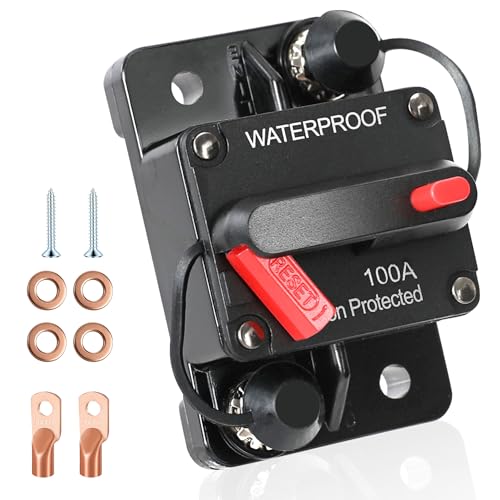
Sezbaifles 100A Marine Circuit Breaker DC 12V-48V

Sezbaifles 60A Marine Circuit Breaker DC 12V-48V

Sezbaifles 40A Marine Circuit Breaker DC 12V-48V
More Details On Our Top Picks
Starting at the top of the ladder, this 200A breaker from Sezbaifles is sized for systems pulling real current, like a big inverter running a microwave or a heavy trolling motor on a larger boat. It sits in the same Sezbaifles family as the smaller units below, so installation feels familiar if you’ve wired the 100A version before.
The sealed IP67 housing shrugs off spray and rain, which matters for any breaker that lives in an engine bay or near a bilge. For owners stepping up from a 100A panel, the extra headroom can mean the difference between nuisance trips and reliable operation under sustained draw.
A Strong Showing
- 200A rating gives serious headroom for inverters and high-draw trolling motors
- IP67 sealing protects terminals in wet bilge and engine-bay conditions
- Compatible with 12V-48V DC systems, covering most marine and RV banks
- Manual reset means a tripped breaker doesn’t need a spare fuse
Trade-Offs To Consider
- Overkill for small boats and modest loads, which adds cost without benefit
- Heavy-gauge wiring is required to safely feed a 200A circuit
Key Specs
Built With In Mind
Owners running 2000W or larger inverters, or anyone feeding a heavy trolling motor on a big boat, will appreciate the breathing room this rating provides.
Consider Something Else When
The Sezbaifles 100A Marine Circuit Breaker is a smarter match for smaller boats and modest accessory banks where 200A capacity goes unused.
The 150A unit fills a useful middle slot that often gets overlooked. People running mid-sized inverters or larger trolling motors sometimes find 100A too tight while 200A feels like overkill, and this rating lands right in that comfortable zone.
It shares the same sealed housing and manual reset switch as its siblings, so the install experience stays consistent if you already have a Sezbaifles breaker on the panel. For mixed-use boats, this rating protects the main feed while leaving room for occasional surges.
Everyday Wins
- 150A rating suits mid-sized inverters and larger trolling motors
- IP67 sealed housing handles bilge and outdoor mounting
- Manual reset switch avoids fuse replacements after a trip
- Same form factor as the rest of the Sezbaifles marine line
Honest Caveats
- Not as commonly stocked as 100A or 200A ratings
- Still requires appropriately gauged cables for safe 150A service
Right Fit For
Boat owners with mid-sized trolling setups or RV solar arrays drawing between 100A and 150A peak will find this rating hits the sweet spot.
A Better Fit Elsewhere
The Sezbaifles 60A Marine Circuit Breaker is a better pick when the load stays under 80A continuous, such as a small solar subpanel.
The 100A breaker is the workhorse of the lineup and the natural center of any DC protection discussion. It matches the main feed on most mid-sized boats and RVs, protecting everything from the battery to the distribution panel without overrating smaller branch circuits.
Owners moving up from a fuse-based system often land here because the manual reset switch makes recovery simple after a fault. The IP67 rating also means it can live near the battery without worry, even on a wet deck or in a damp bilge.
Reasons It Performs
- 100A rating suits most mid-sized boat and RV main feeds
- Manual reset means quick recovery without spare fuses on hand
- IP67 sealed housing tolerates marine and outdoor environments
- Wide 12V-48V compatibility covers common battery banks
Things To Weigh
- Not enough headroom for large inverters drawing above 100A
- Terminals require proper torque and corrosion-resistant lugs in saltwater use
Feature Snapshot
Whose Shelf It Belongs On
Boat and RV owners with mid-sized battery banks running typical accessory loads will find this is the most natural fit.
Skip It When
The Sezbaifles 200A Marine Circuit Breaker is the right call for anyone running a heavy inverter or large trolling motor that pushes past 100A.
Stepping down, the 60A breaker is built for subpanel and mid-range accessory circuits. It fits naturally as a protection device for a small solar array feeding an RV, or as the dedicated feed for a water pump or windlass that draws moderate current.
The same sealed housing and manual reset design carries over from the larger siblings, which keeps wiring practice consistent across an installation. Many owners use a 60A breaker as a secondary layer below a 100A main, isolating one high-draw accessory without risking the whole panel.
Useful Highlights
- 60A rating fits solar subpanels and accessory feeds
- Manual reset switch reduces maintenance compared to fuses
- IP67 sealing handles outdoor or bilge mounting
Some Limits To Know
- Too small for main feeds on larger battery banks
- Requires careful load calculation to avoid nuisance trips on motor startups
- Owners commonly report needing to confirm inrush current matches the 60A trip curve
Quick Facts
Made For
Solar subpanel owners and anyone running a single mid-draw accessory like a pump or windlass will appreciate the focused protection.
Look Elsewhere When
The Sezbaifles 100A Marine Circuit Breaker suits shoppers who need a main-feed breaker rather than a branch-circuit device.
At the small end of the lineup, the 40A breaker handles light branch circuits where space and current demands are modest. Lighting runs, small fan circuits, and accessory feeds that stay well below the 100A threshold all fit comfortably within this rating.
It uses the same physical layout as the larger Sezbaifles units, so it can sit on the same mounting footprint. That consistency helps anyone building out a tiered protection scheme with multiple breakers across a single panel.
Points In Its Favor
- 40A rating suits lighting and small accessory circuits
- Manual reset avoids stocking spare fuses for low-amp runs
- IP67 sealed housing works in marine and outdoor settings
Factors To Consider
- Too small for any motor or inverter load
- Nuisance-trip risk if used on circuits with motor startup surges
- Best treated as branch protection, not main-feed protection
Best Suited To
Shoppers wiring lighting circuits, small pumps, or other low-draw accessories will find this a tidy, focused match.
Swap It Out When
The Sezbaifles 60A Marine Circuit Breaker is the better pick once loads climb past a small lighting run, especially for any motor-driven accessory.
Choosing The Right Trip Rating For Your DC System
A marine or automotive DC breaker exists to protect the wiring, not the device at the end of it. The breaker should match the ampacity of the smallest wire in the circuit, then be sized up to handle normal operating current without tripping. Sizing it right protects cables from melting during a fault and keeps gear running smoothly under steady draw.
Match The Breaker To Wire Gauge
Wire gauge determines how much current a cable can carry safely. A 4 AWG cable typically handles around 100A to 150A depending on insulation and bundling, while 6 AWG lands closer to 60A to 80A. Pairing a 200A breaker with thin 10 AWG wire invites a fire risk during a short circuit, since the wire heats up before the breaker trips. The rule of thumb is simple: the breaker rating should never exceed the wire’s safe ampacity.
Consider Your System Voltage And Environment
Most marine and RV banks run at 12V or 24V, while larger solar systems may use 48V. A breaker rated for the full DC 12V-48V range gives flexibility if the system expands later. For installations in damp bilges, near batteries, or outdoors, an IP67 rating prevents water intrusion from corroding terminals or causing nuisance trips. Saltwater use pushes this further, calling for corrosion-resistant lugs and routine inspection.
Plan For Inrush And Motor Loads
Motors draw several times their rated current at startup, which can trip an undersized breaker. A trolling motor or pump with a 30A running draw might pull 90A or more at first spin-up. That’s why sizing a breaker for motor loads usually means stepping up one rating above continuous draw, rather than matching it exactly. Solid-state and inverter loads behave differently and tolerate tighter sizing, but motor circuits deserve the extra margin.
Decide Between Manual Reset And Fuse-Based Protection
Manual reset breakers cost more upfront than a fuse but pay back through convenience. A tripped breaker flips back on with a button press, while a blown fuse needs a replacement on board. For a remote boat or RV, that convenience often tips the scales toward a breaker-based setup. For vehicles with predictable loads and easy access, fuses remain a fine, lower-cost choice.
What To Watch Before You Buy
Common Shopping Slip Ups
Picking a breaker based on the device it feeds, rather than the wire it protects, is a regular misstep. The other common trap is ignoring inrush current on motor circuits, which leads to nuisance trips every time a pump or windlass starts up. Double-check both the continuous load and the startup spike before committing to a rating.
Where The Extra Money Goes
Higher-amperage breakers cost more because the internal contacts, lugs, and thermal trip elements all scale up to handle the current safely. A 200A unit uses heavier hardware than a 40A unit. The upgrade pays off when the system actually draws near that ceiling, but for small boats and modest accessory banks, that extra capacity sits unused. Spend up only when the wiring and loads justify it.
Frequently Asked Questions
What Does IP67 Actually Mean For A Marine Breaker?
The IP67 rating means the breaker is fully sealed against dust and can survive brief immersion in water up to one meter deep. For bilge, deck, and outdoor installations, this protects the internal contacts from corrosion and water intrusion.
Can I Use One Of These Breakers As My Main Battery Disconnect?
These breakers function as both protection and manual disconnect, which works for many smaller setups. For larger banks with substantial continuous draw, a dedicated heavy-duty disconnect switch may be a more robust long-term choice.
Do I Need A Separate Breaker For Each Accessory Circuit?
Tiered protection usually serves best, with a main breaker sized for the battery feed and smaller breakers on each branch circuit. This way a fault on one accessory doesn’t kill power to the whole panel.
What Happens If I Oversize The Breaker For My Wire?
An oversized breaker will not trip before the wire overheats during a fault, which can melt insulation or start a fire. Always match the breaker to the wire’s ampacity, not to the device’s draw.
Are These Breakers Compatible With Lithium Battery Banks?
The 12V-48V DC rating covers common lithium configurations, including 12V, 24V, and 48V LiFePO4 banks. As always, confirm the continuous draw of the system falls well below the breaker’s trip curve before installing.
Wrap Up
The right 100 amp disconnect comes down to honest load math, proper wire sizing, and a healthy respect for inrush current. Match the breaker to the smallest wire in the circuit, leave headroom for motor startups, and pick a sealed unit for any installation that sees moisture. With those boxes checked, any of these Sezbaifles breakers will serve reliably across boats, RVs, trailers, and solar setups.
