

A 9V battery clip is one of those tiny components that quietly runs a hobby bench, a classroom lab, or a smoke alarm, and nobody thinks about it until a wire snaps or a solder joint gives up. I’ve spent enough time around Arduino builds and electronics repair to know the difference between a clip that holds firm for years and one that pops off mid-project. This roundup covers seven solid options across T-type, I-type, and DC-plug configurations, so you can match the clip to the job instead of guessing.
A Closer Look At The Lineup

CHANZON 9v Battery Clip Connector T-Type Hard Shell Pack of 10

CHANZON 9v Battery Clip I-Type with 2.1×5.5mm Female DC Connector

VWEICYY 10 PCS T-Type 9 Volt Buckle Connector Hard Plastic Shell

California JOS 3 PCS 9V Battery Connector T-Type Hard Shell
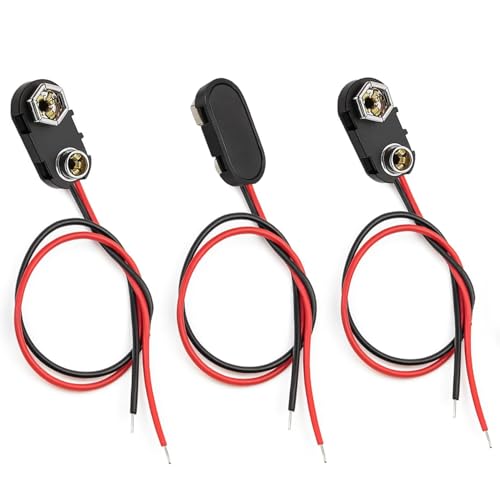
California JOS 3 Pack 9V Battery Clip I-Type Hard Shell

CHANZON UL Wires 5 Pack 9V Battery I-Type DC Connector Clip

RuiLing 5pcs 9V Battery Clip with 15cm Lead Wire I Type
Taking A Closer Look At The Options
When I’m wiring up a batch of Arduino test rigs, the last thing I want is to run out of clips halfway through. CHANZON ships ten in a single pack, which keeps a workbench stocked without constant reordering. The T-style layout places both leads on the same edge, which makes routing into a breadboard or perfboard far cleaner than the inline I-type.
The hard plastic shell feels rigid in hand, and the snap head seats firmly on a standard 9V terminal. Each unit uses 24 AWG UL-listed pigtails at roughly 15 cm, which is long enough for most prototype enclosures without leaving coils of extra wire behind.
The Value In It
- Ten clips per pack keeps an active lab or classroom well stocked for weeks of builds.
- 24 AWG copper leads handle typical 9V sensor and microcontroller loads without voltage drop worries.
- T-type lead exit keeps wiring flat against the board, which helps inside tight enclosures.
- UL-listed wire stock adds a layer of safety in permanent installations like alarm retrofits.
Things To Consider
- Hard plastic shell can crack if pried off repeatedly for battery swaps in heavy-use rigs.
- Lead length may feel short when routing across a full-size project box.
Who It Suits Best
Educators stocking multiple lab stations, makers running Arduino workshops, and anyone building several battery-powered devices at once.
Where Another Pick Suits Better
Shoppers who need a plug-in DC barrel connection rather than bare leads should look at the CHANZON 9v Battery Clip I-Type with 2.1×5.5mm Female DC Connector instead.
For anyone who has fried a board with a bad solder joint, a pre-wired DC jack is a gift. This CHANZON clip ends in a 2.1 x 5.5 mm female barrel connector, which is the standard input size for countless Arduino clone boards and LED controllers. The I-type geometry routes both leads in line, which fits neatly into a project box cutout.
I reach for this style whenever a project needs to be hot-swappable or moved between prototypes. It eliminates the soldering iron entirely and turns a 9V source into a quick-disconnect power feed.
What Helps Most
- Pre-attached 2.1 x 5.5 mm female jack mates with most Arduino and LED controller inputs out of the box.
- Removes the soldering step, which speeds up classroom demos and rapid prototyping.
- Hard plastic shell grips the battery firmly so the connector doesn’t wiggle loose.
- Five-pack offers enough spares for a few active projects without overstocking.
Worth Noting
- Polarization depends on the device, and the bare leads can be crossed if wired backwards on the jack.
- 15 cm cable run is short for installations mounted far from the power source.
- Connector adds bulk that may not fit inside slim enclosures.
Made For
Hobbyists running Arduino or LED strip projects who want clean, solder-free power connections and quick battery swaps.
Consider Something Else When
Users who need a male DC barrel plug at the clip end should look at the CHANZON UL Wires 5 Pack 9V Battery I-Type DC Connector Clip instead.
VWEICYY’s ten-pack targets classroom and lab use, where clips tend to disappear or get damaged mid-semester. The hard plastic shell and metal contact construction feels sturdy enough to survive repeated battery swaps, and the tinned lead ends are genuinely easy to solder, which matters when a class of twenty students is waiting at the bench.
For school electronics kits, the simple T-shape keeps the wiring approachable for beginners who are still learning to read a schematic. It also works fine for hobby repair jobs where the original clip has snapped.
Points In Its Favor
- Tinned lead ends accept solder cleanly, lowering the learning curve for first-time builders.
- Solid metal contacts keep electrical resistance low during long experiment sessions.
- Rigid plastic housing resists cracking when students handle the clip roughly.
- Bulk ten-pack keeps a classroom supplied through a full term of projects.
Trade Offs
- No UL-listed wire designation in the source data, which may matter for permanent installations.
- T-type geometry doesn’t suit every enclosure layout.
Key Specs
Best Suited To
Science teachers, electronics lab instructors, and students building their first battery-powered circuits.
Skip It When
Makers who prefer plug-and-play power delivery over soldering should consider the CHANZON 9v Battery Clip I-Type with 2.1×5.5mm Female DC Connector instead.
Not every project demands a ten-pack. California JOS ships three T-type clips, which is the right size for a quick repair or a single weekend build. The hard shell and metal contact build matches the bigger multi-packs in feel, so smaller quantity doesn’t automatically mean flimsier construction.
I find this size useful for one-off fixes, like replacing a cracked clip inside an old smoke alarm or a handheld multimeter. The T-style lead exit keeps the wiring tidy when the repair has to fit back into a compact housing.
A Few Strong Suits
- Three-pack format avoids waste on small repair jobs.
- Hard plastic body holds up to repeated insertion and removal.
- Compact T-type footprint works well inside tight device casings.
Honest Caveats
- Fewer units per pack than the CHANZON or VWEICYY options for high-volume users.
- Bare lead ends require a soldering iron, which adds a step for beginners.
Who Should Grab It
Repair-focused hobbyists and tinkerers who need just enough clips to replace a few worn-out units around the house.
Look Elsewhere When
STEM classrooms needing bulk inventory should pick the VWEICYY 10 PCS T-Type 9 Volt Buckle Connector Hard Plastic Shell instead.
The I-type configuration routes both leads inline, which suits a wider range of project enclosures than the T-style. California JOS packs the clips in an anti-static bag, which sounds minor but extends shelf life and prevents oxidation during long storage in a classroom closet.
The solid plastic and metal contact construction should handle a year of STEM club projects without complaint, and the tinned leads make for fast soldering during timed build sessions.
Useful Strengths
- Anti-static packaging keeps unused clips in good shape between terms.
- I-type geometry fits inline connector layouts more naturally than T-type.
- Tinned lead ends save time on bench-day soldering.
- Hard shell design holds up to repeated student handling.
Points To Keep In Mind
- Three-pack may run short for full-classroom consumption across a semester.
- No pre-attached DC connector means soldering is required.
Feature Snapshot
Whose Shelf It Belongs On
STEM coordinators running small-group workshops, homeschool parents, and after-school electronics clubs.
Reach For A Different Pick When
Anyone wanting a solder-free experience should grab the CHANZON 9v Battery Clip I-Type with 2.1×5.5mm Female DC Connector.
The male version of CHANZON’s I-type DC clip fills a niche that often gets overlooked. Rather than ending in bare leads or a female jack, this one terminates in a 2.1 x 5.5 mm male barrel plug, which is handy when a project needs to plug into a device that already has a female DC input.
Think of it as the mirror image of the female-jack version. It’s the right choice when you’re powering something that already expects a barrel plug, like a router, a small fan, or a board with an onboard DC jack you want to feed from a portable 9V source.
Useful Touches
- Male DC barrel plug feeds directly into devices expecting standard 2.1 x 5.5 mm input.
- UL-listed wire adds a safety margin for permanent or semi-permanent installations.
- I-type geometry keeps the wiring profile slim inside portable rigs.
- Five-pack offers a few spares without overcommitting on stock.
Worth Noting
- Male plug polarity has to match the target device, and a mismatch can damage equipment.
- 15 cm lead length may be limiting for projects mounted away from the powered device.
The Right Fit
Field technicians and hobbyists who want to power a wall-wart-style device from a portable 9V battery source.
A Better Fit Elsewhere
Makers wanting the reverse setup (battery clip feeding into a board with a female jack) should consider the CHANZON 9v Battery Clip I-Type with 2.1×5.5mm Female DC Connector.
RuiLing’s I-type clip is a classic two-lead pigtail aimed squarely at repair work. The 15 cm leads are stripped and ready for soldering or screw-terminal connection, which makes it a go-to when an existing device has given up its original clip. Think transistor radios, intercoms, remote control toys, smoke alarms, and multimeters, the kind of household gear that quietly runs on a 9V for years and then needs a swap.
The black plastic and metal construction is unflashy but functional. For most repair scenarios, this clip simply needs to grip the battery firmly and conduct reliably, which it does.
Practical Pluses
- Classic I-type two-lead format suits most legacy devices and replacement scenarios.
- 15 cm leads give enough slack for typical enclosure reassembly.
- Five-pack covers several small repairs without buying in bulk.
- Plastic and metal build is compatible with low-current sensor and alarm circuits.
Factors To Consider
- No DC plug attached means soldering or terminal work is required every time.
- Plastic shell may feel thinner than hard-shell alternatives during heavy daily use.
Built With In Mind
DIY fixers tackling smoke alarm replacements, vintage radio repairs, and general household electronics maintenance.
Swap It Out When
Arduino and microcontroller builders wanting a faster plug-in setup should look at the CHANZON 9v Battery Clip I-Type with 2.1×5.5mm Female DC Connector.
Picking The Right 9V Battery Clip Configuration
The first fork in the road is T-type versus I-type lead orientation. T-type clips run both leads out the same edge, which keeps wiring flat against a board and works well for compact PCB layouts. I-type clips route leads inline, which is the more familiar look and tends to fit better in long, narrow enclosures or legacy device housings. For most repair jobs, I-type is the safe default. For new prototype work, T-type often saves headaches inside a project box.
Lead length matters more than it sounds. A 15 cm pigtail is the standard for this category, and it handles most bench work. Anything longer is rare at this price tier and usually means custom wire. For permanent installations behind a wall plate or inside a tight instrument, measure twice and confirm the leads will reach the termination point without strain.
Solder-tinned lead ends make a real difference for first-time builders. Bare copper oxidizes quickly and refuses solder; tinned leads take heat cleanly and produce reliable joints with a basic iron. For STEM classrooms or beginners, tinned leads cut failed solder joints dramatically.
UL-listed wire stock (the kind CHANZON uses across several picks) adds a safety margin for permanent or semi-permanent installations. For battery-only hobby rigs, it’s a nice extra rather than a must-have. For anything that stays plugged in for months, like a wall-mounted sensor or alarm retrofit, UL-listed wire is worth prioritizing.
Pre-attached DC connectors (2.1 x 5.5 mm male or female) are worth the premium for fast iteration. They skip the soldering step entirely and turn battery swaps into plug operations, which matters when a project gets moved between prototypes or shared in a classroom. The trade-off is bulk at the termination point and a fixed polarity that has to match the target device.
Pack size is straightforward but easy to overbuy. Ten-packs make sense for classrooms, lab benches, and active makerspaces. Three- and five-packs are friendlier for one-off repairs, weekend projects, and casual hobbyists who only need a few clips on hand.
Smart Shopping Notes For 9V Battery Clips
Where Shoppers Go Wrong
The most common mistake is grabbing a clip without checking whether the project needs T-type or I-type geometry. They look similar in photos, but the lead exit point changes how the wiring sits inside the enclosure. Measure your available space first.
Another slip-up is ignoring lead length. A 15 cm pigtail is standard, but some builds run the battery far from the board. Stretching thin copper wire across a gap leads to voltage drop and eventual fatigue failure at the joint.
Where The Extra Money Goes
Higher-tier options in this category tend to invest in UL-listed wire stock, tighter shell molding, and tinned lead ends. Those upgrades show up over years of use, especially in permanent installations where oxidation or a cracked shell would force a full rewire.
For most hobby and repair scenarios, mid-tier picks deliver everything that matters. The premium buys long-term durability and slightly cleaner soldering, which is worth it for permanent builds and casual for one-off fixes.
Frequently Asked Questions
What is the difference between T-type and I-type 9V battery clips? T-type clips route both leads out the same edge of the housing, keeping wiring flat against a board. I-type clips route leads inline along the long axis, which fits better in narrow enclosures and most legacy devices.
Can I solder directly to the lead ends of a 9V battery clip? Yes, tinned lead ends solder cleanly with a standard iron. Bare copper leads also solder fine but may need a touch of flux and slightly more heat to take the joint properly.
Are 9V battery clips safe for permanent installations? Clips with UL-listed wire stock are the safer choice for permanent or semi-permanent wiring. For temporary or hobby use, standard hard-shell clips work fine, but they should be inspected periodically for shell cracking.
What pack size makes sense for a small repair project? A three- or five-pack covers most single-device repairs with a spare or two left over. Bulk ten-packs make more sense for classrooms, makerspaces, or anyone running multiple active projects at once.
Do pre-attached DC barrel plugs fit standard Arduino boards? The 2.1 x 5.5 mm size used by CHANZON matches the standard DC input on most Arduino clones and many LED controllers. Always confirm the polarity and voltage rating on your specific board before plugging in.
Bottom Line
A reliable 9V battery clip is a small part that pays for itself the first time it saves a repair or speeds up a prototype. T-type clips suit compact new builds, I-type clips handle most repair and replacement work, and DC-plug versions skip the soldering iron entirely for fast iteration. Match the geometry to your enclosure, confirm lead length before buying, and grab a pack size that fits how often you’ll actually use them.
