

A 5V AC adapter sounds simple until the project demands more than the one in your junk drawer can give. The right match depends on whether you’re powering a single Raspberry Pi, a long LED run, or a household full of phones, and the wrong pick either throttles performance or cooks itself. I’ve narrowed down seven solid options spanning bare-bones replacements, mid-power LED drivers, and dual-port travel bricks to help you find the best 5v ac adapters for your build.
A Closer Look At The Lineup
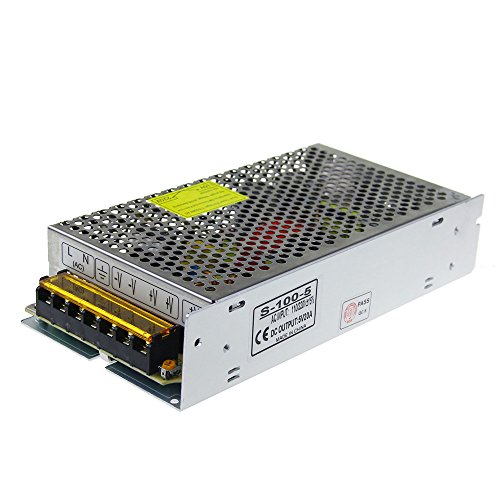
ALITOVE DC 5V Power Supply 20A 100W Transformer

ALITOVE 5V 60A 300W Power Supply LED Driver

JAMECO RELIAPRO DDU050100M2270 Wall Adapter 5V 1A

Herfair 5V 2A USB Wall Charger 2-Pack

ALITOVE 5V 5A Power Supply Adapter 5.5×2.5mm
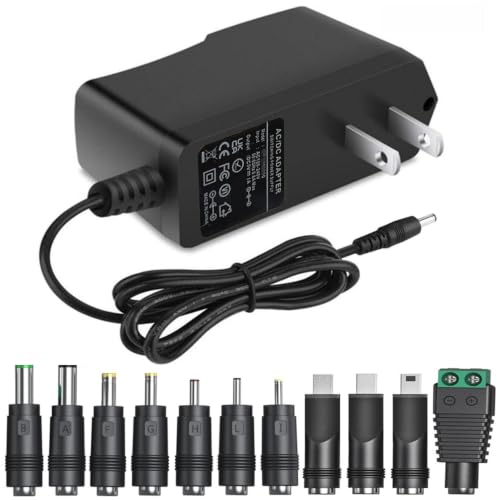
GuanTing 5V 1A Adapter with 11 Plug Tips

UpBright 5V AC/DC Adapter for OttLite Lamps
A Closer Look At Each Pick
Mid-power LED installers who want a silent workhorse tend to gravitate toward this ALITOVE brick. It accepts 110V or 220V AC input and outputs DC 5V at up to 20A (100W), which is enough headroom for a meaningful run of WS2812B pixel strips or several security cameras. The output voltage can be trimmed up to 10%, a useful detail for installations where cable runs cause a slight drop at the far end.
Two output channels let you split the load across separate screw terminals, which keeps wiring neater when a project uses multiple LED zones. Built-in protections include automatic overload, over-voltage, thermal, and short-circuit cut-offs, so the unit should shut itself down before a wiring mistake does permanent damage. Compared to the larger 60A sibling later in this list, this version runs without a fan, which matters in bedrooms or living rooms.
Well-Handled Touches
- Fanless design keeps noise at zero, a real bonus near seating areas or bedrooms.
- Adjustable output voltage (±10%) lets you compensate for voltage sag across long cable runs.
- Two output channels simplify split-zone wiring without extra splitters.
- Quad-layer safety cut-offs (overload, over-voltage, thermal, short-circuit) protect both the supply and connected devices.
- 100W total capacity covers most mid-sized residential LED installations comfortably.
Things To Consider
- The sealed enclosure relies on passive cooling, so owners commonly report leaving clearance around it in enclosed spaces.
- No included mounting hardware, which means planning for a shelf or screw-down location.
Feature Snapshot
Who It Suits Best
DIYers running mid-sized LED pixel projects or a multi-camera CCTV setup who want silent operation and don’t need the absolute highest current.
Consider Something Else When
Anyone planning a long, high-density WS2812B run over a couple of hundred pixels should jump to the ALITOVE 5V 60A 300W Power Supply LED Driver instead, since headroom matters more than silence at that scale.
Bigger LED walls, longer pixel runs, and ambitious art installations run out of juice on smaller bricks. This 300W unit from ALITOVE pushes DC 5V at up to 60A, which is three times the current of the 20A model reviewed above. It accepts 110V or 220V AC input, so it travels between North American and European mains without complaint.
Three independent output channels make it easy to run separate LED strips or cameras from a single supply without busing them all onto one terminal. The built-in cooling fan spins up under load to keep the internals happy, and the same quad-layer safety suite as its smaller sibling shuts things down at the first sign of trouble. Where the 20A version is whisper-quiet, this one trades silence for thermal margin.
Where It Excels
- 300W output handles long pixel strips or multi-camera security racks comfortably.
- Three output channels support clean, separated wiring zones.
- Adjustable output voltage (±10%) compensates for long cable drops.
- Active fan cooling lets it run closer to its rated current without throttling.
Trade Offs
- The internal fan adds audible noise under load, so it’s less ideal for living spaces.
- The chassis runs larger and heavier than mid-power alternatives, requiring solid mounting.
- Overkill for small projects; budget-conscious hobbyists won’t use the headroom.
Right Fit For
Builders tackling high-density WS2812B walls, full-room LED ceilings, or any install where 100W simply won’t cut it.
Look Elsewhere When
A quiet bedroom setup or any project under roughly 100W total draw will do better with the fanless ALITOVE DC 5V Power Supply 20A 100W Transformer reviewed above.
Sometimes the project just needs a clean, reliable wall brick with no fanfare. The Jameco Reliapro DDU050100M2270 delivers DC 5V at 1A (5W), a profile that suits small electronics, hobby circuits, and replacement duties on gear that the original manufacturer no longer ships parts for. It’s manufactured in Taiwan and ships as a bare-bones electronic component rather than a retail-packaged consumer good.
The compact 4-inch wall form factor makes it unobtrusive on power strips, and the single-out design keeps polarity simple for predictable bench setups. Compared to the higher-current ALITOVE drivers reviewed earlier, this is firmly a low-power part meant for breadboards, microcontrollers, and modest peripherals.
Strengths Worth Knowing
- Clean, predictable 5W output is well-matched to microcontroller and sensor projects.
- Wall-mount form factor keeps workspace clutter down.
- From a long-standing electronic components supplier, which suggests consistent build quality.
Honest Caveats
- 1A is the ceiling; any load pulling more will trip or starve the device, so check your project’s draw first.
- Minimal packaging and documentation, expected for an electronic-component listing rather than a retail consumer product.
Quick Facts
Made For
Electronics hobbyists, repair technicians, and engineers who want a dependable low-current 5V source for bench work.
Skip It When
Anyone needing multi-device USB charging on the road should pick the Herfair 5V 2A USB Wall Charger 2-Pack instead, since this adapter lacks USB ports and outputs only 1A.
Frequent flyers and multi-device households want the same brick to work in a hotel room, a kitchen outlet, and a borrowed office socket. The Herfair 2-pack delivers DC 5V at 2A through a USB-A port, and the wide 100–240V AC input means the charger adapts to most global mains without a separate converter. That’s the kind of detail that earns a permanent spot in a carry-on.
Two bricks in the box let you keep one at home and one in a travel pouch, or stage a charger in two rooms at once. The unit is UL listed, which matters to anyone safety-conscious about leaving adapters plugged in unattended. Compared to the bare Jameco wall adapter reviewed above, this one trades raw electronic simplicity for consumer-grade convenience and a USB plug.
What Helps Most
- Wide 100–240V AC input works across most countries without a voltage converter.
- 2A output charges phones and tablets briskly while staying within standard USB power budgets.
- UL listing signals baseline safety certification for unattended use.
- Two-pack format covers home and travel from a single purchase.
Worth Noting
- USB-A only, so newer USB-C-only devices need a cable adapter.
- Cables are not included in the box, so plan on supplying your own.
Feature Card
Best Suited To
Business travelers, students, and anyone running multiple USB-chargeable devices from a single outlet pair.
Not Your Match When
Builders powering LED strips, CCTV rigs, or other DC-barrel projects should look at the ALITOVE 5V 5A Power Supply Adapter 5.5×2.5mm instead, since this brick is a USB charger, not a general DC supply.
Makers and CCTV installers often need a mid-current 5V brick with a standard DC barrel jack instead of screw terminals. This ALITOVE adapter outputs DC 5V at up to 5A (25W), which sits comfortably between the 1A Jameco bench brick and the higher-current LED drivers earlier in this list. It accepts 100–240V AC input, so the same unit works on a US workbench or a European job site.
The 5.5mm x 2.5mm barrel plug is the common CCTV and LED-controller size, and the included screw-on DC female connector lets you wire bare leads without soldering. Built-in protections cover overload, over-voltage, thermal, and short-circuit events, mirroring the safety suite of the larger ALITOVE drivers. The trade-off versus the 20A and 60A siblings is a smaller current ceiling, but for most single-strip or single-camera projects, 5A is plenty.
A Strong Showing
- 5A (25W) output suits a single mid-length LED strip or a small CCTV camera cluster.
- 5.5×2.5mm barrel plug fits the most common CCTV and LED controller inputs.
- Screw-on DC connector eliminates soldering for quick wire terminations.
- Wide 100–240V AC input supports international travel and varied worksite mains.
- Same safety cut-off suite as larger ALITOVE drivers.
Points To Keep In Mind
- Single fixed barrel plug, so non-standard DC jack sizes need an adapter or a different supply.
- 25W ceiling caps the project at roughly one reel of dense pixel LEDs.
Who Should Grab It
Hobbyists and installers who want a plug-and-play 5V source for CCTV cameras, single LED strips, or small maker projects that exceed the 1A Jameco brick’s limits.
Reach For A Different Pick When
Anyone running multi-camera rigs or long LED walls should step up to the ALITOVE DC 5V Power Supply 20A 100W Transformer reviewed earlier in this list.
Houses accumulate orphaned gadgets: baby monitors, Graco swings, Raspberry Pi boards, and oddball routers that all sip DC 5V at varying currents. The GuanTing adapter ships with 11 swappable DC plug tips, which dramatically improves the odds that one fits the forgotten device in the back of a closet. The base output is DC 5V at 1A (5W), with compatible lower-current modes down to 100mA for very low-draw gear.
The 6-foot cable reaches behind furniture without stretching, and the polarity is center-positive (the standard convention, though checking the receiving device is wise). Compared to the fixed-barrel ALITOVE 5A brick reviewed above, this one trades current capacity for tip flexibility, which is the right call when matching a known-low-power mystery gadget.
The Upside
- 11 interchangeable plug tips cover a wide range of legacy DC barrel sizes.
- Compatible current ratings from 1A down to 100mA suit low-draw devices safely.
- 6-foot cord reaches outlets hidden behind furniture.
- Universal 100–240V AC input works across most household mains.
Practical Considerations
- 5W max means it cannot power LED strips, security camera arrays, or other mid-current loads.
- Polarity is fixed center-positive, so any center-negative device will not work even with the right tip.
- For long-term 24/7 use, staying under 80% of rated output (about 800mA) extends the adapter’s life.
Whose Shelf It Belongs On
Households with a drawer full of forgotten 5V gadgets, parents replacing baby-monitor or swing adapters, and tinkerers who want one brick for many small projects.
Swap It Out When
Anyone powering a security camera, LED strip, or Raspberry Pi under load should pick the ALITOVE 5V 5A Power Supply Adapter 5.5×2.5mm instead, since this adapter’s 1A ceiling will starve those devices.
When a niche lamp’s original adapter dies, generic replacements often fry the lamp because the voltage is off by half a volt. This UpBright unit targets OttLite handheld task lamps, including the CDO-007, 290089, 4050, 290G59, ODO-007, 290009, 259WBC, and 29000C models, covering both 4.5V and 5.0V variants of those portable LED lights. It accepts 100–240V AC input, so the same brick works at a US desk or a European hotel.
The package includes two adapters, which is convenient for keeping a spare at the office or replacing a lamp in two rooms. OVP, OCP, and SCP protections guard against over-voltage, over-current, and short-circuit events. The compatibility list is intentionally narrow, and UpBright is explicit that this is not for the 6V, 9V, 12V, 13V, or 13.2V OttLite models, which is the kind of clarity that prevents costly mix-ups.
Good Reasons To Consider
- Wide OttLite model coverage, including both 4.5V and 5.0V lamp variants.
- Two adapters per order covers multiple lamps or a backup location.
- Triple-layer safety protections (OVP, OCP, SCP) suited to unattended lamp duty.
- World-wide 100–240V input travels with international OttLite users.
A Few Limitations
- Strictly for listed OttLite models; even similar OttLite lamps at 6V, 9V, 12V, 13V, or 13.2V will not work.
- Specialty design means it has no useful role beyond the supported lamp lineup.
The Right Fit
Owners of compatible OttLite handheld task lamps who need a reliable replacement adapter without sourcing from the original manufacturer.
A Better Fit Elsewhere
Anyone powering a general-purpose 5V project like an LED strip or a Raspberry Pi should look at the ALITOVE 5V 5A Power Supply Adapter 5.5×2.5mm reviewed above, which is built for broader DC applications.
Picking the Right 5V Supply for Your Build
Voltage is only half the decision; current and form factor matter just as much.
Match Current to the Load, Not the Label
The “5V” in the name is fixed, but the amp rating is the part that determines whether your project runs clean or browns out. As a rule, the listed current is the maximum, and pushing a supply near its ceiling for hours invites thermal shutdown. Add up your load’s rated draw, then size the supply to roughly 1.25x that number for headroom. The 1A Jameco brick reviewed earlier is fine for a microcontroller, but it will starve a multi-camera CCTV rig; that rig wants the 5A ALITOVE adapter or the higher-current LED drivers instead.
Understand the Connector Before You Buy
Most CCTV cameras, LED controllers, and small electronics use a 5.5mm x 2.5mm or 5.5mm x 2.1mm barrel plug (the small cylindrical DC connector with a hollow pin). USB-powered devices need a USB-A or USB-C port. The polarity convention (center-positive versus center-negative) matters too, since reversed polarity damages electronics. The GuanTing adapter reviewed above sidesteps the connector question by including 11 swappable tips, which is helpful when the original plug is unknown.
Choose Open-Frame or Wall-Mount Based on Installation
Open-frame drivers like the ALITOVE 100W and 300W units mount into a project enclosure or sit on a shelf with screw terminals. Wall-mount adapters like the Jameco brick and Herfair USB charger plug directly into an outlet and suit portable or temporary setups. For a permanently installed LED wall or a workshop CCTV hub, open-frame wins; for a kitchen counter phone charger or a hotel-room travel setup, wall-mount is cleaner.
Decide Between USB and Barrel Outputs
USB supplies (like the Herfair 2-pack) are universal but limited to roughly 2A in this category. Barrel-jack supplies (like the ALITOVE 5A adapter) push more current and fit industrial loads. Travelers want USB; makers want barrel; the two rarely overlap cleanly.
Smart Habits Before You Click Buy
Pitfalls Shoppers Hit
The most common slip is underrating the current. A 5V LED strip pulling 60W demands a 12A supply at minimum, and a 1A brick will either trip or burn out. The reverse mistake also happens: buying a high-current supply for a tiny load, which adds cost without benefit. Connector mismatches cause the next-most-frustrating return, so confirm the barrel size (5.5×2.5mm versus 5.5×2.1mm) and the polarity (center-positive versus center-negative) before ordering. Finally, ignoring ventilation turns any open-frame driver into a thermal liability; a few inches of clearance around the unit prevents premature failure.
Where The Extra Money Goes
Higher-tier 5V supplies add active cooling, tighter voltage regulation, and stronger safety cut-offs, which translates into longer life under continuous load. A 60A LED driver costs more than a 5A adapter because the internal transformers, capacitors, and heat sinks are physically larger. For a 24/7 CCTV rack or a long LED installation, that extra cost buys reliability over years, not months. For a temporary or hobby project, a mid-tier 5A or 20A supply is the practical sweet spot.
Frequently Asked Questions
How do I know what current my 5V device needs?
Check the device’s label or original adapter for a current rating in amps or milliamps. Add up the draw if you’re powering multiple items on one supply, then size the adapter with about 25% headroom.
Can I use a higher-current 5V adapter on a lower-current device?
Yes, the device only draws what it needs. A 5A supply powering a 1A load is safe as long as the voltage and connector match.
What’s the difference between a USB wall charger and a DC adapter?
A USB charger outputs through a USB port and is designed for phones, tablets, and small electronics. A DC adapter uses a barrel plug or screw terminals and is built for industrial loads like LED strips or CCTV cameras.
Do these supplies work outside the US?
Most of the picks listed accept 100–240V AC input, which covers North American, European, Asian, and Australian mains. Travelers should still confirm plug shape compatibility with the destination outlets.
How long do open-frame 5V power supplies typically last?
With proper ventilation and operation below the rated current, open-frame drivers commonly run for several years. Continuous operation near the rated ceiling shortens lifespan significantly.
Bottom Line
The right 5V adapter comes down to matching current, connector, and form factor to the project in front of you. Quiet LED installs favor the fanless ALITOVE 100W unit, while serious LED walls need the 300W driver. The Jameco brick fits low-power bench work, the Herfair 2-pack covers travel and family charging, the ALITOVE 5A adapter handles CCTV and mid-size maker projects, the GuanTing kit solves mystery-gadget replacements, and the UpBright adapter restores compatible OttLite lamps. Pick the one that matches your actual load, and skip the rest.
