

I’ve watched too many cart owners wrestle with tired lead-acid banks that lose punch halfway up a hill. A modern 48V lithium battery flips that script, shaving hundreds of pounds, holding voltage under load, and lasting the kind of cycle count that actually justifies the upgrade. The seven picks below cover carts, RVs, trolling motors, and off-grid solar setups, so the right match depends more on your controller and terrain than on raw amp hours alone.
The Essentials At A Glance

Mosasaur 48V 100Ah LiFePO4 Golf Cart Battery w/ Charger

OGRPHY 48V 105Ah Lithium Golf Cart Battery (51.2V)

Mehrpow 48V Lithium Battery Golf Cart Batteries Kit
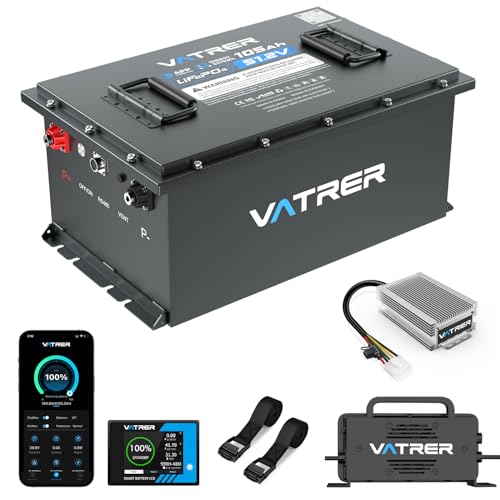
VATRER POWER 48V 105Ah Lithium Golf Cart Battery (UL2271)

DC HOUSE Metal Case 48V 100Ah Lithium Battery Kit

OGRPHY 48V 105Ah Lithium Golf Cart Battery (Solar-Ready)

OGRPHY 48V 100Ah Lithium Battery with Onboard Charger
Meet The Standout Selections
Lead-acid swap-outs can rattle a confident cart owner, since the wiring, dimensions, and terminal layouts rarely line up perfectly with the original bank. Mosasaur sidesteps that anxiety by packaging its 48V 100Ah LiFePO4 (lithium iron phosphate) cell in a case shaped like a traditional lead-acid group, so the swap usually means dropping it into the existing tray and bolting the cables back on. At roughly 77 lb, it’s a single-unit lift rather than a six-pack shuffle, which matters when the install happens at the storage lot instead of a workshop.
Compared with the OGRPHY options further down this list, the Mosasaur trades away some peak surge capability in exchange for a friendlier out-of-box experience: the included 18A charger, the on-unit LCD touch panel, and the Bluetooth app cover most owners’ day-one questions without needing extra accessories.
Positive Takeaways
- Lead-acid-shaped case fits most factory battery trays without modification
- Built-in 200A BMS (battery management system) protects against over-charge, over-discharge, and short circuits
- Dual monitoring through an app and an LCD touchscreen helps track state of charge on the fly
- Charges fully in roughly five hours using the bundled 18A charger
- Rated for 4000+ cycles, comfortably outlasting a typical lead-acid bank
Worth Noting
- 10.24 kW peak is solid for stock carts, but heavily modified high-amp controllers may want more headroom
- At 77 lb the case still requires two hands and a flat spot to set down safely
Key Specs
Who It Suits Best
First-time upgraders moving from a tired 6x8V lead-acid bank who want a near-direct swap with included charging gear.
A Better Fit Elsewhere
Shoppers running high-amp aftermarket controllers should consider the OGRPHY 48V 105Ah Lithium Golf Cart Battery (51.2V), which posts a higher peak current for demanding setups.
OGRPHY’s 51.2V 105Ah pack targets owners who treat their carts less like putt-putt cruisers and more like neighborhood hill climbers. The 200A BMS keeps steady current flowing under heavy throttle, while the 1000A peak window (rated for roughly three to five seconds) covers the launch surge when four adults pile in on a steep ramp. The grade-A prismatic LiFePO4 cells (rectangular hard-case cells, as opposed to soft pouch cells) are matched at the factory, which is why the manufacturer publishes a 10-year lifespan figure rather than the typical five.
Versus the Mosasaur I covered first, this OGRPHY leans into raw output and slightly higher capacity. Where Mosasaur courts the plug-and-play crowd, this one rewards owners who already know their controller’s amp draw and want a battery that won’t blink at it.
What Stands Out
- 1000A peak current for 3-5 seconds handles launch surges without voltage sag
- 105Ah capacity nudges usable range beyond a standard 100Ah pack
- Touch LCD monitor delivers live voltage and state-of-charge readings at the dash
- Manufacturer rates lifespan at 10 years for typical seasonal cart use
Trade Offs
- Larger capacity raises the pack weight, so a second pair of hands helps during install
- Premium positioning can stretch budgets for carts used only on flat paths
Right Fit For
Cart owners tackling hilly neighborhoods, long trail loops, or heavy passenger loads who need sustained high-current delivery.
Look Elsewhere When
Gentle flat-terrain cruisers on a tight budget should look at the Mehrpow 48V Lithium Battery Golf Cart Batteries Kit, which prioritizes cycle count over peak surge.
Mehrpow publishes one of the most generous cycle claims in this category, advertising 10,000+ deep cycles at 80% depth of discharge. That number matters when the cart leaves the garage every morning and returns dusty, because longevity often trumps peak performance for daily commuters and rental fleets. The pack leans on 16 EVE grade-A LiFePO4 cells with matched voltage, which is the kind of detail that helps explain why the cycle figure isn’t pure marketing fluff.
The honest read is that this kit skews toward owners who care more about decade-long value than about LCD touchscreens or app integration. If you’re the type who swaps batteries once and never wants to think about it again, the math works out in Mehrpow’s favor.
Where It Helps
- 10,000+ cycle rating at 80% depth of discharge
- Plug-and-play wiring keeps the install to a single afternoon
- Full 48V 100Ah complete kit format for first-time converters
Points To Note
- Hazardous-materials shipping means freight delivery rather than standard parcel
- Fewer dashboard frills than competitors with built-in LCD panels
- Spec sheet is less transparent than the more thorough OGRPHY listings
Made For
High-mileage daily drivers and rental fleet operators who measure value in years of service rather than dashboard extras.
Skip It When
Owners who want onboard monitoring out of the box should consider the DC HOUSE Metal Case 48V 100Ah Lithium Battery Kit, which ships with both an app and an LCD.
Safety certifications rarely move the needle for casual cart owners, but for anyone storing the battery in a garage, an RV bay, or a fishing-boat console, the UL2271 mark from Intertek is a real differentiator. UL2271 is the standard for light electric vehicle battery systems, covering resistance to overcharge, short circuits, thermal runaway, vibration, and impact. VATRER POWER leans into that credential rather than chasing the highest peak-current number in the category.
For shoppers upgrading a UTV side-by-side or a trolling-motor rig where vibration and impact are daily realities, the third-party-tested build earns a closer look.
Practical Pluses
- UL2271 certification validated by Intertek testing
- 105Ah capacity adds range over a 100Ah pack
- Tested for vibration and impact resilience
Less-Strong Areas
- Peak-current number lands below the OGRPHY 1000A ratings
- Source listing omits some real-time monitoring features found elsewhere
- Hazardous-materials freight applies to this pack as well
Key Specs
Best Suited To
UTV and trolling-motor owners who rack up trail hours and want a documented safety pedigree behind the pack.
Another Choice May Suit
Shoppers who need the highest peak current for steep terrain should step up to the OGRPHY 48V 105Ah Lithium Golf Cart Battery (51.2V) instead.
Most lithium packs ship in plastic or composite cases that shrug off minor bumps but groan at serious trail abuse. DC HOUSE builds around a metal case that shrugs off vibration and debris, which is the kind of detail that matters on a hunting buggy bouncing down a fire road. The included 18A charger, Bluetooth app, and LCD monitor cover the modern convenience checklist, while the 670A peak handles launch surges for most stock and mildly upgraded controllers.
Versus the Mosasaur from pick 1, the DC HOUSE swaps the lead-acid-style shell for a sturdier metal box. Owners running carts over rough terrain are likely to notice the difference sooner than anyone driving smooth pavement.
Where It Excels
- Metal case resists vibration and impact damage better than plastic shells
- Bluetooth app and LCD monitor for at-a-glance telemetry
- 670A peak current covers launch surges on moderately tuned carts
- Kit includes charger, so no separate purchase required
A Few Limitations
- Metal case adds a bit of weight compared to plastic-shelled equivalents
- Peak current trails the OGRPHY 1000A figure
Feature Card
Whose Shelf It Belongs On
Trail and farm owners who punish their carts on uneven ground and need a tougher enclosure than the average pack offers.
Reach For A Different Pick When
Owners chasing the highest peak current for high-amp controllers should pivot to the OGRPHY 48V 105Ah Lithium Golf Cart Battery (51.2V).
OGRPHY’s solar-flavored variant speaks the same electrical language as the 51.2V version I covered earlier, but pairs it with a slightly different accessory bundle aimed at off-grid owners. The 200A BMS delivers up to 1000A peak current, and the included touch monitor plus mobile app cover the data dashboard needs of anyone running solar charge controllers. Compatibility with major golf-cart controllers means the swap rarely requires firmware changes or adapter harnesses.
For off-grid cabins, the 105Ah capacity acts as a sensible buffer bank, and the 4000+ cycle rating keeps the math reasonable over a long service life.
Notable Upsides
- Built-in touch monitor and mobile app for real-time state-of-charge tracking
- 105Ah capacity buffers solar charging for cabins and off-grid setups
- 1000A peak current covers most aftermarket controller demands
- Compatible with major golf-cart controllers without rewiring
Where It Is Less Suited
- Two OGRPHY listings can confuse first-time shoppers comparing similar SKUs
- Solar-tagged positioning adds features some cart-only owners won’t use
Feature Card
Built With In Mind
Off-grid solar users who want one battery that doubles as a golf-cart pack and a small cabin buffer bank.
Swap It Out When
Pure cart owners not running solar should compare against the VATRER POWER 48V 105Ah Lithium Golf Cart Battery (UL2271) for its third-party safety certification.
An onboard charger turns a lithium upgrade into a more appliance-like experience: pull the cart into the garage, plug a single cord into a wall outlet, and let the pack top itself off. OGRPHY’s 5.12 kWh pack pairs an 18A charger with the familiar 200A BMS and 1000A peak figures from the brand’s other variants, all without demanding a separate charger box cluttering the floor.
For owners who don’t want to keep a portable charger in the trunk, the integrated approach cleans up the install considerably. Compare it to the Mosasaur I opened with, and the difference is essentially where the charger physically lives.
What Earns Its Place
- Onboard 18A charger eliminates a separate accessory in the garage
- 5.12 kWh capacity handles a typical 18-hole loop plus margin
- 1000A peak current handles launch surges on most stock and tuned carts
- 5,000+ cycle rating backed by grade-A cell construction
Honest Caveats
- Onboard charger adds weight compared with a separate unit
- If the onboard charger fails, repair is more involved than swapping an external brick
Who Should Grab It
Garage-charging owners who prefer a single-cord routine over hauling a portable charger between storage spots.
Where A Sibling Pick Shines
Cart owners who want better documented safety certification should pivot to the VATRER POWER 48V 105Ah Lithium Golf Cart Battery (UL2271).
What To Weigh Before Picking A 48 Volt Lithium Battery
Capacity, Voltage, And Real-World Range
Amp-hour ratings translate into roughly 5 kWh of usable energy on a 48V 100Ah pack, which covers most 18-hole loops with room to spare. Riders running hilly courses, four-passenger setups, or accessories like headlights and heaters will feel the difference between a 100Ah and a 105Ah pack more than casual flat-path cruisers will. Capacity also matters for solar and trolling-motor users, where the battery doubles as a buffer bank between sun and load.
BMS Ratings And Peak Current
The BMS is the brain inside the pack, governing how much current flows, when cells balance, and what happens during a fault. A 200A BMS handles stock and lightly tuned controllers without tripping. Heavy amp draws from aftermarket controllers, steep launches, or regenerative braking spikes call for higher peak-current ratings like the 1000A figure on several OGRPHY variants.
Safety Certification And Cell Quality
LiFePO4 chemistry is intrinsically more stable than older lithium-ion formulas, but cell matching still varies between manufacturers. Look for grade-A prismatic cells and third-party certifications like UL2271 when the battery lives in vibration-prone environments. Documentation of cycle life and matching procedures matters more than marketing cycle counts.
Form Factor, Weight, And Charging
Lead-acid-shaped cases simplify the swap, while metal or reinforced enclosures handle trail abuse better. Bundled chargers shorten the install, and onboard charging streamlines the daily routine for garage keepers. Lithium cuts roughly 70% of the weight of a comparable lead-acid bank, which alone transforms how a cart handles hills and rough ground.
Key Considerations Across These Picks
Pitfalls Shoppers Hit
A common stumble is assuming a higher amp-hour rating fixes every range complaint, when controller draw and terrain quietly drain the pack regardless. Another is buying on cycle count alone without checking that the BMS can handle the controller’s amp draw. Wiring and charger compatibility get overlooked too, since not every bundled charger matches every existing outlet routine.
What The Higher Tier Buys
Premium tiers typically fund better cell matching, third-party safety testing, and onboard monitoring hardware rather than raw capacity bumps. The upgrade usually pays off for tuned carts, off-grid solar users, and owners who want documented safety margins. For flat-path neighborhood cruisers on modest budgets, a mid-tier pack like the Mehrpow covers the essentials without the extras.
Frequently Asked Questions
How long does a 48V lithium battery typically last?
Most LiFePO4 packs in this category are rated for 4,000 to 10,000 cycles depending on depth of discharge, which often translates into 8-10 years of seasonal cart use before meaningful capacity loss. Real-world lifespan depends on charging habits, climate, and how deeply the pack is discharged on a typical day.
Can I swap a 48V lithium battery into a stock lead-acid cart without rewiring?
Most drop-in packs in this list, including the Mosasaur and DC HOUSE kits, fit standard lead-acid trays and use the existing cable terminals. Owners should still verify terminal orientation and check that the onboard charger or cart charger matches the lithium chemistry before completing the swap.
Are these lithium batteries safe to charge indoors?
LiFePO4 chemistry is significantly more thermally stable than older lithium-ion formulas, and many packs in this list ship with chargers rated for enclosed spaces. Charging in a ventilated area and avoiding damaged cables remains sensible practice regardless of chemistry.
Do I need a special charger for a 48V lithium golf cart battery?
Yes, lithium chemistry requires a charger profile matched to LiFePO4 voltage curves rather than lead-acid equalization modes. Every pack in this roundup ships with a compatible 18A charger, which removes the guesswork for first-time upgraders.
Will a 48V lithium battery work for solar storage or trolling motors?
Several packs on this list, particularly the OGRPHY solar-ready variant, are sized and rated for solar buffer duty and trolling-motor draw. Owners should confirm the BMS continuous rating matches the motor’s amp draw before committing to a pack for marine use.
Closing Thoughts
Pick the battery that aligns with your controller, terrain, and charging routine, and the rest of the upgrade tends to take care of itself. The Mosasaur is the friendliest first step for most cart owners, while the OGRPHY options cover demanding terrain and solar users. Match the pack to the way the cart actually gets used, and the upgrade pays back in smoother drives and fewer battery headaches for years to come.
