

A 400-watt inverter turns a 12V vehicle battery into household-style AC power, which is exactly the range most commuters, campers, and weekend DIYers actually need. Run a laptop, charge camera batteries, power a small fan or a CPAP machine, or keep a string of work lights going at a remote jobsite. In this list I focused on models that stay cool under load, deliver pure sine output where sensitive electronics matter, and ship with the cabling and protections you’d want from day one.
The Choices Worth Comparing

Renogy Inverter P2 1000W Pure Sine Wave Inverter 12V DC to 120V AC

Renogy Inverter P2 2000W Pure Sine Wave Inverter 12V DC to 110V AC

Renogy Inverter PUH 1000W Pure Sine Wave Power Inverter

Cummins CMN400 400 Watt Car Inverter DC 12V to 110V AC

Whistler PI-400W 400 Watt Power Inverter
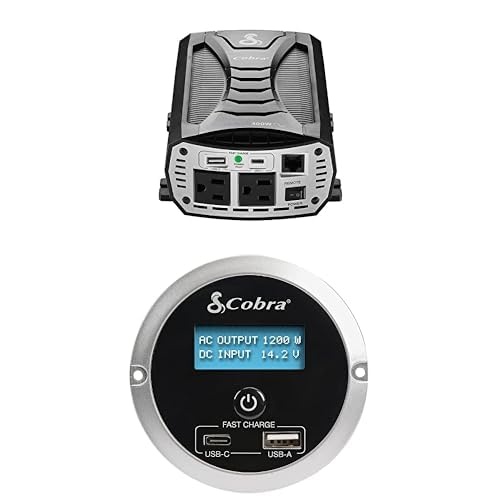
Cobra CPI400PSW Pure Sine Portable Power Inverter
More On The Choices That Made The List
The Renogy P2 sits in that comfortable middle ground where most off-grid beginners land. It pushes a continuous 1000W from a 12V battery source, with a 2000W peak surge (peak surge is the brief burst an inverter can deliver when a motor-driven appliance first spins up) for tool and compressor startups, and the pure sine output means sensitive electronics like laptop chargers and audio gear run cleanly. In a weekend cabin or a small backup closet, that combination tends to cover most of the actual load without forcing you into commercial territory.
Compared to the smaller 400W units further down this list, the Renogy has real headroom, which matters the moment someone plugs in a small microwave or a shop vac. LED indicators across the front flag under-voltage, over-voltage, over-temperature, overload, and short-circuit events before they become damaging, and the included remote controller is genuinely useful when the inverter lives under a bench.
Why It Works Well
- Pure sine output keeps laptops, chargers, and audio gear running without buzzing or heat issues.
- 1000W continuous with 2000W peak handles typical small appliances and inductive loads (devices with motors, like fans or pumps, that draw a startup surge).
- Built-in 5V/2.1A USB port charges phones and tablets directly without needing a wall adapter.
- Hardwire terminal lets a tidy installation feed a sub-panel or a few dedicated outlets.
- Cooling fan and protective shutdowns reduce the chance of thermal damage during long sessions.
Things To Consider
- The unit is heavier than 400W competitors, so mounting location matters more than with compact models.
- No Bluetooth monitoring; status reads from the front panel or the wired remote only.
Made For
Cabin owners and RV travelers building a permanent 12V-to-120V setup who want genuine headroom over the 400W class.
Skip It When
The Cobra CPI400PSW makes more sense for someone who only needs pure sine output in a smaller, plug-and-play form factor.
The 2000W sibling doubles the continuous output of the unit above it, and that step up matters when the load list includes a small induction cooktop, a residential fridge in an RV, or a heavier shop tool. The 4000W peak surge covers compressor startups without tripping, and the same pure sine waveform applies, so anything plugged in stays happy.
This is the model to look at when a truck sleeper cab, a tiny home, or an off-grid workshop has outgrown the 1000W class. The trade-off is current draw from the battery bank, which means heavier gauge wiring and a battery that can actually sustain the load. In most cases, expect this to live next to a lithium bank rather than a single starter battery.
Where It Excels
- Continuous 2000W supports induction cooking and small residential-style appliances.
- 4000W peak surge handles motor startups without nuisance shutdowns.
- Hardwire terminal plus AC outlets offer flexible install layouts for permanent builds.
- Protective LED indicators help catch wiring or battery faults early.
Trade Offs
- Heavier and bulkier than 400W competitors, so vehicle installs need solid mounting.
- Requires a battery bank that can deliver sustained high current, not just a single 12V starter.
- Cooling fans run more often under heavy load, which adds audible noise indoors.
Best Suited To
Full-time RVers and tiny-home dwellers running real household appliances from a 12V battery bank.
Look Elsewhere When
Most daily driving fits the Cummins CMN400 better, since 2000W of inverter is overkill for laptop and phone charging alone.
The PUH version adds two features the standard P2 does not have: a built-in UPS transfer switch (an automatic switchover that keeps power flowing when grid or shore power drops out) and Bluetooth monitoring. For an off-grid cabin with intermittent shore power, that automatic switchover from battery back to AC mains is genuinely useful, since electronics stay live without manual intervention.
The Renogy app then surfaces battery voltage, load wattage, and fault codes on a phone, which simplifies troubleshooting in tight install spaces. Where the basic P2 forces you to walk to the inverter and read LEDs, this one tells you what’s happening from inside the house. That said, the Bluetooth module only pairs with the Renogy ecosystem, so anyone outside that app environment loses most of the smart benefits.
Reasons It Performs
- Built-in UPS transfer switch keeps loads running during shore-power dropouts.
- Bluetooth monitoring shows real-time voltage, load, and fault data on a phone.
- Pure sine output protects sensitive electronics from waveform noise.
- 2000W surge capacity handles typical motor-driven startup loads.
Honest Caveats
- Bluetooth features depend on the Renogy app and ecosystem support.
- Priced above the standard P2 for features that not every install will use.
Quick Facts
Whose Shelf It Belongs On
Solar system owners who want app-based monitoring and automatic switchover from a single unit.
Swap It Out When
The Renogy Inverter P2 1000W is the better value for installs that don’t need Bluetooth or a transfer switch.
The Cummins CMN400 is the kind of unit that lives in a glove box or a center console and only comes alive when someone needs to charge a laptop at a rest stop. It pushes a true 400W continuous from a vehicle’s 12V system, and the full cable kit (36-inch positive, negative, and ground leads) means it can be hardwired for a cleaner install rather than relying solely on a cigarette-lighter plug.
The two AC outlets are useful when two people both need to plug in, and the USB-A plus USB-C ports cover the phone-and-tablet side of things without dragging out a wall adapter. In our view, the modified sine output (a stepped waveform that approximates AC but can cause noise or heat in delicate electronics) is the honest trade-off here, since it’s not the cleanest waveform for medical gear or audio equipment, but it’s fine for most laptop chargers and small consumer electronics.
Points In Its Favor
- Two AC outlets handle two devices at once, useful for passenger-and-driver setups.
- USB-A plus USB-C ports charge modern phones without extra adapters.
- Full wiring kit included, so a hardwired install is possible right out of the box.
- Compact size fits under a seat or inside a small storage bin.
A Few Limitations
- Modified sine output may cause audible buzz in some chargers and sensitive electronics.
- 400W ceiling limits what you can actually run at once.
Right Fit For
Commuters and road-trippers who want a simple, all-in-one inverter with USB ports for daily device charging.
Not Your Match When
The Cobra CPI400PSW is a better pick for users running CPAP machines, medical pumps, or other electronics that need pure sine output.
The Whistler PI-400W is a stripped-down workhorse built around one job: plugging into a cigarette lighter and powering small loads on the road. Continuous 400W with 800W peak is enough for laptop chargers, camera battery chargers, and small fans, and the cooling fan kicks in only when the load demands it.
Electronic circuit protection covers overload, short-circuit, and thermal events, which is reassuring for a unit that often ends up buried under a seat. Battery cables are included for users who want a direct connection, and the lighter-plug path means anyone can install it without touching the vehicle wiring. The honest read is that this is a basic, no-frills unit; it lacks USB ports, modern surge handling, and app features, but it covers the essentials.
Practical Pluses
- Cigarette-lighter plug means zero-install setup for casual users.
- Includes battery cables for direct-to-battery hookup when needed.
- Electronic protection against overload, short-circuit, and heat.
- Lightweight and compact for stashing in a glove box or door pocket.
Points To Note
- No USB ports, so phones and tablets still need a wall adapter.
- Modified sine waveform may bother some laptop chargers and audio gear.
Who Should Grab It
Budget-focused shoppers who need a simple plug-and-play inverter for short trips and light electronics.
Consider Something Else When
The Cummins CMN400 is a smarter buy if USB-C charging and dual AC outlets matter for daily use.
The Cobra CPI400PSW delivers pure sine output in a compact 400W chassis, which puts it in a useful middle ground between the heavier Renogy units and the lighter modified-sine competition. The two grounded AC outlets plus two fast-charge USB ports cover most road-warrior setups, and the included remote controller lets the unit hide under a seat while still being controllable from the cab.
Where this unit pulls ahead is waveform quality. Sensitive electronics, including CPAP machines, audio interfaces, and modern laptop chargers with active PFC (power factor correction, a circuit that improves charging efficiency but demands clean AC), run cooler and quieter on pure sine than on a modified sine signal. Four mounting options also help in tight installs, from under a console to behind a seat. The trade-off is that pure sine hardware costs more than a basic modified sine unit, so budget shoppers may still lean toward the Whistler.
The Good Stuff
- Pure sine waveform protects medical and audio gear from noise and heat.
- Remote on/off controller adds convenience when the inverter is mounted out of reach.
- Two grounded AC outlets plus two fast-charge USB ports reduce the need for adapters.
- Multiple mounting options suit vehicle, RV, and boat layouts.
Where It May Fall Short
- Pure sine hardware costs more than modified sine units of the same wattage.
Perfect Match For
Pro drivers, overlanders, and medical-device users who need clean AC from a 400W-class inverter.
Another Choice May Suit
The Renogy Inverter PUH makes more sense for users needing higher continuous wattage with smart monitoring features.
Picking The Right 400W Class Inverter For Your Setup
Match Waveform To The Load
Modified sine units cost less and handle simple loads like laptop bricks and fan motors just fine. Pure sine units produce a cleaner waveform that sensitive medical and audio gear actually needs. CPAP machines, modern laptop chargers with active PFC, and any device with a small variable-speed motor will run cooler and last longer on pure sine. For a once-a-week camping inverter powering string lights, modified sine is fine; for nightly CPAP use, pure sine is worth the upgrade.
Size The Battery To The Draw
A 400W inverter pulling full load from a 12V source draws around 35 amps continuously, and that current adds up fast. A small vehicle starter battery will run down within an hour or two at full draw, so deep-cycle or lithium battery banks are the realistic match. Cable gauge matters too: longer runs need heavier wire to avoid voltage drop (the loss of voltage that happens when electricity travels through undersized wire, causing dim lights or underperforming tools) that triggers the inverter’s low-voltage cutoff.
Think About Install Location
Heat is the enemy of inverter longevity, so a spot with airflow beats a sealed compartment every time. Cigarette-lighter plug models like the Whistler PI-400W go anywhere with a socket, while hardwire-capable units like the Cummins CMN400 and the Renogy P2 series need a planned mounting spot near the battery. Removable displays and remote controllers, like the Cobra CPI400PSW includes, make hidden installs far more usable day to day.
Plan For Protections And Certifications
Look for low-voltage shutdown (so the inverter cuts off before it drains the battery completely), over-temperature protection, and short-circuit protection at a minimum. These features keep the unit, the wiring, and the battery safe when something goes wrong, and they’re standard on every pick in this list. For permanent installs, a fuse or breaker close to the battery is non-negotiable.
Key Considerations Across These Picks
Pitfalls Shoppers Hit
Treating wattage as the only spec leads to disappointment when the waveform, the cooling design, or the cable kit isn’t right for the use case. A modified sine unit can power a fan and a laptop, but it may buzz or overheat a sensitive medical device, and that’s not the inverter’s fault, it’s a mismatch. Read the load list, then match the waveform.
Where The Extra Money Goes
Higher-tier pure sine hardware uses better filtering and tighter output regulation, which is what lets a CPAP machine or an audio interface run reliably. Build quality also improves with cooling fans, sturdier housings, and more robust internal components that survive daily mobile use. The premium is justified for nightly or professional use; for occasional camping, the savings on a modified sine unit often make more sense.
Frequently Asked Questions
What Can A 400 Watt Inverter Run?
A 400W inverter can run laptop chargers, camera battery chargers, small fans, phone and tablet chargers, and some low-wattage CPAP machines. It will not run a hair dryer, a microwave, or a standard space heater, since those draw far more than 400W.
How Long Will A 400W Inverter Run On A Car Battery?
At full 400W draw, a typical car battery (around 50Ah usable capacity) will last roughly one to two hours before the inverter’s low-voltage cutoff kicks in. Deep-cycle or lithium batteries stretch that significantly and handle repeated deep discharges better than starter batteries.
Is Pure Sine Necessary For A Laptop?
Most modern laptop chargers work on modified sine, but some active-PFC chargers run hotter or behave erratically. CPAP machines, audio interfaces, and anything with a small variable-speed motor benefit noticeably from pure sine output.
Can A 400W Inverter Damage A Car Battery?
Running a vehicle’s alternator while using the inverter prevents deep discharge, but extended use with the engine off can drain a starter battery below the point where it can restart the car. A deep-cycle battery or a battery monitor prevents that scenario.
Are Hardwire And Cigarette-Lighter Connections Equally Safe?
Both are safe when installed properly. A cigarette-lighter plug is limited by the socket’s fuse (often 10 to 15 amps), so heavy loads need a hardwired connection with an appropriately fused cable run directly to the battery.
Bottom Line
The right 400W-class inverter depends on what you actually need to power and where. Daily commuters and casual campers get plenty of value from a compact modified sine unit like the Cummins CMN400 or the Whistler PI-400W. Anyone running medical gear, audio equipment, or sensitive electronics benefits from the pure sine output of the Cobra CPI400PSW. For permanent off-grid installs, the Renogy P2 line scales up to 1000W or 2000W with the surge capacity that real household loads demand.
