

A dead battery on a motorcycle that’s been sitting through winter, or a classic car that only sees sunny weekends, can ruin plans faster than anything else in the garage. I’ve been there: that sinking feeling when the key turns and nothing happens. A good 12v charger is the kind of tool that quietly earns its shelf space, keeping powersports batteries topped off through storage without overcooking them. The seven models below cover everything from tiny maintainers for a single bike to serious chargers that can wake up larger batteries, and each one fits a slightly different garage routine.
An Overview Of The Picks

Battery Tender Junior 12V, 750mA Charger and Maintainer
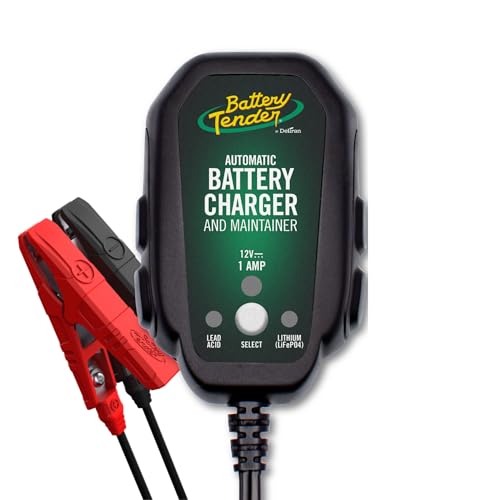
Battery Tender Junior 12V, 800mA Battery Charger and Maintainer

Battery Tender Plus 12V 1.25 AMP Battery Charger and Maintainer

Battery Tender Plus 12V 1.25 AMP Battery Charger and Maintainer

NOCO GENIUS1 1A 6/12V Smart Battery Charger

NOCO GENIUS10 10A 6/12V Smart Battery Charger

NOCO GENIUS5 5A 6/12V Smart Battery Charger
The Strengths Of Each Pick
The original Battery Tender Junior is the model most people picture when they think of a small “leave it connected all winter” maintainer, and that reputation is earned. Its 750mA output is gentle enough that I wouldn’t worry about walking away for weeks at a time on a motorcycle or ATV battery that just needs to stay topped off.
It runs a four-step charging cycle: initialization, bulk charge, absorption, then float mode. The float stage is the part that matters long-term: once the battery is full, the unit idles down to a maintenance voltage so it isn’t slowly boiling the cells dry. For someone storing a bike through a snowy off-season, that hands-off behavior is exactly what a charger needs to do.
Reasons It Performs
- Four-step program (initialization, bulk, absorption, float) keeps batteries topped off without manual babysitting.
- Works with flooded, AGM, and gel cell lead-acid batteries, covering the vast majority of powersport setups.
- Compact brick that tucks into a saddlebag or shop drawer between uses.
- Float-mode handoff means owners commonly leave it connected for weeks or months at a stretch.
Things To Consider
- 750mA is too slow to recover a deeply discharged battery in any reasonable window.
- Lead-acid only, so lithium owners will want the 800mA Junior covered next.
Who It Suits Best
First-time owners parking a motorcycle, scooter, or ATV for the off-season and wanting a plug-and-forget option.
Where Another Pick Suits Better
Anyone running lithium batteries should step up to the Battery Tender Junior 12V, 800mA model covered next.
The 800mA Junior looks nearly identical to the original, but it quietly fixes the chemistry gap. A button on the housing lets the user flip between lead-acid profiles and lithium iron phosphate, which is a real advantage if a garage holds a mix of bikes, lawn tractors, and modern lithium-equipped machines.
For most households running mixed-fleet storage, that switch matters more than the bump from 750mA to 800mA. The internal microcontroller manages the chosen profile automatically, so the user doesn’t have to think about voltages once the right mode is selected at the bench.
A Few Highlights
- Push-button chemistry selection covers AGM, flooded, gel, and LiFePO4 lithium.
- Automatic ISM-controlled charging transitions into a safe maintenance state when full.
- Same small footprint as the original Junior, making it easy to mount near a bike or tuck on a shelf.
- Useful for households slowly transitioning older bikes to lithium without buying separate chargers.
Worth Noting
- 800mA still feels slow reviving a deeply discharged battery, so it’s mainly a maintainer with light charging duties.
- Switching modes requires reading the manual first; selecting the wrong chemistry can confuse less experienced owners.
Feature Snapshot
Made For
Garages and small shops that need one charger to handle both lead-acid and lithium batteries.
Consider Something Else When
Owners looking for higher current to wake up larger batteries will be happier with the NOCO GENIUS10 covered further down.
Step up from the Junior line and you land on the Battery Tender Plus, which moves from 750mA to a full 1.25 amps. That doesn’t sound dramatic, but it shortens the bulk-charge phase noticeably on car and ATV batteries, which the smaller units dawdle on.
The same four-step adaptive logic still does the heavy lifting, so the charger adapts to whatever state the battery arrives in. In a home garage that sees a daily-driven car alongside weekend-only toys, that flexibility is the real story: one tool handles both roles without forcing the user to swap units.
Everyday Advantages
- 1.25A output reaches a usable charge faster on cars, lawn tractors, and ATVs than the Junior line.
- Adaptive charging reads battery condition and adjusts the program accordingly.
- Float-mode handoff keeps topped-off batteries safe during long storage.
- Compatible with flooded and AGM batteries, the two most common types in this category.
Trade Offs
- Still not a lithium-compatible unit, so newer LiFePO4 setups need a different model.
- Bulkier than the Junior, which may matter for riders wanting a tiny saddlebag-friendly charger.
Right Fit For
Shoppers maintaining a mixture of powersports vehicles and small automotive batteries from a single outlet.
Skip It When
Anyone wanting more output and lithium support should look at the NOCO GENIUS10 later in this list.
This is the California-compliant variant of the Battery Tender Plus, built with the same 1.25A output but engineered to meet stricter energy regulations. For shoppers in regulated states, that compliance removes any hesitation about long-term use on the garage shelf.
The internal algorithm is the same adaptive logic that made the Plus popular, which means charging behavior feels predictable and well-tested across AGM and flooded batteries. Users in regions with stricter efficiency rules can plug this in without worrying about the unit pulling more power than it should.
Where It Delivers
- California-compliant design meets energy efficiency rules where they apply.
- 1.25A charging rate handles car, motorcycle, and ATV batteries competently.
- Float-maintenance mode protects stored batteries without overcharging.
- AGM and flooded compatibility covers most lead-acid setups found in older vehicles.
Points To Note
- Lead-acid only; lithium batteries need the 800mA switchable Junior instead.
- Compliance focus adds no functional advantage for users outside regulated regions.
Best Suited To
Shops and homeowners in California and other regulated states who want a familiar Plus-style maintainer.
Look Elsewhere When
Shoppers wanting lithium support or higher current output should consider the NOCO GENIUS5 covered later.
The GENIUS1 is the smallest NOCO of the bunch, and it’s the one I’d grab for motorcycles, lawn gear, and classic cars. It handles both 6V and 12V batteries, which is genuinely useful for vintage vehicle owners who still run older six-volt systems.
One nice touch is its compatibility with lithium-ion LiFePO4 batteries alongside the usual lead-acid chemistries. For a small, do-everything maintainer that lives on a workbench and connects to whatever happens to be flat, the GENIUS1 punches above its 1A rating.
Notable Gains
- Dual-voltage 6V and 12V support opens up classic car and tractor use.
- Works with flooded, gel, AGM, deep-cycle, and lithium-ion batteries.
- Smallest NOCO body, easy to mount in tight garage spaces.
- Functions as both charger and long-term maintainer.
Minor Gripes
- 1A output is slow on larger automotive batteries.
- Six-volt compatibility is a real plus, but only matters to specific owners.
Feature Snapshot
Perfect Match For
Owners with a mixed stable of vintage and modern vehicles who want a compact bench-friendly charger.
Reach For A Different Pick When
Bigger batteries or faster recovery are priorities, in which case the NOCO GENIUS10 is a better match.
Where the GENIUS1 dabbles, the GENIUS10 commits. Ten amps is genuinely high-output territory for a smart charger, and it’s enough to wake up larger car, truck, and marine batteries without leaving them hooked up overnight.
The added features matter too. Overcharge protection and temperature compensation keep the charging voltage sane in hot summer garages and cold winter ones. The force mode gives the user a manual override for deeply discharged batteries that won’t accept a normal charge on their own.
Real Benefits
- 10A output handles larger batteries up to about 230 amp-hours without dragging the process out.
- Built-in desulfation helps recover batteries that have sat unused long enough to sulfate.
- Force mode lets experienced users manually start deeply discharged batteries.
- Temperature compensation adjusts output for hot and cold environments.
Honest Caveats
- Bulkier than 1A or 1.25A models, so it wants a real spot on the bench.
- More expensive than entry-level maintainers, which may be overkill for simple seasonal storage.
Who Will Love This
Garage enthusiasts with car-sized batteries, marine applications, or neglected batteries worth reviving.
Swap It Out When
Smaller motorcycles and powersports-only owners will find the NOCO GENIUS1 a more practical size.
The GENIUS5 sits right between the GENIUS1 and GENIUS10, and that middle position is its real strength. Five amps is enough to wake up most car batteries in a reasonable window without the bulk, cost, or amperage of the bigger unit.
It keeps the same 6V and 12V flexibility, plus the same lead-acid and lithium-ion chemistry support as the rest of the GENIUS line. For most people maintaining a daily driver and a weekend toy, the GENIUS5 handles both without owning two separate chargers.
Noteworthy Benefits
- 5A output strikes a usable balance between charging speed and physical size.
- Dual 6V/12V compatibility covers classic and modern vehicles.
- Lead-acid and lithium-ion support future-proofs the purchase.
- Functions as charger, maintainer, and desulfator in one unit.
Potential Drawbacks
- Slower than the GENIUS10 for very large batteries.
- Costs more than the small Junior models while doing less peak work than the GENIUS10.
Built With In Mind
Shops and homeowners wanting one versatile charger that handles both maintenance and mid-size battery recovery.
A Better Fit Elsewhere
Powersports-only owners on a tighter budget will get more value from the Battery Tender Junior 750mA model.
What To Weigh Before Choosing a 12v Battery Charger
Match the Charger to the Battery Size
A 750mA maintainer feels right on a motorcycle but barely moves the needle on a depleted truck battery. Output current is measured in amps, and it determines how quickly the unit delivers charge. Small batteries under about 20 amp-hours are well-served by sub-1A maintainers. Mid-size automotive batteries around 50 to 100 amp-hours benefit from 5A to 10A units. Picking a charger that can’t deliver enough current means long charge times and frustration.
Consider Battery Chemistry Compatibility
Lead-acid batteries come in flooded, AGM, and gel variants, each with slightly different charging voltages. Lithium iron phosphate, often labeled LiFePO4, has its own profile entirely. Chargers that support multiple chemistries include a switch or auto-detect feature, and they’re worth the small premium for mixed-fleet garages. Owners running lithium should specifically confirm LiFePO4 support before buying.
Look for Float or Maintenance Mode
A pure trickle charger just keeps pushing current, which over time damages batteries. Smart chargers include a float mode that drops to a maintenance voltage once the battery is full. This single feature is what separates a charger I trust to leave connected for months from one I unplug after every use.
Plan for Storage and Mounting
A garage shelf is rarely tidy. Chargers with longer integrated leads and accessible ring-terminal or alligator-clip connectors tend to get used more often because setup is faster. Wall-mountable units are worth considering for permanent shop installations where the same battery gets topped off every week.
Common Shopping Slip Ups and Smart Upgrades
Pitfalls Shoppers Hit
The biggest one is buying the cheapest trickle charger and expecting it to do smart-maintainer work. Continuous current with no float stage slowly degrades batteries, so a slightly pricier smart unit pays back in battery life. Another mistake is ignoring chemistry compatibility and ending up with a lead-acid-only charger that can’t safely service a lithium setup.
Where The Extra Money Goes
Higher-output chargers justify their cost through faster recovery, multi-chemistry support, and added features like desulfation and temperature compensation. Owners of larger batteries or neglected vehicles see real value here, while owners storing a single small bike through winter get everything they need from an entry-level maintainer. The upgrade pays off when the use case involves variable battery types or sizes, not when a single small battery is the only job.
Frequently Asked Questions
Can a 12v charger be left connected indefinitely?
Smart chargers with float-mode maintenance are designed for long-term connection. The unit drops to a lower voltage once the battery is full, keeping it topped off without overcharging. Entry-level trickle chargers without this feature should not be left connected for weeks at a time.
What’s the difference between a charger and a maintainer?
Chargers actively push current to refill a depleted battery. Maintainers keep an already-charged battery at full capacity during storage. Many modern smart units, including several on this list, combine both functions in one device.
Do lithium batteries need a special charger?
Yes, lithium iron phosphate batteries use different charging voltages than lead-acid types. Chargers labeled LiFePO4-compatible include the correct profile, and using a lead-acid-only charger on lithium can damage the cells or shorten their lifespan.
How long does it take to charge a dead battery?
Charging time depends on battery size and charger output. A deeply discharged motorcycle battery might recover overnight on a 1A maintainer. A car battery on a 10A unit can move from flat to functional in a few hours. Larger or deeply sulfated batteries take longer.
Is a higher-amp charger always better?
Not always. More current speeds up charging but adds bulk and cost. For a single small motorcycle battery, a high-amp charger is overkill. For a large automotive or marine battery, low amperage means painfully slow charging. The right size depends on what battery the charger will service most often.
Closing Thoughts
The right 12v battery charger comes down to matching output, chemistry support, and maintenance behavior to the batteries on hand. A small motorcycle fleet wants a gentle maintainer, while a varied garage benefits from a smarter, higher-output unit. Pick the model that fits the actual workload, and the rest of the storage season takes care of itself.
