

Clean power distribution is the difference between a tidy install and a tangled mess of wires. I’ve seen rigs where every accessory runs back to the battery, leaving no room to trace a fault. A solid 12 volt distribution block pulls those branches together, gives each circuit its own home, and makes future work far less painful.
Whether you’re wiring a car audio build, a boat’s accessory panel, or a solar battery bank, the right block saves headaches. The seven below cover everything from compact two-way splitters to heavy-duty marine-rated bars, so you’ll know what fits your setup before you open the toolbox.
Your Options, Compared

DAIERTEK 12V Bus Bar 6 x M8 Studs Power Distribution Block

DAIERTEK Mini Bus Bar 150A with Cover 4 x 5/16″ Posts

DaierTek 300A Marine Bus Bar 6 x M10 Studs with Cover
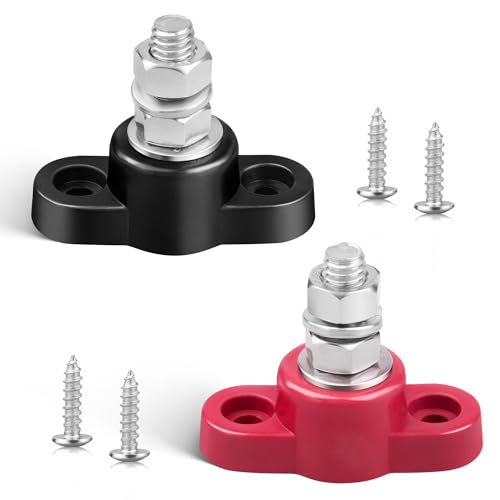
RED WOLF 12V 150A Single Stud Busbar M8 Terminal (2PC)

Joinfworld 12V Car Audio 2-Way Ground Distribution Block

Joinfworld 12V 250A Bus Bar 4 x 5/16″ Studs Marine

150A 12V Bus Bar with 4 M8 Studs, Lugs & Heat Shrink
A Deeper Look At The Lineup
The DAIERTEK 12V bus bar lands as a versatile mid-sized option for anyone building out a vehicle or solar setup that won’t stay tiny for long. Six M8 (5/16″) terminal studs on each block give you room to branch out accessories like lights, fans, amplifiers, or charge controllers without crowding the terminals.
It ships as a positive and negative pair, and each unit is rated for 150A continuous DC with a 48V ceiling. Compared to the smaller four-stud models later in this list, this one feels like the sweet spot for most DIYers who want a little headroom without jumping to a 300A marine unit.
Where It Helps
- Six studs per bar accommodate a growing accessory list, so early builds don’t run out of room.
- 150A DC continuous rating covers most car audio, marine, and solar battery setups comfortably.
- Includes a protective cover that limits accidental contact with live terminals in cramped engine bays.
- Round-corner base design tends to sit flush on flat panels, simplifying mounting layout.
- M8 (5/16″) studs accept larger wire lugs than smaller M6 hardware, which matters for higher-amperage circuits.
Things To Consider
- Six studs can feel like overkill for a single-amp head unit or a basic two-accessory rig.
- The 150A ceiling means pushing high-output inverters or competition-grade amps warrants the heavier DaierTek 300A pick instead.
Feature Snapshot
Right Fit For
DIYers running a mid-sized car audio build or a boat with three to five accessories who want one block that can handle a few years of additions.
A Better Fit Elsewhere
Anyone running a single amplifier and a head unit will find the Joinfworld two-way ground block a simpler match.
The DAIERTEK Mini bus bar trims the footprint down to four studs while keeping the same 150A DC rating. A tin-plated copper bar inside (tin plating helps resist corrosion in damp environments) pairs with stainless steel hardware and a polycarbonate cover for a tidy, sealed package.
Where the previous DAIERTEK entry aims at growing builds, this one targets tight installs where panel real estate is precious. Think small boat consoles, motorcycle accessory racks, or compact solar charge boxes.
Notable Gains
- Tin-plated copper bar resists corrosion in marine or humid environments where bare copper would tarnish.
- Smaller base footprint fits where larger six-stud bars physically won’t mount.
- Polycarbonate cover shields terminals from stray tools and accidental shorts.
- Stainless steel nuts and studs reduce the rust streaks that often show up on steel hardware in wet installs.
Points To Note
- Four studs fill up fast when accessories stack up, so plan branches carefully before mounting.
- The “mini” base is great for tight spots but offers less physical leverage for thick gauge cables, so heavy lugs may need extra strain relief.
Built With In Mind
Boat owners and overlanders working with limited console space who still want corrosion-resistant hardware for damp or salty environments.
Look Elsewhere When
A rig running more than four branches per polarity should step up to the DAIERTEK 12V six-stud bus bar instead.
DaierTek’s 300A bus bar pushes into serious territory with M10 (3/8″) studs and a continuous current ceiling that doubles what the smaller units offer. The larger stud diameter accepts heavier wire gauges and beefier lugs without the stud itself flexing under torque.
This is the block I’d reach for when the load list includes inverters, high-output alternators, or stacked amplifier banks. It still ships as a positive and ground pair and keeps the same 48V ceiling, so it slots into standard 12V and 24V systems without rewiring the rest of the rig.
Key Advantages
- 300A continuous rating comfortably supports inverters, winches, and multi-amp audio setups.
- M10 (3/8″) studs accept larger wire lugs than M8 hardware, reducing resistance at high-current junctions.
- Six-stud layout balances capacity with enough branch points for most heavy-accessory rigs.
- Round-corner base design matches the smaller DaierTek family, keeping the look consistent across a multi-block install.
Worth Noting
- The 300A capability is wasted on a simple head-unit-and-fan setup, so lighter builds won’t see the benefit.
- M10 lugs cost more than M8 lugs, which adds up across a six-stud install.
- Larger studs mean a wider mounting pattern, so confirm panel space before committing to the layout.
Quick Facts
Made For
Marine electrical systems and off-grid solar banks where the draw regularly exceeds what a 150A block can sustain.
Skip It When
The load list tops out at a few accessories, in which case the DAIERTEK six-stud 150A bar is a better match.
The RED WOLF bus bar steps away from multi-stud layouts entirely. Each block carries a single M8 (5/16″) stud, which turns it into a clean junction post rather than a branch-heavy distribution block. Two pieces ship in the box, one red and one black, ready to anchor positive and negative runs.
It fits projects that need one solid tie-in point for a battery bank or a heavy gauge feed line, then branch off elsewhere. Compared to the multi-stud DAIERTEK options above, this is more of a junction post than a splitter.
Real-World Strengths
- Single-stud layout simplifies heavy gauge cable landings, since all torque goes to one bolt.
- 150A ceiling supports typical battery-to-busbar feeds for solar banks or auxiliary battery setups.
- Compact body fits where multi-stud bars physically won’t, like inside a battery box sidewall.
- Two-piece red-and-black pair keeps polarity visible without extra labeling.
Some Limits To Know
- Only one stud means no branching from this block, so accessories need their own downstream blocks.
- The 150A continuous current derates in high-temperature environments, a common concern in engine bays during summer driving.
Who Should Grab It
Anyone building a battery bank or auxiliary feed where a single tie-in point matters more than a multi-branch layout.
Swap It Out When
More than two branches are needed at the same point, in which case the Joinfworld 12V 250A bus bar with four M8 studs makes more sense.
The Joinfworld two-way block leans into the car audio world with gauge-specific ports rather than open studs. A single input hole accepts 0, 2, or 4 gauge wire, while two output holes accept 4, 8, or 10 gauge wire. That pinout removes the guesswork of stacking ring lugs on a single stud.
The included cover shields the live contacts once everything is tightened down, which helps in installations where passengers or cargo might brush against exposed metal. It’s a focused tool for amp splits rather than a general-purpose bus bar.
Useful Highlights
- Gauge-specific ports eliminate the stacking mess of multiple lugs on a single stud.
- Protective cover reduces accidental contact with live conductors in cabin or trunk installs.
- Single 0/2/4 gauge input feeds two outputs cleanly, ideal for one-amp-and-sub setups.
- Simple build style makes first-time installs feel approachable without specialized tools.
Trade Offs
- Only two outputs cap the system at a basic single-amp configuration.
- The fixed gauge ports mean stranded wire outside the listed gauges won’t seat properly.
Key Product Details
Best Suited To
Car audio enthusiasts splitting one amplifier feed into two clean branches without juggling ring lugs.
Consider Something Else When
Multi-amp systems need more outputs, in which case the Joinfworld 250A bus bar covers broader branching.
Joinfworld’s 250A bus bar sits between the 150A mainstream and the 300A heavy hitter. The 4mm-thicker copper plate is the headline detail: thicker copper lowers resistance across the bar and handles a wider cable gauge range without flexing when you torque the nuts down.
Four M8 (5/16″) studs handle moderate branching, and the unit ships as a positive and negative pair. It leans toward 12V circuit demands where 150A feels light but 300A feels like overkill.
The Case For It
- 250A continuous rating bridges the gap between mid-tier and heavy-duty marine bars.
- Thicker copper plate reduces voltage drop across the bar under sustained load.
- M8 (5/16″) studs accept the same lugs commonly used in marine and solar installations.
- Red-and-black pair simplifies polarity discipline across multi-block installs.
Room For Improvement
- Four studs run out of room faster than the six-stud DAIERTEK option for accessory-heavy rigs.
- The 250A rating falls between two clear choices, so buyers on the edge may second-guess whether to jump to 300A instead.
Technical Highlights
Perfect Match For
Installers wiring mid-to-high demand 12V systems in boats or solar setups who want capacity headroom without the full 300A marine build.
Reach For A Different Pick When
More than four branches per polarity are needed, in which case the DAIERTEK six-stud 150A bar offers more posts at a similar size.
RVMARINEPAT’s 150A bus bar arrives as a kit rather than a bare block. Eight copper lugs and heat shrink tubing ship in the box alongside the red and black bars, which removes the extra sourcing step that often slows down a first install.
Four M8 (5/16″) studs and a 150A ceiling match the mainstream tier covered earlier. The differentiator here is convenience: someone new to DC wiring gets everything in one package instead of hunting for matching lugs at the local shop.
Benefits That Matter
- Included copper lugs and heat shrink save a trip to the parts store for first-time installers.
- 150A continuous rating covers standard automotive, marine, and small solar builds.
- Protective cover limits accidental shorts once the install is finished.
- M8 studs accept common ring lug sizes used across most 12V accessory wiring.
Minor Gripes
- The included lug quantity caps the system at a few branches, so larger installs still need additional lugs sourced separately.
- Eight lugs is a small kit; buying bulk aftermarket lugs can cost less per piece for bigger jobs.
Who Will Love This
First-time installers who want one box with the block, lugs, and heat shrink rather than ordering each component separately.
Where Another Pick Suits Better
Experienced installers building multi-branch rigs will find the DAIERTEK six-stud bus bar more efficient.
What Matters Most Before Choosing 12 Volt Distribution Blocks
Match the Current Rating to Your Load
A 150A block handles most car audio and small solar setups without complaint. A 250A or 300A block earns its keep when inverters, winches, or stacked amplifiers push the system draw higher. Continuous current ratings derate in hot engine bays, so leaving headroom protects long-term reliability.
Pick Stud Size Based on Cable Gauge
M8 (5/16″) studs accept most ring terminals used in automotive and marine work. M10 (3/8″) studs step up for heavy gauge cables feeding inverters or large battery banks. Choosing the wrong stud size means adapting lugs or buying oversized terminals that don’t seat cleanly.
Cover or No Cover?
Protective covers shield terminals from accidental shorts and stray tool contact. They’re especially valuable in cabin, trunk, or cabin-side installs where passengers and gear move around. Open bus bars work fine inside sealed battery boxes where nothing touches the terminals.
Plan Polarity and Mounting
Positive and negative pairs in matching footprints keep the install tidy. Round-corner bases sit flush on flat panels and make drilling templates easier. Consistent layouts across multiple blocks simplify future troubleshooting when every terminal looks the same.
Picking Smart Across These Options
Pitfalls Shoppers Hit
Underestimating current draw is the most common mistake. A 150A block sounds generous until a 2000-watt inverter asks it for 170 amps at peak. Overspec slightly rather than running right at the ceiling. Forgetting polarity labeling is another trap; red and black pairs help, but a quick marker-label pass before final torquing saves headaches during future service.
The Upgrade Payoff
Higher-tier blocks bring thicker copper plates, M10 studs, and 300A continuous ratings. The upgrade pays off when the system draws more than 150A, lives in a hot engine bay, or carries heavy gauge battery cables. For simple builds, a 150A block at a friendlier price point is the practical call.
Frequently Asked Questions
What Does a 12 Volt Distribution Block Actually Do?
A 12 volt distribution block takes one heavy gauge feed and splits it into multiple branch circuits. It replaces a tangle of stacked ring terminals with a clean, labeled tie-in point.
Can I Use a 150A Block for a 2000-Watt Inverter?
A 2000W inverter at 12V draws roughly 170 amps, which exceeds a 150A block’s continuous rating. Step up to a 250A or 300A marine bus bar for inverter service.
Are Bus Bars and Distribution Blocks the Same Thing?
They serve overlapping purposes. A bus bar is typically an open copper bar with multiple studs, while a distribution block often accepts wires through ports and may include a cover.
Do I Need One for Positive and One for Ground?
Yes. A positive feed and a ground return both need clean tie-in points, which is why most of these products ship as red-and-black pairs.
How Do I Mount a Bus Bar Safely?
Mount the block on a flat, non-conductive surface away from moving parts. Torque studs to the manufacturer’s spec, and route cables so vibration and heat don’t fatigue the connections over time.
Wrap Up
The right 12 volt distribution block depends on your current draw, branch count, and space constraints. Mid-sized rigs with growing accessory lists land well on the DAIERTEK six-stud 150A bar, while high-demand marine and solar setups earn their keep on the 300A or 250A options. Tight installs and first-timers both have tailored picks above. Match the rating to the load, choose the stud size that fits your gauge, and the rest tends to fall into place.
