A modern entertainment center pulls serious current: a TV, a soundbar, a console, maybe a streaming box, plus chargers for headphones and remotes. One weak power strip hidden behind the cabinet and a single spike can take the whole stack with it. I pulled together eight surge protectors that match the way people actually wire up their living rooms and media rooms, from compact three-outlet units to a 22-outlet beast built for a full home theater.
The Choices Worth Comparing
PickWhy We Picked ItBest ForAction

Editor’s ChoiceNANOLAKE Surge Protector Power Strip 10ft Cord (4800J)
High joule rating, USB-C PD
Full living room setups
Top PickSUPERDANNY Power Strip Surge Protector, 22 AC 6 USB
Largest outlet count here
Dedicated home theater rooms
Heavy Duty PickPOWSAV 18 Outlets Surge Protector Power Strip 2100J
Wide-spaced outlets, ETL listed
Gaming desks and rigs
Compact ChoiceGE 3-Outlet Power Strip Surge Protector, 8 Ft Braided
Small footprint, tidy cord
Bedsides and desktops
Smart UpgradeAnker Power Strip with 2100J Surge Protector, 20W, 12 AC
Refined build, 8-point safety | Polished home offices
Value PickALESTOR 6 Ft Surge Protector Power Strip 12 Outlets 4 USB
Strong 2700J at low cost
Mid-size media consoles
Premium PickBelkin Surge Protector 8 Rotating 4 Standard Outlets 4320J
Pivoting outlets, high joules
Chunky power bricks and AV gear
Specialty ChoiceTreybair Surge Protector with USB-C and Voltage Monitoring
Active voltage stabilization
Unstable grid or rural areas
What Each Pick Brings To The Table
The NANOLAKE reads like the power strip I’d hand to a friend building out a full living room from scratch. It carries a 4800-joule rating, the highest on this list, which translates to a far bigger cushion of protection before the internal components give up. Eighteen AC outlets sit across a long chassis, with the spacing wide enough to accept chunky wall warts side by side without constant rearranging.
Two USB-A and two USB-C ports round out the front, and the USB-C ports support 20W Power Delivery, enough to fast-charge a phone or top up a small tablet while the rest of the rack runs. A 10-foot cord and a flat plug help the strip slip behind a console without kinking the cable. Owners commonly report it running cool during long gaming sessions, though you may find the long body awkward in shallow media cabinets.
The Upside
- ✓4800-joule rating handles serious spikes
- ✓18 AC outlets with wide spacing for wall warts
- ✓USB-C PD 20W fast-charges phones and tablets
- ✓10-foot cord and flat plug ease tight spaces
- ✓LED status indicators confirm protection is active
Things To Consider
- •Long body may not fit narrow media cabinets
- •Higher joule count comes with a larger footprint than simpler strips
Feature Snapshot
| | Feature | Specification | Why It Matters |
|---|
| Joule rating | 4800J | Highest absorption capacity on this list |
| Outlet count | 18 AC + 2 USB-A + 2 USB-C | One strip runs an entire media center |
| USB-C output | 20W PD | Fast charges modern phones and small tablets |
| Cord length | 10 feet | Reaches distant wall outlets |
Who It Suits Best
Anyone running a full living room setup, including a TV, soundbar, console, and streaming box on a single power rail.
Look Elsewhere When
Shoppers with a shallow media console should reach for the ALESTOR 6 Ft Surge Protector Power Strip 12 Outlets 4 USB, since its shorter chassis slides into tighter spaces.
Where the NANOLAKE impressed with joule rating, the SUPERDANNY 22-Outlet Power Strip wins on raw outlet count. Twenty-two grounded three-prong receptacles line a long horizontal body, giving a serious home theater a single place to land every component. The 2100-joule rating sits in the middle of the pack, which is plenty for clean suburban grids but not the most aggressive buffer on the market.
Six USB ports handle phones, tablets, and e-readers without an extra brick. A 6.5-foot extension cord and a flat plug make the strip forgiving to position behind a wide console. You may find the sheer size excessive in a small apartment, but for a media room with a projector, AV receiver, and four speakers, this thing eats the wiring job for breakfast.
A Few Strong Suits
- ✓22 AC outlets cover an entire home theater
- ✓6 USB ports cut down on charging bricks
- ✓Flat plug fits behind flush-mounted furniture
- ✓UL-certified cord for added safety assurance
Trade Offs
- •2100J rating is lower than the NANOLAKE’s 4800J
- •Long chassis demands a wide shelf or rack
- •No dedicated fast-charge USB-C PD port
Made For
Owners of dedicated media rooms running a projector, AV receiver, multiple speakers, and a console stack from one power rail.
Consider Something Else When
Anyone with frequent lightning or brownouts should pick up the Treybair Surge Protector with USB-C and Voltage Monitoring, which actively corrects under-voltage conditions.
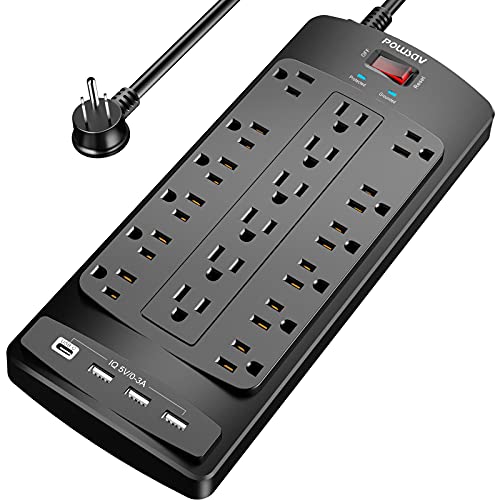
The POWSAV 18-Outlet Surge Protector earns its place on this list by leaning hard into the “gamer who plugs in everything” use case. Eighteen outlets are spaced widely across the bar, so two adjacent plugs never fight for room. A 2100-joule rating offers solid protection for desktop setups in regions with reliable power, and the ETL listing adds a third-party safety mark to lean on.
Four USB ports sit on the end for quick phone or headset charges. A 6-foot heavy-duty cord and a flat plug slide under a desk or behind a low console. Compared to the NANOLAKE, the POWSAV trades joule headroom for a more affordable price and a cleaner, slightly smaller shell. The cord is on the shorter side, so you may need to position the strip within six feet of a wall outlet.
Benefits That Matter
- ✓18 wide-spaced outlets accept bulky adapters
- ✓ETL listed for verified safety standards
- ✓Flat plug tucks behind tight furniture
- ✓4 USB ports for accessories and phones
Worth Noting
- •6-foot cord limits placement in larger rooms
- •2100J rating is mid-range, not top tier
- •No USB-C PD fast charging
Right Fit For
Gamers running a PC, monitor, console, headset stand, and a stack of accessories from a single desk-side power bar.
A Better Fit Elsewhere
Anyone who needs serious joule headroom and USB-C fast charging should look at the NANOLAKE Surge Protector Power Strip 10ft Cord (4800J) instead.
The GE 3-Outlet Surge Protector is the minimalist on this list, and that’s the point. Three grounded outlets, an 8-foot braided extension cord, and a slim body that hides behind a nightstand or a small desk. The 245-joule rating is on the light side, so I’d recommend this for low-draw electronics rather than a $2,000 home theater.
It earns its place because not every outlet situation needs 18 receptacles. A bedside lamp, a phone charger, and a small speaker are exactly the workload this strip was built for. The braided cord resists scuffs and tangles far better than the vinyl cords on most budget strips, which owners commonly report as a small daily quality-of-life win.
Practical Pluses
- ✓Compact body fits behind tight furniture
- ✓Braided cord resists wear and tangles
- ✓8-foot length reaches distant wall outlets
- ✓Three-prong grounded outlets for safer connections
Soft Spots
- •Only three outlets limits expandability
- •245J rating suits only low-draw electronics
- •No USB ports for direct device charging
Best Suited To
Anyone building out a small secondary station, like a guest room TV or a bedside charging spot, where outlet count matters less than a tidy footprint.
Skip It When
Shoppers running a full entertainment center need more headroom and should pick up the SUPERDANNY 22-Outlet Power Strip for the higher outlet count.
Anker built its reputation on tidy, well-engineered power products, and the Anker 12-Outlet Power Strip carries that polish through. Twelve AC outlets run along a clean rectangular body, with one 20W USB-C port and two USB-A ports up front. The 2100-joule rating matches the SUPERDANNY, and the 8-point safety system bundles surge protection, fire resistance, overload protection, and temperature monitoring in one package.
The fast-charge USB-C port is the headline feature. It pushes enough current to take a modern phone from empty to roughly half in well under half an hour, useful for quick top-ups before heading out. Compared to the POWSAV 18-Outlet, the Anker feels more refined, and the build tends to look more at home on a clean desk, though it offers fewer total outlets.
The Practical Payoff
- ✓20W USB-C fast charges modern phones
- ✓8-point safety system for peace of mind
- ✓Compact rectangular body for clean desk setups
- ✓Anker’s reputation for long-term reliability
Where It May Fall Short
- •Only 12 AC outlets, fewer than the POWSAV
- •2100J matches the SUPERDANNY but trails the NANOLAKE
- •Single USB-C port may bottleneck in multi-device homes
Key Specs
| | Feature | Specification | Why It Matters |
|---|
| Joule rating | 2100J | Solid mid-tier absorption |
| USB-C output | 20W | Fast charges iPhone and Android |
| Safety system | 8-point | Surge, fire, overload, and temperature control |
Who Will Love This
Home office workers and remote professionals who want a clean, refined power bar that doubles as a fast phone charger.
Not Your Match When
Shoppers with a serious AV rack should reach for the Belkin Surge Protector 8 Rotating 4 Standard Outlets 4320J, which handles bulky power bricks far more gracefully.
ALESTOR’s 12-outlet power strip sits in that sweet middle ground the category rarely hits. The 2700-joule rating beats the SUPERDANNY and Anker strips by a clear margin, yet the price tends to land well below the NANOLAKE. Twelve AC outlets, four USB charging ports, and a 6-foot heavy-duty cord cover most living room setups without demanding a media rack.
Two of those outlets are spaced wider apart to accept large adapters, which is a small touch that makes a daily difference in real cable management. The protected-indicator LED confirms the surge component is still doing its job, a useful reminder to replace the strip after a major event. Compared to the Anker 12-Outlet, the ALESTOR gives up a fast-charge USB-C port but gains joule capacity and a lower cost.
What It Does Well
- ✓2700J rating beats most mid-tier strips
- ✓2 wide-spaced outlets for large adapters
- ✓4 USB ports for phones and accessories
- ✓LED confirms surge protection status
Honest Caveats
- •6-foot cord may fall short in larger rooms
- •No USB-C, only USB-A ports
- •Plastic shell feels lighter than the Anker
Perfect Match For
Mid-size media consoles running a TV, soundbar, console, and a couple of accessories without breaking the budget.
Reach For A Different Pick When
Anyone who needs fast USB-C phone charging on the same strip should grab the Anker Power Strip with 2100J Surge Protector, 20W, 12 AC for the dedicated PD port.
The Belkin 12-Outlet Pivot Plug is the strip I’d reach for when a row of bulky power bricks threatens to take over the back of the media cabinet. Eight pivoting outlets rotate 90 degrees to face the direction each adapter wants, and four stationary outlets handle standard plugs. The 4320-joule rating sits just below the NANOLAKE on this list, which is genuinely stout.
An 8-foot cord and a flat pivot plug slide into tight corners without bending the cable at a sharp angle. The build leans more substantial than most plastic shells, and owners commonly report the rotating outlets holding their position well over time. Where the SUPERDANNY focuses on quantity, the Belkin focuses on flexibility, and for an AV receiver with chunky wall warts, that flexibility matters.
Where It Delivers
- ✓8 pivoting outlets handle bulky adapters
- ✓4320J rating offers strong surge absorption
- ✓Flat pivot plug reduces strain on tight outlets
- ✓Substantial build quality for long-term use
Possible Compromises
- •No USB ports, so phone charging needs a separate brick
- •Higher cost than basic 12-outlet strips
- •Rotating outlets add slight bulk to the chassis
Built With In Mind
AV enthusiasts and home theater owners who run receivers, subwoofers, and powered speakers with brick-style plugs from a single power bar.
Swap It Out When
Shoppers who want USB charging built in should pick the NANOLAKE Surge Protector Power Strip 10ft Cord (4800J), which pairs high joules with PD-capable USB-C.
The Treybair Surge Protector goes a step beyond the others on this list because it doesn’t just absorb spikes; it actively watches the incoming voltage. The unit stabilizes power across roughly 80V to 140V, which means it can keep a fridge, TV, or computer running through the brownouts and under-voltage events that hit rural grids and older neighborhoods during summer peaks.
USB-C support and an LED voltage readout add everyday utility to a specialty device. The two-pack form factor helps if you want to protect both the kitchen fridge and the living room TV with the same order. For shoppers on a stable city grid, this is more protection than necessary, but anyone who has lost a refrigerator compressor to a sag will recognize the value immediately.
Everyday Perks
- ✓Active voltage stabilization across 80V-140V
- ✓LED display shows real-time voltage
- ✓USB-C port for direct device charging
- ✓Two-pack covers multiple rooms in one order
Things To Weigh Up
- •Overkill for stable urban power grids
- •Fewer AC outlets than typical entertainment strips
- •Specialty role means higher cost per outlet
Feature Card
| | Feature | Specification | Why It Matters |
|---|
| Voltage range | 80V-140V | Stabilizes under-voltage and brownouts |
| Display | LED voltage readout | Confirms incoming power at a glance |
| Material | Fireproof UL94V-1 | Resists heat in fault conditions |
| Pack size | 2-pack | Covers multiple appliances or rooms |
Whose Shelf It Belongs On
Homeowners in areas with frequent brownouts, sags, or unstable grid conditions who want to protect a fridge, TV, or computer.
Where A Sibling Pick Shines
City dwellers with a clean grid and a packed entertainment center will get more value from the SUPERDANNY 22-Outlet Power Strip, since the higher outlet count serves a media stack better.
Reading the Specs Before You Buy
Joules tell you how much energy a surge protector can absorb before the internal metal-oxide varistor (the MOV, the small component that sacrifices itself to shunt a spike) wears out. Higher joules mean a longer service life and more headroom during a serious lightning event. For an entertainment center with a $1,500 TV, I’d want at least 2,000 joules as a starting point. Anything below that belongs on lamp-and-laptop duty.
Outlet spacing matters more than people expect. A row of tightly packed receptacles looks generous on the box, then one wall wart blocks three neighbors. Wide-spaced or pivoting outlets solve the problem cleanly, which is why the Belkin Pivot Plug earns its slot. USB-C PD is a real quality-of-life feature if you charge a modern phone on the same strip, because 20W output means a quick top-up before bed instead of an overnight trickle.
For an entertainment setup, a flat plug is genuinely useful. Standard right-angle plugs stick out four inches from the wall and prevent furniture from sitting flush. The flat plug on the NANOLAKE, POWSAV, and Belkin solves that problem without any rewiring.
For a typical living room, 8 to 12 outlets is plenty. A dedicated home theater with a projector, AV receiver, and four powered speakers should look at 18-plus. Rural and older homes with unstable voltage should weigh a voltage-stabilizing unit like the Treybair over raw outlet count.
Common Shopping Slip Ups
The biggest mistake I see is treating joule rating like a marketing checkbox. A 200-joule strip on a $2,000 TV is a roll of the dice, since one bad spike ends the protection for good. Another common slip is buying a power strip with no surge protection at all and assuming any multi-outlet bar will do. Basic power strips have no MOVs, so a single surge passes straight through to whatever is plugged in.
Size and cord length also trip people up. A 22-outlet monster that won’t reach the wall is useless, and an 8-foot cord on a 10-foot gap is just as bad. Measure the run from the wall to the equipment before you click, especially for the SUPERDANNY 22-Outlet Power Strip and NANOLAKE Surge Protector Power Strip 10ft Cord, since both demand planning around outlet placement.
Where The Extra Money Goes
The jump from a basic 245-joule strip to the NANOLAKE 4800J isn’t just a bigger number on the box. You’re paying for a larger MOV array, heavier internal wiring, and a chassis that runs cooler under load. The Belkin Pivot Plug commands a higher cost partly because the rotating outlets and pivot plug require tighter mechanical tolerances than a fixed socket row.
The Treybair voltage stabilizer sits at a different tier entirely. Active voltage regulation circuitry costs more to build than a passive MOV clamp, and the LED display and USB-C port add their own bill of materials. For shoppers on a stable grid, that extra spend is hard to justify. For shoppers on a flaky grid, it’s the difference between a working fridge and a $1,200 replacement.
Frequently Asked Questions
How many joules do I need for a TV and soundbar? For a modern entertainment setup, look for at least 1,500 joules, with 2,000-plus as a safer starting point. The NANOLAKE 4800J and Belkin 4320J both offer generous headroom.
Do I really need USB ports on a surge protector? Not strictly, but they reduce clutter by removing extra charging bricks. The Anker 20W USB-C port is genuinely useful for fast phone charging.
Is a higher joule rating always better? Higher joules mean more cumulative absorption before the MOV wears out, so yes for expensive gear. After a major surge, even a high-joule strip should be replaced if the protected LED goes out.
What is an MOV and why does it matter? An MOV, or metal-oxide varistor, is the component that shunts voltage spikes away from your gear. Every surge slightly degrades it, which is why joule ratings exist as a lifespan indicator.
Can I plug one surge protector into another? It is not recommended. Daisy-chaining multiplies resistance and can overheat the first strip, and most manufacturers void the safety certification if the units are chained.
Closing Remarks
A good surge protector is one of the cheapest insurance policies in a home entertainment setup, and the right one depends on how much gear you actually run. Compact three-outlet strips earn their keep on nightstands, while a 22-outlet bar makes sense only when a media room truly fills it. Match the strip to the workload, replace it after a major surge, and your gear will outlast the next electrical storm.