

I still remember the night a storm knocked out my old desktop’s power supply, so I tend to think about surge protection a little more carefully than most. Whether you’re running a PC tower, a monitor, a printer, and a modem in one spot, or you’re trying to reach a distant outlet without overloading a wall socket, the right power strip matters. This roundup focuses on heavy-duty options with real gauge cord ratings and proper circuit protection, because undersized cords and cheap surge suppression are how gear gets damaged. I pulled these ten picks together based on build quality, outlet count, cord specs, and how well each one fits a real-world setup.
The Leading Options At A Glance

CCCEI 12 Gauge Long Extension Cord 50FT (Yellow)

CCCEI 12 Gauge Long Extension Cord 100FT (Yellow)

CCCEI Heavy Duty Surge Protector with USB Ports (Black, 6FT)

POWSAV 18 Outlets Surge Protector Power Strip (2100 Joules)

Belkin 12-Outlet Surge Protector with 8ft Flat Plug
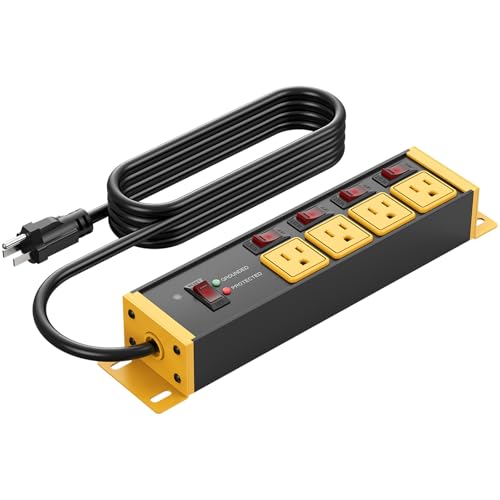
CCCEI 12 Gauge Heavy Duty Surge Protector (Yellow, 6FT)

CCCEI Magnetic Heavy Duty Surge Protector (Orange, 6FT)

CCCEI Magnetic Heavy Duty Power Strip 8 Ports (Yellow, 6FT)

CCCEI 12 Gauge Heavy Duty Power Strip GFCI 8 Ports (Grey, 6FT)
CCCEI Heavy Duty Surge Protector 20A Individual Switches (Yellow, 6FT)
A Closer Look At Each Pick
When the nearest wall outlet feels too far from your workbench, this 50-foot cord from CCCEI gives you room to breathe. The 12 gauge wire (a thicker conductor that handles high-draw tools better than the thin 16 gauge cords on cheap strips) supports a 15A/125V/1875W load, which is plenty for a PC tower plus peripherals, or for shop tools like a miter saw or air compressor.
It comes equipped with eight outlets along the strip body and a single master switch, plus overload and grounding protection to cut power before things get dangerous. The flat 3-prong plug sits flush against the wall, so you can push furniture closer without bending the cord sharply. For anyone whose PC setup lives in a basement or detached garage, that reach alone is worth the trade-off in storage space.
Real Benefits
- 50 feet of reach means freedom from rearranging the whole room around one outlet.
- 12 gauge cord stays cooler under load, so the cable stays cooler even with a tower and monitor running for hours.
- Eight outlets give headroom for tower, monitor, printer, speakers, and a desk lamp at once.
- Built-in circuit breaker trips before damage reaches your gear.
- Flat plug profile tucks behind desks and bookshelves without sticking out.
Points To Keep In Mind
- A 50-foot cord is bulky to coil and store when not in use, especially in tight closets.
- Yellow jacket is bright by design, but it stands out in living areas where you may prefer something neutral.
- One master switch means you cannot isolate a single outlet, which some power users find limiting.
Who It Suits Best
Garage workshops, basement PC setups, and anyone whose outlet sits across the room from the desk.
Look Elsewhere When
For pure desktop convenience with USB charging, the CCCEI Heavy Duty Surge Protector with USB Ports (Black, 6FT) is a tidier fit.
Twice the length of the 50-foot version, this 100-foot CCCEI cord is built for serious distance. Same 12 gauge conductor, same 15A/125V/1875W rating, same eight-outlet block with overload and grounding protection. It is the cord to grab when the only available outlet is on the opposite side of the house or out by a detached shed.
I see this working best for someone running power to a backyard office, a detached garage conversion, or a workshop that is genuinely far from the panel. The thicker wire gauge matters more at distance, because voltage drop (a slow loss of power over a long run) can make tools run weak and electronics misbehave. The flat plug stays close to the wall, and the yellow jacket is easy to spot if it ends up across a lawn or walkway.
The Practical Payoff
- 100 feet reaches anywhere a normal extension cord cannot, from detached garages to yard projects.
- 12 gauge thickness reduces voltage drop, which keeps sensitive electronics stable over long runs.
- Eight outlets at the end give a true hub rather than a single-socket extension.
- Circuit breaker adds a real safety layer for outdoor and remote use.
- High-visibility yellow jacket helps prevent trip hazards in busy workspaces.
Trade-Offs
- Coiling 100 feet of 12 gauge cord takes real storage space, more than most people plan for.
- Heavier than smaller cords, which can drag on the outlet if left hanging across a span.
- Single master switch limits granular control of individual devices.
Made For
Homeowners with detached workshops, yard offices, or anyone powering a setup far from the main panel.
Swap It Out When
For a tidier desk-side hub with USB ports, swap to the CCCEI Heavy Duty Surge Protector with USB Ports (Black, 6FT) instead.
This is the strip I would pick for a desk where the tower, monitor, and a phone all need power at once. CCCEI built it with four AC outlets, plus two USB-C ports and one USB-A port on the side, so a laptop, a tablet, and earbuds can plug straight in without a separate wall charger eating an outlet.
Each AC outlet gets its own switch, and a master switch kills everything at once when you leave the desk. The 12 gauge, six-foot cord handles the same 15A/125V/1875W load as the longer CCCEI cords, so it stays cool even with a gaming tower and a 27-inch monitor running together. Overload and grounding protection round out the package. The black housing looks at home next to a monitor and keyboard, which the bright yellow shop cords definitely do not.
Standout Benefits
- Two USB-C and one USB-A port free up the four AC outlets for things that actually need them.
- Individual outlet switches let you shut down the printer without killing the tower.
- 12 gauge cord stays cool under sustained PC loads.
- Black finish suits an office or bedroom better than industrial yellow.
- Master switch offers a clean all-off when leaving the desk.
Worth Noting
- Six feet of reach may fall short for desks pushed against the far wall from the outlet.
- USB ports do not support the fastest charging standards some newer laptops prefer.
- Four AC outlets is plenty for most desks but tight for multi-monitor setups with speakers and a printer.
Best Suited To
Home office workers, students, and anyone whose desk holds a PC plus a phone and tablet on the same surface.
Not Your Match When
For wider rigs with many peripherals, the POWSAV 18 Outlets Surge Protector Power Strip (2100 Joules) has more breathing room.
A gaming rig with two monitors, a streaming PC, a console, speakers, a headset stand, and a lamp will eat outlets fast, and that is exactly what this POWSAV strip is built for. It carries 18 AC outlets plus four USB ports rated at 5V/3.0A/17W, spaced widely enough that bulky power bricks do not block neighboring sockets.
The 2100-joule surge rating (the amount of energy the protector can absorb before it gives out) is a step up from basic strips, and overload protection keeps the system from pushing past safe limits. A 10-foot flat-plug cord reaches behind a desk or media center without an awkward bend, and the flat profile sits flush against the wall so furniture can stay close. It carries an ETL listing (a third-party safety certification similar to UL) for added peace of mind on a busy power hub.
Where It Excels
- 18 widely spaced outlets handle full setups without power bricks blocking neighbors.
- Four USB ports charge phones, tablets, and controllers without a separate hub.
- 2100-joule rating gives meaningful surge absorption for expensive PCs.
- 10-foot cord reaches across rooms and behind furniture.
- Flat plug keeps the wall outlet close to the wall.
Some Limits To Know
- The long, multi-outlet body takes up real desk or shelf space and is hard to hide.
- At 1875W max, it shares the same ceiling as other strips in this roundup, so it cannot deliver more power, just distribute it.
- Wide outlet spacing wastes some sockets if you only use small plugs.
Who Should Grab It
Gamers, streamers, and home-office multitaskers running many devices from a single hub.
Consider Something Else When
For heavy shop tools needing individual switches, the CCCEI Heavy Duty Surge Protector 20A Individual Switches (Yellow, 6FT) is more practical.
Belkin has been making power strips for a long time, and this 12-outlet model is the sort of dependable middle ground most home setups actually need. It carries a 3,940-joule rating, the highest in this roundup, which gives a meaningful cushion against the kind of spike that follows a lightning storm or a brownout.
The cord stretches eight feet with a flat plug that sits close to the wall, and the housing is UL-listed (a U.S. safety certification) for verified build standards. Six of the 12 outlets are block-spaced, which means room for chunky wall warts side by side. Coaxial protection is also present for setups that still run cable internet through a modem. For most people replacing an aging strip behind a TV or a desk, this is the safe, well-known option.
What Helps Most
- 3,940-joule rating is the strongest surge absorption in this list.
- 12 outlets split between standard and block-spaced layouts handle most home arrangements.
- UL listing adds an independent safety check beyond the brand name.
- 8-foot flat-plug cord fits cleanly behind sofas and desks.
- Coaxial protection covers cable modems without needing a separate adapter.
Trade-Offs
- No USB ports, so phones and tablets require their own wall chargers.
- Lacks individual outlet switches, so everything powers on or off together.
- 12 outlets in one housing take up noticeable space on a low-profile media shelf.
The Right Fit
Home offices, living room media setups, and anyone who values a strong joule rating over extra features.
Reach For A Different Pick When
For desk-side USB charging alongside AC outlets, the CCCEI Heavy Duty Surge Protector with USB Ports (Black, 6FT) is a smarter match.
This is the CCCEI strip that steps into proper shop territory. It carries four outlets rated for 20 amps with individual circuit breakers, so each outlet controls itself rather than the whole strip. The housing is built for wall mounting, which keeps it up off the bench and out of the way of sawdust and stray tools.
The 12 gauge, six-foot cord plugs into a standard 3-prong outlet, and overload and grounding protection are built in. For someone running a table saw, a shop vac, and a bench grinder in turn, the ability to isolate each tool on its own switch is genuinely useful. Compared to the Belkin I just covered, this one trades outlet count and joule rating for switchable control and a tougher industrial footprint.
Useful Strengths
- Individual 20A breakers give each outlet independent control.
- Wall-mountable design clears bench space and stays accessible.
- 12 gauge cord supports sustained high-draw tool use.
- Overload and grounding protection included.
- Heavy-duty housing stands up to shop environments better than plastic office strips.
A Few Limitations
- Four outlets is fewer than most home-office users will want.
- Yellow industrial look feels out of place in a living room or bedroom.
- 6-foot cord may need an extension on larger workshop floors.
Whose Shelf It Belongs On
Shops, garages, and serious DIYers who want switchable control over individual high-draw tools.
Where A Sibling Pick Shines
For a longer reach across a workshop, the CCCEI 12 Gauge Long Extension Cord 50FT (Yellow) gives more outlets and more cord.
The trick here is the magnetic back. Built-in magnets let this CCCEI strip cling to the side of a tool cabinet, a steel workbench, or even the side of a car lift, which is the sort of feature that only makes sense once you have tried balancing a power strip on a rolling stool. It carries four outlets with individual switches plus a master switch, the same 12 gauge cord, and the same 15A/125V/1875W ceiling as the rest of the family.
For auto work, garage hobbies, or anywhere with a lot of steel surfaces, the magnet makes the strip genuinely portable in a way wall-mounted versions are not. A dedicated 20A circuit breaker keeps each outlet under control. The orange housing is bright enough to spot on a crowded bench, which helps avoid the classic “where did I put the strip” hunt.
Bright Spots
- Magnetic back sticks firmly to steel benches, cabinets, and lifts.
- Individual switches plus master switch offer layered control.
- 12 gauge cord matches the heavier-duty picks in this roundup.
- 20A breaker rated for higher-draw shop tools.
- Orange finish is easy to find on a busy workbench.
Honest Caveats
- Magnets only stick to ferrous metal (iron-bearing steel), so aluminum or wood benches get no benefit.
- Four outlets is the minimum count in the family and tightens quickly with multiple tools.
- Six-foot reach limits placement unless the wall outlet sits close to the bench.
Perfect Match For
Garage mechanics, hobbyists, and anyone with a steel workbench who wants their strip right at hand level.
A Better Fit Elsewhere
For more outlets in a similar magnetic form, the CCCEI Magnetic Heavy Duty Power Strip 8 Ports (Yellow, 6FT) covers more devices.
Take the orange 4-outlet magnetic strip and double the outlets, and you get this one. CCCEI bumped the count to 8 outlets while keeping the magnetic back that lets it cling to metal surfaces, so the strip stays put even when cords are being yanked around by heavier tools. The 14 gauge cord is a step lighter than the 12 gauge family, but the 15A/125V/1875W ceiling stays the same.
The flat plug slips behind tight workshop spots where a chunky right-angle plug would not fit. A 15A breaker keeps the strip under control. Compared to the smaller magnetic version I covered a moment ago, this one gives up a slightly heavier gauge cord in exchange for more outlets in the same footprint, which is usually the better trade for a busy hobby bench.
Features That Help
- Eight outlets cover a full bench setup without juggling strips.
- Magnetic back holds firm during heavy tool use.
- Flat plug fits tight spaces and stays close to the wall.
- 15A breaker protects against accidental overloads.
- Wall-mountable design adds placement flexibility beyond steel surfaces.
Practical Considerations
- 14 gauge cord is slightly lighter than the 12 gauge picks, and the cable runs warmer under sustained heavy loads.
- Eight outlets in a row can mean some sockets sit close together for bulky plugs.
- Magnetic mount is only useful on ferrous metal surfaces.
Right Fit For
Workshop benches, hobby rooms, and DIYers who need more outlets than a basic 4-port strip offers.
Skip It When
For kitchen or damp-area use with ground-fault protection, swap to the CCCEI 12 Gauge Heavy Duty Power Strip GFCI 8 Ports (Grey, 6FT).
Kitchens, basements, and laundry areas are the spots where GFCI (Ground Fault Circuit Interrupter) protection actually matters, because it cuts power the moment it detects current going somewhere it should not, like through water. This CCCEI strip builds that protection into the strip itself, alongside eight outlets, a 20A switch, and a 12 gauge cord that handles the same 1875W ceiling as the rest of the family.
Overload and grounding protection are both included, and the grey housing blends into kitchen counters and laundry walls better than the bright yellow shop models. The cord stays cool even at full load, which matters in a kitchen where the strip may sit near an appliance that already runs warm. Compared to the magnetic 8-port strip earlier, this one trades the magnetic back for GFCI safety, which is the right trade in any damp or splash-prone room.
Key Advantages
- GFCI protection cuts power fast if water is involved.
- Eight outlets handle small kitchen appliances, a microwave, and a coffee maker at once.
- 12 gauge cord keeps temperatures low under sustained load.
- Grey finish blends into kitchen and laundry room decor.
- Overload and grounding protection built in.
Small Caveats
- GFCI test and reset buttons take up some front-panel space, narrowing usable outlet area.
- 6-foot cord is short for kitchens with wall outlets on the opposite side of the room.
- No USB ports for direct phone or tablet charging.
Built With In Mind
Homeowners outfitting a kitchen counter, laundry room, or workshop with a sink nearby.
Where Another Pick Suits Better
For full GFCI plus per-outlet switches, the CCCEI Heavy Duty Surge Protector 20A Individual Switches (Yellow, 6FT) is the heavier-duty option.
This one takes the GFCI strip from the previous pick and adds per-outlet switches. Four outlets, each with its own 20A switch, give independent control over what is plugged in, while GFCI protection guards against ground faults. The 12 gauge cord and the same 15A/125V/1875W rating keep it consistent with the rest of the family.
For someone running a kitchen with multiple appliances, or a shop with a mix of tools and lighting, that combination of switches and ground-fault protection is hard to match. The cord stays cool under full load, which is the part most shoppers never see until a cheaper strip starts smelling warm. The yellow housing is unmistakably industrial, so this strip is built for spaces where function beats form.
The Upside
- GFCI plus per-outlet 20A switches deliver layered control and safety.
- 12 gauge cord stays cool at full load.
- Overload and grounding protection built in.
- Heavy-duty housing fits shop and kitchen environments.
- NEMA 5-15P plug works in standard household outlets.
Where It May Fall Short
- Four outlets is the smallest count in this roundup, which limits multi-device setups.
- Yellow housing stands out in finished living spaces.
- 6-foot cord is short for shops where the outlet sits far from the bench.
Who Will Love This
Professionals, serious DIYers, and homeowners outfitting kitchens, shops, or garages needing both GFCI safety and individual switching.
Not Your Match When
For a tidier desk setup with USB ports, switch to the CCCEI Heavy Duty Surge Protector with USB Ports (Black, 6FT) instead.
What Matters When Picking a Pc Surge Protector
The first thing to check is the surge rating in joules. A joule is the unit of energy the protector can absorb before it gives out, and once it is spent, the strip keeps working as a power strip but stops protecting. For a desktop PC and monitor setup, anything above roughly 1,000 joules gives a meaningful cushion against the small daily spikes that wear components down over time.
Cord gauge matters more than people expect. A 12 gauge cord is thicker than a 16 gauge cord and handles high-draw tools and sustained PC loads without heating up. Length is the second half of the cord equation. A short cord is fine when the wall outlet is right behind the desk, but workshops and detached spaces often need 25 to 100 feet.
Outlet count and spacing depend on what you plug in. Power bricks for laptops and monitors are wider than standard plugs, so block-spaced outlets (sockets placed farther apart to fit bulky plugs) save real frustration. USB ports add convenience for phones, tablets, and headsets, especially in desk-side setups. Switches matter when you want to cut power to one device without unplugging anything.
GFCI protection belongs anywhere water is nearby, including kitchens, laundry rooms, basements, and outdoor-adjacent workshops. Magnetic mounting is a small but meaningful feature for anyone with a steel workbench or tool cabinet.
Key Considerations Across These Picks
Common Shopping Slip Ups
Many shoppers buy on outlet count alone and end up with a strip too short for the desk. Measure the distance from the wall outlet to the device cluster before choosing cord length, and add a couple of feet for slack. Another common mistake is ignoring the joule rating. A strip with no stated surge rating or one below 500 joules offers little real protection for a desktop PC, monitor, or modem.
Buyers also tend to skip the gauge number. A thin 16 or 18 gauge cord can overheat when a gaming PC and monitor run together for hours. For PC setups, 12 gauge or 14 gauge is the safe range.
What The Higher Tier Buys
Spending up on a higher-tier model usually means a stronger surge rating, a thicker cord, and longer or better-protected housings. A premium pick like the Belkin 12-Outlet Surge Protector delivers a 3,940-joule rating and UL listing that budget strips often skip. Higher-tier GFCI models add ground-fault protection worth paying extra for in kitchens and workshops.
The honest read is that the upgrade pays off most when the gear plugged in is expensive, the room involves water, or the setup runs for many hours a day. For a basic bedroom charging strip, the extra spend is harder to justify.
Frequently Asked Questions
How many joules do I need for a desktop PC setup? A joule rating above 1,000 is a sensible starting point for a tower and monitor, and ratings of 2,000 or more make sense for setups with expensive displays or networking gear that stays on 24/7.
What is the difference between a surge protector and a power strip? A power strip just adds outlets, while a surge protector absorbs voltage spikes through components designed to fail safely before they reach your gear. Surge protectors have a joule rating; basic power strips do not.
Is GFCI protection necessary for an indoor PC setup? GFCI matters most where water and electricity might meet, including kitchens, bathrooms, basements, and laundry rooms. For a dry home office, standard surge protection is usually enough.
Can I daisy-chain power strips to add more outlets? Most safety guidance discourages chaining strips, because it stacks the load on a single outlet and increases fire risk. Add a single strip with enough outlets instead.
How long does a surge protector last? Surge protectors wear out as they absorb energy, so any strip more than a few years old, or one that has taken a known large spike, is worth replacing. Some higher-end models include indicators that show protection status.
Final Verdict
A solid Pc Surge Protector comes down to matching the strip to the room and the gear. For most desks, a 12 gauge cord and at least 1,000 joules of protection cover the basics. Workshops and garages earn magnetic mounting and individual switches, while kitchens call for ground-fault protection. The right pick is the one that fits the space, the plug count, and the way you actually use it.
