

A single blown transformer, a sudden lightning strike, or even a noisy outlet can quietly fry a desktop motherboard or wipe out a monitor. For anyone running a home office or a serious gaming desk, a quality surge protector isn’t a luxury; it’s the cheapest insurance policy sitting between your gear and the wall.
The Shortlist At A Glance

CCCEI 12 Gauge Heavy Duty Extension Cord 50FT

POWSAV 18-Outlet Surge Protector Power Strip

Belkin Surge Protector 12-Outlet 8ft

SMALLRT Power Strip Tower 12 Outlets 4 USB

Belkin Power Strip Surge Protector 12-Outlet 10ft
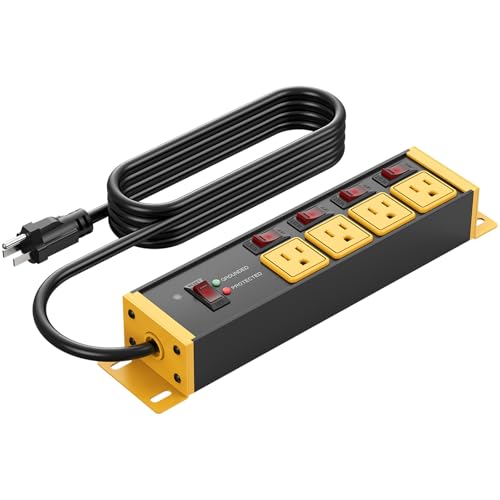
CCCEI 12 Gauge Heavy Duty Surge Protector 6FT

CCCEI Magnetic Heavy Duty Surge Protector Orange

CCCEI Magnetic Heavy Duty Power Strip 8 Ports

SMALLRT Travel Power Strip 2-Pack Purple
The Strengths Of Each Pick
The CCCEI 50-foot cord solves a problem that shorter office strips simply can’t: reaching a distant outlet across a workshop, basement, or open garage without daisy-chaining extension cords. The bright yellow jacket stays visible in cluttered spaces, and the 12-gauge wire comfortably handles the kinds of loads a typical home office power strip shouldn’t see. For someone running a 3D printer in one corner and a desktop PC in another, that kind of reach is genuinely useful.
It carries eight outlets fed by a heavy 12-gauge conductor, with a built-in circuit breaker that pops independently of the wall breaker. For most homeowners, the honest read is that this is overkill for a living room TV setup, but absolutely fits a maker space or shop.
Where It Helps
- Fifty feet of 12-gauge cord reaches outlets that ordinary power strips can’t access
- Eight grounded outlets share a dedicated breaker that won’t trip your main panel
- High-visibility yellow jacket reduces trip hazards on shop floors
- Rated for 15A / 125V / 1875W, so it handles high-draw workshop gear
- Flat three-prong plug sits flush behind furniture and benches
Things To Consider
- Fifty feet of cable adds bulk; storage requires a spool or hook to avoid tangles
- Owners commonly report the cord stays coiled at first and takes a day to relax fully
Feature Snapshot
Whose Shelf It Belongs On
DIYers and home-shop hobbyists running tools or 3D printers well away from the nearest wall outlet.
Where Another Pick Suits Better
The CCCEI 12 Gauge Heavy Duty Surge Protector 6FT (Item 6) is a tighter fit when the outlet sits right behind the bench and you want individual switches per outlet.
The POWSAV 18-outlet strip is built for desks where every USB port, monitor, and gaming accessory fights for space. Eighteen widely spaced outlets plus four USB ports mean a single strip can absorb a full battlestation: tower, two monitors, speakers, headset stand, console, lamp, and phone charger, all without juggling adapters. The flat 10-foot plug reaches behind a desk cleanly.
ETL listing confirms third-party safety testing, and the 2100-joule rating handles the kind of everyday brownouts common in older neighborhoods. You may find the layout generous but the housing longer than a standard strip, so plan depth under the desk.
Useful Strengths
- Eighteen outlets accommodate multi-monitor gaming or streaming rigs in one strip
- Four USB ports eliminate separate wall chargers for phones and tablets
- Flat plug profile sits flush against baseboards and desks
- 2100-joule protection covers typical household surge events
Points To Keep In Mind
- The elongated housing demands deeper under-desk clearance than compact towers
- Owners commonly mention widely spaced outlets still struggle with bulky “wall wart” plugs sitting next to each other
- No individual switches per outlet, so the whole strip cycles together
Who It Suits Best
Streamers, gamers, and content creators running a dozen-plus peripherals from a single hub.
Consider Something Else When
The SMALLRT Power Strip Tower 12 Outlets 4 USB (Item 4) saves footprint space when the desk is shallow and vertical clearance is plentiful.
The Belkin 12-outlet surge protector with coaxial protection is the kind of strip that quietly earns its keep behind a home office desk. Six outlets are block-spaced to accept oversized plugs without blocking neighbors, and the other six sit closer together for slimmer bricks. The 3,940-joule rating is generous for the category, and coaxial line protection guards a cable modem or older antenna feed.
Compared to the larger POWSAV 18-outlet strip above, this Belkin takes up less rail space and adds line-protective features the others skip. The right-angle flat plug keeps furniture pushed flush against the wall.
Notable Gains
- Block-spaced outlets handle bulky chargers without wasting neighboring slots
- Coaxial line protection defends cable modems and antenna gear against line surges
- 3,940-joule rating sits in the higher tier of consumer surge strips
- UL-listed construction meets recognized safety standards
Honest Caveats
- Coaxial ports only help users who actually run a coax feed to the desk
- Eight-foot cord is solid for most rooms but short in loft-style spaces
Made For
Home office workers who bundle a desktop, monitor, and cable modem into one station and want a quieter, cleaner surge solution.
Look Elsewhere When
The Belkin Power Strip Surge Protector 12-Outlet 10ft (Item 5) is a better match for setups needing extra cord length and the highest joule rating on the list.
Where traditional strips sprawl horizontally across a power strip shelf, the SMALLRT tower stands up like a small lighthouse on your desk. Twelve AC outlets ring the body at multiple levels, so a chunky laptop brick on one tier doesn’t block a slim phone charger two tiers up. Four USB ports on top add cable-free charging for everyday carry items.
The tower shape also tends to disappear behind a monitor or in a corner, freeing up actual desktop real estate. Depending on cable management habits, the vertical layout may actually reduce cable spaghetti.
Good Reasons To Consider
- Vertical tower design fits neatly in tight dorm desks or corners
- Stacked outlets prevent bulky plugs from blocking neighboring slots
- Four USB ports handle phones, tablets, and e-readers directly
- 6.5-foot cord reaches across most room layouts comfortably
Trade-Offs
- Towers can tip if all the heaviest plugs hang from one side; stabilizing the base matters
- Owners commonly mention the USB ports share total output, so fast-charging all four at once slows each one
- No individual switches per outlet, only a master control
Best Suited To
Students in dorm rooms and remote workers with shallow desks who need lots of outlets in a small footprint.
Skip It When
The POWSAV 18-Outlet Surge Protector (Item 2) is a better fit when a wide, flat strip behind the desk works fine and you want maximum outlet count.
The Belkin 12-outlet with 4,156 joules of protection represents the upper end of what consumer-grade strips offer before stepping into pro audio or hospital-grade territory. Twelve outlets sit in a row along a 10-foot flat-plug cord, with phone-line and coaxial protection bundled in for users still relying on landlines or cable feeds. The joule rating means it can absorb repeated small surges over years before the protection circuit finally sacrifices itself.
For an expensive desktop tower, large monitor array, and network gear, this is the strip that insurance policies quietly nod toward. For most setups with modest gear, the extra joules may be more than necessary.
Benefits That Matter
- 4,156-joule rating leads the list and handles repeated moderate surge events
- Phone-line and coaxial protection covers older connected hardware
- Ten-foot flat plug reaches further than the 8-foot Belkin in Item 3
- Twelve outlets cover a full home office with spare capacity
Points To Note
- Higher internal protection typically correlates with a larger housing footprint
- Phone-line protection adds little value to setups that have fully cut the cord
Who Will Love This
Home professionals and prosumers protecting high-end desktop towers, studio monitors, and networking hardware worth many times the strip’s price.
A Better Fit Elsewhere
The Belkin Surge Protector 12-Outlet 8ft (Item 3) is a smarter spend for setups that don’t need the additional joule headroom and prefer a slightly shorter cord.
The CCCEI 6-foot heavy-duty strip with 20-amp output is genuinely built for shop equipment rather than laptops. It accepts both 5-20R and 6-20R plugs, which means heavier table saws, air compressors, and welders can plug directly in without adapter headaches. Each of the four outlets has its own 20-amp breaker, so a fault on one tool doesn’t black out the whole bench.
The wall-mount design keeps cords off the floor and the 12-gauge cable stays cool even at sustained high loads. For a desk job, this strip is genuinely overkill, but that is the point.
A Favorable Mix
- 20-amp circuit accepts higher-draw tools than standard 15-amp strips
- Individual switches per outlet let you isolate tools without unplugging
- Wall-mount holes lift the strip off bench surfaces entirely
- 12-gauge cord handles continuous heavy loads without overheating
Some Limits To Know
- Only four outlets means light-duty users may want a denser strip instead
- 20-amp output requires a matching 20-amp wall circuit to deliver full benefit
Feature Card
The Right Fit
Woodworkers and garage hobbyists running 20-amp-rated tools on a dedicated workshop circuit.
Reach For A Different Pick When
The CCCEI Magnetic Heavy Duty Surge Protector Orange (Item 7) suits shop users who want a strip that clings to metal surfaces rather than mounting hardware.
The orange CCCEI magnetic surge protector solves one specific shop problem really well: keeping a power strip exactly where you left it. The built-in magnets on the back grip steel tool cabinets, breaker box covers, and metal shelving without screws or brackets. For a bench that already migrates around the garage, that portability is the main selling point.
Four outlets run through a 20-amp master breaker with individual switches, and the 12-gauge cord carries the same load handling as the larger CCCEI models above. For home offices, the magnetic feature is unnecessary, but in a metal-rich shop it earns its keep.
Useful Touches
- Magnetic back panel clings to steel surfaces with no mounting hardware
- Individual 20-amp switches isolate each outlet independently
- High-visibility orange jacket stands out against most shop backgrounds
- Flat three-prong plug slips into tight outlet recesses
Practical Considerations
- Magnetic feature only helps in spaces with available steel mounting surfaces
- Owners commonly report magnets losing grip if the metal surface is painted or uneven
- Only four outlets limit dense multi-tool arrangements
Who Should Grab It
Garage tinkerers with steel tool cabinets or workbenches who reposition their strip often.
Where A Sibling Pick Shines
The CCCEI Magnetic Heavy Duty Power Strip 8 Ports (Item 8) is the smarter grab when the same shop setup needs eight outlets instead of four.
The yellow CCCEI 8-port magnetic strip expands on the orange model’s mounting trick with double the outlet count. The 14-gauge cord sits one step lighter than the 12-gauge workhorses above, but still handles 15 amps comfortably for everyday shop tools, chargers, and bench lighting. The flat plug again disappears behind tool cabinets.
Eight outlets ring the body, so a soldering station, two battery chargers, a work light, and a small vacuum can all share one strip without crawling behind furniture. The trade-off, of course, is the slightly thinner cord that won’t run heavy welders as comfortably as the 12-gauge siblings.
Strengths Worth Knowing
- Eight ports handle denser bench setups than the four-port magnetic sibling
- Magnetic back panel grips steel without drilling holes
- Wall-mount holes provide an alternative mounting option for wood surfaces
- Flat plug design reaches tight outlet spaces behind furniture
What To Weigh
- 14-gauge cord is lighter than the 12-gauge CCCEI models above; sustained heavy loads may run warmer
- Owners commonly mention magnets are weaker on thick powder-coated metal
Perfect Match For
Workshop organizers running multiple battery chargers, bench lights, and small power tools from a single magnetic station.
Swap It Out When
The CCCEI 12 Gauge Heavy Duty Surge Protector 6FT (Item 6) is a better match for shops running high-draw 20-amp tools on dedicated circuits.
The SMALLRT travel strip arrives as a two-pack, which solves the common travel problem of needing outlets in both a hotel room and a carry-on bag. Each compact strip tucks into a laptop sleeve, the 3.3-foot wrapped cord stays tidy, and the four AC outlets plus USB ports cover a laptop, phone, watch charger, and camera battery from a single wall plate. The cruise-approved, no-surge design also slips past the surge-protection restrictions many cruise lines and older hotels enforce.
The fireproof PC shell and 1250W rating match typical travel loads, though this strip is not the right fit for high-draw home gear.
Advantages To Know
- Two-pack design covers hotel rooms plus carry-on bags simultaneously
- Cruise-approved form factor meets common shipboard outlet policies
- Fireproof PC shell resists heat and short circuits
- Compact 3.3-foot wrapped cord stores neatly in luggage
Details To Watch
- No surge protection means it’s strictly for travel, not home desktop defense
- 1250W rating caps simultaneous device draw, so hair dryers and kettles belong elsewhere
Feature Snapshot
Right Fit For
Frequent flyers, cruise travelers, and remote workers splitting time between home and hotel desks.
Not Your Match When
The Belkin Power Strip Surge Protector 12-Outlet 10ft (Item 5) belongs at a stationary home desk where joule-rated protection matters.
Factors To Consider When Choosing Computer Surge Protectors
A joule rating describes how much energy a surge protector can absorb before its internal components sacrifice themselves. Higher numbers mean longer real-world service life for the strip, but anything above 1,000 joules handles the vast majority of household electrical events.
Outlet count and spacing matter more than people expect. A charger brick sitting in a standard outlet can easily block the neighbor, so block-spaced layouts (like the Belkin models above) save real headaches for anyone running laptop power supplies.
Cord length changes everything about furniture placement. A 6-foot cord forces a desk close to a wall; a 10-foot cord lets the same setup breathe in the middle of a room. Match the cord length to the actual distance, not to an idealized floor plan.
USB ports on the strip itself cut down on wall-wart clutter for phones, tablets, and wireless headphones. For most setups, four shared USB ports cover daily carry items without slowing each one down.
Key Considerations Across These Picks
Where Shoppers Go Wrong
The biggest mistake is treating a basic power strip and a surge protector as the same thing. A plain outlet multiplier offers zero protection against voltage spikes; the joule-rated MOV (metal-oxide varistor) components inside a true surge strip absorb excess energy before it reaches connected gear. For any computer setup, the joule rating matters more than the outlet count.
A second slip-up is daisy-chaining surge strips. Plugging one protected strip into another multiplies the surge path and can exceed the first strip’s breaker rating. One wall outlet should feed one surge strip directly, period.
What The Higher Tier Buys
Stepping up from a basic 1,000-joule strip to a 4,000-joule model adds durability against repeated smaller surges over years of service. Premium tiers also tend to bundle coaxial and phone-line protection for cable modems and landlines, plus longer flat-plug cords that fit behind furniture.
The upgrade pays off when the connected equipment justifies the insurance: expensive towers, large monitors, and networking hardware that costs many times the strip’s price. For a budget laptop in a dorm room, the base tier is plenty.
Frequently Asked Questions
How many joules do I need for a computer setup?
For most home offices, 1,500 to 2,500 joules handles routine electrical noise and small spikes. Expensive desktops and monitors benefit from 3,500 joules or more to absorb repeated events over the strip’s lifetime.
Can a surge protector really save my computer?
A joule-rated strip absorbs excess voltage from spikes and brownouts before it reaches connected hardware. Repeated large events will eventually wear out the protection circuit, so replacement every few years is reasonable for active setups.
Is a tower design better than a flat strip?
Tower designs save footprint on shallow desks and keep bulky plugs from blocking neighbors. Flat strips slide behind furniture more easily and often cost less for similar outlet counts.
Why do some travel strips skip surge protection?
Many cruise ships and older hotels restrict surge-protected strips because of their protective components. A non-surge travel strip sidesteps that rule while still expanding the limited outlets in a typical room.
How long does a surge protector actually last?
The protective MOV components wear down with every absorbed surge, even small ones. Most manufacturers suggest replacing consumer strips every three to five years, or sooner after a known large event like a lightning strike nearby.
Closing Remarks
The right surge protector quietly disappears into your setup and runs for years without a second thought. Match the joule rating to the gear you’re protecting, the cord length to the actual room layout, and the outlet count to how your desk will look a year from now, not just today. From there, the differences come down to where and how you’ll use it.
