

Picking up an oscilloscope for the first time feels intimidating, and most starters I talk to want the same things: clear menus, enough bandwidth for everyday circuits, and a screen big enough to actually read. The picks below cover bench models for a home workspace, handheld units for the garage, and even one power supply that pairs naturally with whichever scope you choose. I’ve focused on gear that teaches you well without burying you in features you won’t touch for months.
The Main Contenders
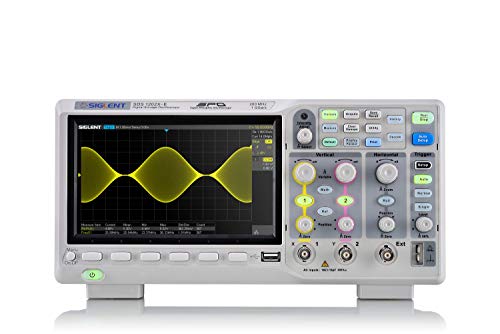
Siglent SDS1202X-E 200 MHz Digital Oscilloscope
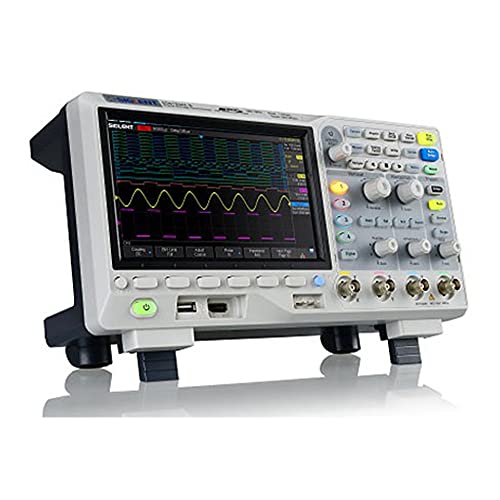
Siglent SDS1104X-E 100 MHz 4-Channel Oscilloscope
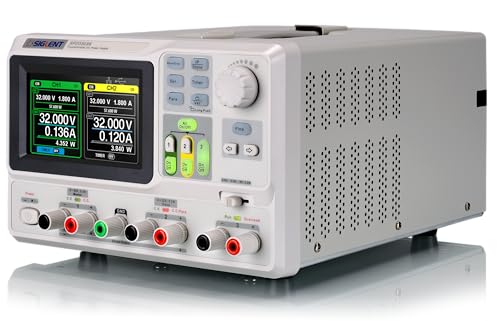
Siglent SPD3303X-E Triple Output Power Supply

FNIRSI DSO-510 Handheld 10 MHz Oscilloscope
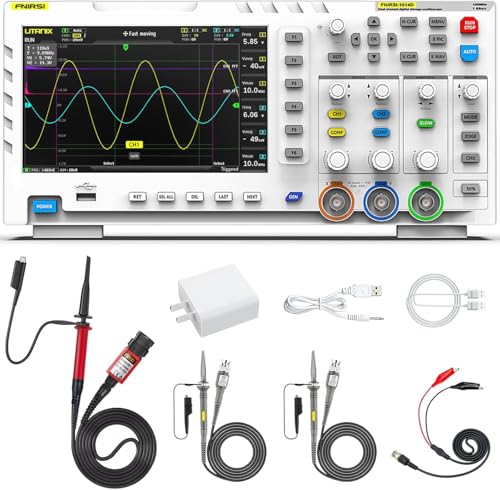
FNIRSI 1014D 100 MHz 2-Channel Oscilloscope

RIGOL DS1102Z-E 100 MHz 2-Channel Oscilloscope

Rigol DS1054Z 50 MHz 4-Channel Oscilloscope
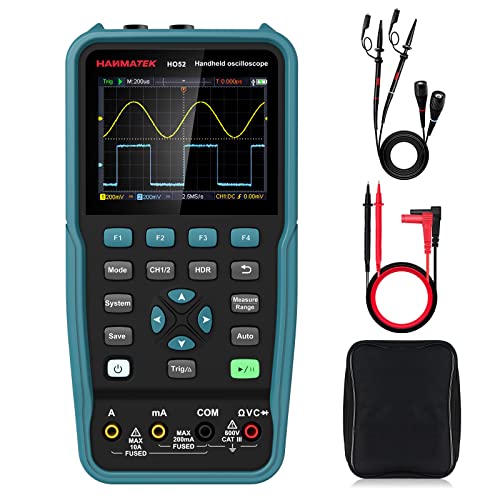
HANMATEK HO52 50 MHz Handheld Oscilloscope

RIGOL DS1202Z-E 200 MHz 2-Channel Oscilloscope
What to Know Before Buying Your First Scope
Bandwidth is the headline number, and it tells you the highest frequency signal a scope can measure accurately. For most starter projects involving audio circuits, microcontrollers, and basic sensors, 50 to 100 MHz covers everything you need for the first year or two. Sampling rate, measured in samples per second (Sa/s), decides how precisely the scope reconstructs a signal, and a rate at least twice your bandwidth keeps waveforms smooth.
Channel count matters more than beginners expect. Two channels handle most beginner work, but four channels let you watch a clock signal alongside data lines, which becomes useful the moment you start debugging serial protocols. Memory depth, measured in points (pts), determines how much of a waveform the scope can hold at once. Deeper memory means you can zoom into long captures without losing detail.
Triggering is how the scope stabilizes a repeating waveform so you can actually read it. Basic edge triggering covers most needs, while protocol decoding for I²C, SPI, and UART buses becomes handy once you start working with digital communication. Display size and update rate influence how easy the scope feels to use. Larger screens with intensity-graded color make glitches easier to spot, and faster update rates reduce the chance of missing rare events.
Connectivity rounds out the picture. USB ports let you save screenshots and waveform data, while LAN connections support remote control from a laptop. For a true beginner, two channels, 100 MHz of bandwidth, and a 7-inch screen form a sensible starting point that won’t feel limiting within a year.
More Details On Our Top Picks
The Siglent SDS1202X-E sits in that sweet spot where the price still feels reasonable for a learner, yet the spec sheet reads like gear you’d find on a professional bench. With 200 MHz of bandwidth and a 1 GSa/s sampling rate, it leaves plenty of headroom for projects that outgrow your first Arduino experiments.
Compared to entry-level two-channel options, this model brings a larger display and a more responsive interface that won’t frustrate you while learning menus. Owners commonly report that the menu structure is intuitive enough to navigate without constantly consulting the manual, which matters when you’re still building vocabulary around terms like “trigger holdoff” and “vertical scale.”
What Pays Off
- 200 MHz bandwidth comfortably covers audio, microcontroller, and basic RF projects for years of learning.
- 1 GSa/s sampling rate keeps fast signals clean and readable.
- High waveform capture rate helps catch occasional glitches that slower scopes miss.
- Standard decoder support for common serial protocols saves the cost of an upgrade later.
Things To Consider
- The two-channel layout may feel limiting once you start debugging parallel buses.
- Menu depth rewards patience, so the first week involves a real learning curve.
Made For
Hobbyists who want a single scope that grows with them from basic circuits into more advanced digital work without forcing an upgrade within a year.
Where Another Pick Suits Better
Classroom learners on a tighter budget will get more value from the Rigol DS1054Z, which trades bandwidth for a fourth channel at a lower entry cost.
Four channels change the debugging experience in ways that aren’t obvious until you try them. The Siglent SDS1104X-E lets you watch a clock, a data line, a power rail, and a sensor output all at once, which mirrors what real product development looks like.
At 100 MHz of bandwidth with a 1 GSa/s sampling rate, the spec sheet lines up with the two-channel Siglent above, though you trade some top-end bandwidth for the extra inputs. The display stays the same generous size, so reading four traces doesn’t mean squinting at a thin slice of screen.
Features That Help
- Four analog channels make multi-signal debugging genuinely practical.
- Built-in decoder for common protocols reduces the need for extra software or modules.
- The interface shares DNA with the SDS1202X-E, so upgrading later keeps the learning curve short.
- Solid memory depth supports longer captures without dropping sample rate.
Points To Note
- The 100 MHz ceiling means RF and high-speed digital projects will eventually outgrow it.
- More channels create more setup choices, which can overwhelm a true first-day beginner.
Best Suited To
Learners who already know they’ll work on projects involving multiple signals at once, such as motor control, embedded systems, or sensor arrays.
Consider Something Else When
Complete beginners sticking to simple two-circuit experiments will find the Rigol DS1054Z easier to grow into at a friendlier starting cost.
A scope alone isn’t a full bench. The Siglent SPD3303X-E is a triple-output programmable power supply that gives you 3.3 V, 5 V, and adjustable rails in one unit, replacing the mess of wall warts and breadboard regulators that clutter a starter workspace.
True linear regulation means the output stays quiet, which matters when you’re measuring small analog signals on your scope. The 10 mV and 10 mA resolution lets you dial in voltages precisely enough for low-voltage digital and analog experiments alike.
Noteworthy Benefits
- Three independent outputs replace multiple adapters and save bench space.
- Linear regulation keeps ripple low, protecting sensitive analog measurements.
- PC software support via Easy Power streamlines repetitive test setups.
- SCPI compatibility means it slots into automated workflows later.
Room For Improvement
- The fan profile, while temperature-controlled, still produces audible noise in a quiet room.
- Not strictly a scope, so it pairs with another pick on this list rather than replacing one.
Right Fit For
Builders assembling a serious starter bench who want one power source that handles analog, digital, and mixed-signal projects without constant rewiring.
Skip It When
You mainly work on battery-powered or single-rail designs, in which case a simpler fixed supply may suit the workflow better.
Handheld scopes earn their place when your project lives in a car, a control panel, or somewhere that won’t fit a bench unit. The FNIRSI DSO-510 combines a 10 MHz oscilloscope with a DDS signal generator in a portable shell, so you can troubleshoot automotive sensors or test circuits away from a workbench.
The 2.8-inch TFT screen is small by bench standards, though it’s perfectly readable at arm’s length. One-click auto setup lowers the learning curve for newcomers who don’t yet know which time base or trigger to pick for a given signal.
Everyday Wins
- Handheld form factor reaches tight spots under dashboards and inside equipment racks.
- The built-in signal generator saves carrying a second piece of gear for stimulus testing.
- One-click auto setup simplifies first measurements while you’re still learning the controls.
Worth Noting
- 10 MHz bandwidth caps the unit well below the bench options on this list, so it’s not a substitute for serious work.
- The compact display can feel cramped when comparing multiple waveform features side by side.
Who Should Grab It
Field technicians, automotive tinkerers, and learners who want a starter scope they can throw in a toolbox rather than dedicate a corner of a desk to.
Look Elsewhere When
You plan to do most of your work at a fixed bench, in which case the Rigol DS1054Z offers a much larger screen for a similar learning investment.
Compact bench scopes at modest prices have come a long way, and the FNIRSI 1014D shows what’s possible when you bundle a 100 MHz scope with a DDS signal generator. For a hobbyist on a tight budget, that combination removes the need for a separate function generator on day one.
Unlike the handheld FNIRSI above, this unit expects to sit on a desk, and the larger color display makes waveform reading much easier. The 1 GSa/s real-time sampling rate keeps 100 MHz signals clean enough for most learning projects.
Points In Its Favor
- Two-in-one design saves the cost of buying a dedicated signal generator.
- 100 MHz bandwidth gives the same headroom as pricier competitors for typical hobby work.
- Single, normal, and automatic trigger modes cover beginner measurement needs.
Points To Keep In Mind
- Build quality and firmware polish don’t always match the bigger brand names, so menu quirks can surface.
- Two channels only, which limits debugging of multi-rail or parallel-bus circuits.
Perfect Match For
DIY builders and students who want the most capability per dollar and don’t mind spending time learning the menus through trial and error.
A Better Fit Elsewhere
Anyone who values long-term reliability and brand support should step up to the RIGOL DS1102Z-E, which offers similar bandwidth with more refined firmware.
RIGOL built a reputation around the DS1000Z series for good reason, and the DS1102Z-E carries that lineage forward. A 100 MHz bandwidth, 1 GSa/s sampling rate, and 24 Mpts of memory give you serious capture depth for the price, which pays off when you’re hunting for rare glitches.
The 7-inch WVGA display with intensity-graded color helps transient signals stand out, which is one of the first features beginners notice after they outgrow a basic scope. Waveform capture rates up to 30,000 wfms/s mean intermittent events are less likely to slip past unnoticed.
Notable Gains
- Deep memory supports longer captures at full sample rate.
- Intensity-graded color display makes occasional glitches easier to spot.
- RIGOL’s firmware ecosystem has matured, so menu quirks are well documented online.
- External trigger input enables synchronization with external events.
A Few Limitations
- Two channels only, so multi-signal debugging means careful signal switching.
- The learning curve matches the feature depth, and beginners may not use half the menu for months.
Who Will Love This
Learners who want a trusted platform, deep community documentation, and a screen that doesn’t feel small the moment they sit down to work.
Reach For A Different Pick When
Four channels matter to your project workflow, in which case the Siglent SDS1104X-E offers a similar display experience with more inputs.
The Rigol DS1054Z has earned its reputation as the scope that teaches a generation of engineers, and the 50 MHz bandwidth covers most classroom and hobby circuits without breaking the bank. Four channels open up debugging possibilities that two-channel units can’t match, especially for digital work.
The 7-inch display with intensity-graded color and 30,000 wfms/s capture rate mirrors what you find on its higher-bandwidth siblings, so the learning experience scales naturally if you upgrade later. Serial decoding for UART, I²C, and SPI comes standard, removing one of the typical add-on costs.
Positive Points
- Four channels handle parallel bus debugging out of the box.
- Standard protocol decoding for common serial standards saves an upgrade.
- Large waveform record and playback features help review captured events at your own pace.
- A massive community of users means tutorials and troubleshooting tips are everywhere.
Honest Caveats
- 50 MHz bandwidth will eventually feel limiting for RF or high-speed digital projects.
- The interface depth can overwhelm a true first-day user, though the auto-setup button helps.
Feature Snapshot
Built With In Mind
Students, classroom labs, and self-taught hobbyists starting from zero who want a forgiving platform with room to grow.
Where A Sibling Pick Shines
Project work that pushes past 50 MHz, such as switching supply or RF experiments, will appreciate the extra bandwidth on the Siglent SDS1202X-E.
The HANMATEK HO52 doubles as a scope and a multimeter, which is unusual for a handheld unit at this size. A 3.5-inch backlit TFT screen sits between the probes, and the 50 MHz bandwidth covers a wider range of circuits than the smaller FNIRSI handheld above.
Auto-calibration helps when you’re switching between very different signal levels throughout a session. The two-channel input still lets you compare timing between two signals, though the small screen means dense multi-trace work stays a stretch.
What Earns Its Place
- Scope and multimeter in one unit reduces the gear you carry to a job site.
- 50 MHz bandwidth reaches further than entry-level handhelds, opening more measurement scenarios.
- Auto-calibration simplifies setup between very different measurement tasks.
Trade-Offs
- The 3.5-inch screen feels compact when reading fast or noisy waveforms.
- Battery life on handheld units like this typically demands regular charging during heavy use.
Whose Shelf It Belongs On
Tinkerers who fix things on the go, from arcade machines to vintage audio gear, and want one tool that handles both voltage checks and waveform checks.
Swap It Out When
Bench-based learning is your main mode, since the Rigol DS1054Z offers a larger screen and four channels for a similar investment.
The RIGOL DS1202Z-E takes everything the DS1102Z-E offers and stretches it to 200 MHz of bandwidth, which is meaningful headroom once you start exploring higher-speed digital interfaces or RF circuits. Two channels still apply here, so the trade-off mirrors the rest of the lineup.
Same 7-inch WVGA display, same 24 Mpts of memory, same 30,000 wfms/s capture rate. The upgrade reads as a bandwidth extension rather than a complete re-platform, which makes it easier to recommend for hobbyists who already know they want more frequency range.
The Case For It
- 200 MHz bandwidth extends useful life into switching supply and basic RF projects.
- Familiar RIGOL interface shortens the adjustment period compared to switching brands.
- Same deep memory and fast capture rate as the lower-bandwidth sibling.
- External trigger input preserves synchronization flexibility for advanced experiments.
Worth Bearing In Mind
- Two channels remain the limit, which constrains multi-rail debugging compared to four-channel units.
- The extra bandwidth goes unused for simple beginner circuits, so it’s a future-proofing buy.
Feature Snapshot
Perfect Match For
Hobbyists who already know their projects will push past 100 MHz and want a single scope that won’t bottleneck their growth.
Not Your Match When
Your work stays in the audio and micro-controller realm, where the Rigol DS1054Z offers more channels for the same learning budget.
Picking the Right Beginner Scope for Your Work
Pitfalls Shoppers Hit
Buying more bandwidth than your projects need is one of the most common beginner traps. A 200 MHz scope sounds impressive, yet audio circuits and slow sensor signals work just as well on a 50 MHz unit, and the extra cost rarely translates to better learning. Choose bandwidth that matches the fastest edges you expect to see in the next year or two, not the spec sheet you wish you needed.
Ignoring channel count is another common miss. Two channels handle a basic input/output comparison, but the moment you start working with serial communication, motor control, or power supply debugging, four channels save hours of probe swapping. Spending a little more now on a four-channel unit often beats trading in a two-channel scope later.
Underestimating display size makes measurements harder than they need to be. A 7-inch screen with intensity-graded color reveals glitches that disappear into a small monochrome display. Probe quality, while easy to overlook, shapes your daily experience more than most beginners expect. The standard probes that ship with most scopes work fine for learning, though worn or generic replacements introduce noise that beginners mistake for circuit problems.
Where The Extra Money Goes
Premium-tier scopes justify their cost through deeper memory, faster waveform update rates, and broader protocol decoding. The Rigol DS1202Z-E and Siglent SDS1202X-E sit in this tier, and the upgrade pays off once your projects involve fast digital signals or repetitive captures where a slow update rate hides rare events. Four-channel units like the Siglent SDS1104X-E bundle more inputs without sacrificing much bandwidth.
The upgrade makes sense when your projects have outgrown a starter scope’s capture depth or channel count. For learners still mastering triggering and voltage scales, a 50 or 100 MHz unit with a 7-inch screen offers everything needed to build real skill without overspending on headroom that won’t get touched yet.
Frequently Asked Questions
How much bandwidth do I really need as a beginner?
For audio circuits, microcontrollers, and basic sensors, 50 to 100 MHz covers nearly every beginner project. Reach for 200 MHz only when you start exploring switching supplies, high-speed digital, or radio frequency work.
Do I need four channels from the start?
Two channels are enough for the first few months of learning. Once you start debugging serial communication or watching a power rail alongside a signal, four channels save a lot of probe swapping and become the new normal.
What is protocol decoding, and do beginners need it?
Protocol decoding turns serial buses like I²C, SPI, and UART into readable text on the screen, rather than raw waveforms. It’s not essential on day one, though it makes digital projects much easier to interpret once you reach that stage.
Is a handheld scope enough for learning, or should I get a bench unit?
A handheld scope suits field work and quick checks, yet the small screen and limited bandwidth make it a tough primary learning tool. A bench scope with a 7-inch display and proper trigger controls teaches you faster for most home projects.
How important is memory depth for a beginner scope?
Memory depth matters once you start zooming into long captures. Beginners benefit from at least a few million points so the scope can hold detail at slower time bases without going blurry.
Wrap Up
The right beginner scope is the one you’ll actually use, not the one with the most impressive spec sheet. Start with a clear sense of which signals you’ll measure most, and pick the smallest unit that covers those needs with room to grow. A reliable bench scope with a usable screen will teach you more in six months than a feature-packed unit that sits untouched because the menus feel overwhelming. Take your time, learn the basics on whatever you choose, and upgrade when your projects clearly demand it.
