

Setting up a home workbench usually starts with a real question: where’s the power coming from? A bench power supply turns a wall outlet into a steady, controllable DC source for testing radios, repairing circuit boards, charging 12-volt gear, or running small bench experiments. The hard part is matching the right supply to the kind of work you actually do. I pulled together ten options that span simple 12-volt converters, mid-range variable units, and pro-leaning programmable supplies, so you can skip the spec-sheet rabbit hole and pick one with confidence.
The Picks In Brief

Pyramid PS15K.5 10 Amp Linear Bench Power Supply

Pyramid PS9KX 5 Amp Linear Bench Power Supply

Jesverty SPS-50II 50 Amp Regulated Bench Power Supply

Pyramid 7A Bench Power Supply with USB

Mean Well RS-15-5 AC to DC Power Supply 5V 3A

WANPTEK TPS-C3010 30V 10A Variable Bench Power Supply

Pyramid PS14KX.5 12 Amp Linear Bench Power Supply
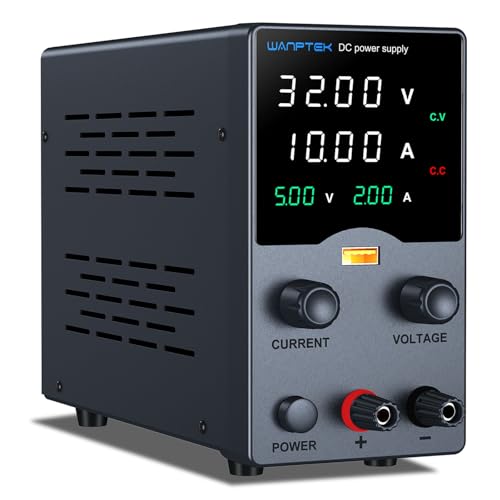
WANPTEK 30V 10A Adjustable Bench Power Supply

Hyelec 30V 5A Adjustable Switching Bench Power Supply

WANPTEK 0-30V 0-10A Adjustable Switching Bench Supply
More Details On Our Top Picks
The Pyramid PS15K.5 sits in that comfortable middle ground where hobbyists and tinkerers tend to land. It takes standard 115V AC from the wall and delivers a regulated 13.8V DC output (a regulated supply keeps voltage steady even as load changes), which is the sweet spot for running CB radios, scanners, and ham gear from a bench setup. The 10-amp capacity gives you headroom for accessories without immediately tripping protection, and the included cigarette lighter plug is handy for testing 12-volt automotive devices indoors.
Compared with the smaller Pyramid PS9KX that follows on this list, this one trades compactness for breathing room. For most home benches running mid-current 12-volt loads, the extra amperage is the difference between “just enough” and “comfortably enough.”
A Few Highlights
- Linear regulated design (linear regulation produces cleaner DC output with less electrical noise than many switching supplies) at 10 amps for steady bench performance
- Universal screw-type terminals accept a wide range of wire gauges and connectors
- Front cigarette lighter socket adds quick testing capability for car-style accessories
- Solid choice for radio work where clean 13.8V matters more than adjustable output
Things To Consider
- Fixed 13.8V output, so it is not the right tool for projects needing variable voltage
- Linear supplies run heavier and warmer than switching units, so plan ventilation around the bench
Who Should Grab It
Anyone setting up a ham or CB radio bench who wants clean, predictable 12-volt power without fiddling with knobs.
Reach For A Different Pick When
Shoppers needing adjustable voltage for circuit testing should look at the Jesverty SPS-50II further down this list.
The Pyramid PS9KX is the kind of supply you buy once and forget about. It accepts 115V AC, converts it to a steady 13.8V DC, and hands it out through screw-type terminals plus a 10-amp cigarette plug for accessories. There are no menus, no encoders, no modes to learn. Plug it in, attach your load, and the unit quietly does its job.
It is a noticeably smaller sibling to the Pyramid PS15K.5 covered above, trading down from 10 amps to 5 amps and from 250 watts to 70 watts. For light radio work, charging small 12-volt devices, or running a single bench fixture, that is plenty. For heavier multi-radio setups, it will feel under-sized.
What Works In Its Favor
- Linear regulated output keeps ripple (residual AC hum that rides on top of DC) low for sensitive radio gear
- Compact chassis fits on a crowded shelf or in a smaller work area
- Universal screw terminals and cigarette plug cover the common 12V connector styles
Worth Noting
- 5 amps caps how many accessories you can run at once
- Single fixed voltage, so this is not the unit to reach for when dialing in different rails
Built With In Mind
Beginners running a single CB radio or basic 12-volt accessories who want a simple, no-learning-curve supply.
Swap It Out When
Higher-current radio racks benefit more from the Jesverty SPS-50II covered later in this roundup.
The Jesverty SPS-50II is the muscle car of this list. Where the smaller Pyramid supplies hand out a fixed 13.8V, this unit lets you dial the output anywhere from 9 to 15 volts while pushing up to 50 amps. A built-in cooling fan keeps things stable during long bench sessions, and large screw-type main terminals accept thick cables for high-current loads.
Compared with the Pyramid PS14KX.5 linear supply covered later, this is a switching design (switching supplies are lighter and more efficient, though they can introduce more electrical noise). For a basement ham shack or an audio bench running multiple amplifiers, the adjustable voltage alone justifies the jump. Hobbyists with smaller rigs will rarely use even half of what it offers.
Noteworthy Benefits
- Continuously adjustable 9V to 15V output covers most DC device testing scenarios
- 50-amp capacity handles demanding multi-radio or amplifier loads without sagging
- Dedicated cooling fan supports extended high-current draws
- Large screw terminals make heavy-gauge cable terminations straightforward
Room For Improvement
- Switching topology means more careful filtering is needed for very noise-sensitive radio work
- Larger footprint than fixed-voltage supplies, so it needs dedicated bench space
- Overkill for someone only running a single low-power radio
Feature Snapshot
Whose Shelf It Belongs On
Amateur radio operators and audio hobbyists running high-current 12-volt equipment from a permanent bench.
A Better Fit Elsewhere
The Pyramid PS14KX.5 is a calmer pick for someone who values linear regulation over raw current.
The Pyramid 7A keeps the familiar 12V bench format but adds something the older Pyramid models skip: front-panel USB ports. You still get the regulated 13.8V DC conversion from a 120V AC wall outlet, plus universal banana plug terminals (banana plugs are standard 4mm connectors used widely on test equipment) and a cigarette lighter socket for car-style devices. The 7-amp capacity lands between the small PS9KX and the larger PS15K.5.
For someone testing a mix of radios, phones, and small electronics at the same bench, having USB on the front panel means fewer wall adapters cluttering the workspace. The trade-off is that you give up some of the raw current headroom that the 10-amp and 12-amp Pyramid supplies offer.
Real-World Strengths
- Two front USB ports let you charge phones and small devices directly from the supply
- Banana plug terminals accept standard 4mm test leads without adapters
- Regulated 13.8V output suits radio and 12V accessory testing equally well
- Front cigarette lighter socket mirrors the larger Pyramid units for compatibility
Trade Offs
- 7 amps is the ceiling, so larger amplifiers will outpace it
- USB ports add convenience but are slower than dedicated high-current bench supplies
Right Fit For
Tinkerers who split their bench time between radio gear and modern USB-powered devices.
Consider Something Else When
The WANPTEK 30V 10A unit further down this list is a smarter match when variable voltage is the priority.
The Mean Well RS-15-5 is not a bench supply in the traditional sense. It is an enclosed 15-watt AC-to-DC converter that delivers a single fixed 5V output at 3 amps. The chassis measures just 2.5 by 2.0 by 1.1 inches, small enough to tuck inside an enclosure or mount behind a project panel. For someone building a permanent 5V rail into a larger system, that compactness is the whole appeal.
Mean Well has a long reputation for industrial-grade power electronics, and the RS-15-5 reflects that. Ripple and noise stay at 80 mV peak-to-peak, and load regulation (the spec that tells you how much voltage drifts as you draw more current) holds within 1.5 percent. It accepts a wide 88-264VAC input range, so it travels well between 120V North American outlets and 230V European supplies.
What Stands Out
- Tiny footprint fits inside enclosures, projects, or tight control panels
- Wide 88-264VAC input range supports international mains without rewiring
- Solid load and line regulation for an enclosed fixed-voltage converter
- Reliable Mean Well build quality favored in industrial installations
A Few Limitations
- Fixed 5V output only, so it does not replace a general bench supply
- 15W total power caps how much you can run at once
- No display or adjustment, so dialing in voltages is not possible
Quick Facts
Perfect Match For
Embedded developers and DIY builders who need a clean fixed 5V rail inside a project rather than on the bench surface.
Skip It When
Anyone wanting adjustable voltage and a real bench display should head to the WANPTEK supplies later in this roundup.
The WANPTEK TPS-C3010 is where this roundup pivots from fixed 12-volt converters into true variable bench supplies. The output covers 0 to 30 volts at up to 10 amps, so it handles everything from logic-level 3.3V work up to amateur radio voltages. The four-digit LED display, encoder knob, and memory presets feel closer to professional bench gear than the Pyramid units above.
Compared with the simpler Hyelec 30V 5A covered below, this one doubles the current ceiling and adds an output switch, key lock, and overcurrent protection (OCP shuts the unit down if it draws more current than you set). USB fast-charge on the front panel is a small but practical touch for keeping test devices topped up while you work.
The Practical Payoff
- Full 0-30V, 0-10A adjustable range covers the widest bench scenarios in this list
- Memory presets save common voltage/current combinations for repeat jobs
- OCP protection limits damage when a prototype circuit misbehaves
- Output switch lets you disconnect the load without powering down the supply
- USB fast-charge port handles phones and small electronics at the bench
Where It May Fall Short
- More complex menu and button layout than fixed-voltage supplies, so newcomers face a learning curve
- Switching supply design may need extra filtering for ultra-sensitive RF work
Who It Suits Best
Repair technicians and serious hobbyists running daily diagnostic work who appreciate preset recall and protection features.
Look Elsewhere When
Shoppers wanting simpler operation should consider the Hyelec 30V 5A further down this list.
The Pyramid PS14KX.5 is the beefiest of the fixed-voltage Pyramid units in this lineup. It delivers 13.8V DC at up to 12 amps, fed by a 270W AC input, with screw terminals and overload protection for the main outputs. A built-in cooling fan is the upgrade that matters most, keeping the chassis cool during long sessions where the smaller PS15K.5 would run warmer.
The fan noise is the obvious trade-off: in a quiet basement shack, the hum becomes noticeable. Compared with the Jesverty SPS-50II covered earlier, you give up adjustable voltage and gain the cleaner output of a linear supply. For someone who only ever needs 12 volts but wants the cleanest signal possible, this sits in a comfortable middle.
Useful Highlights
- 12 amps of linear regulated output suits multi-radio or amplifier loads
- Cooling fan supports extended high-current bench sessions
- Overload and short circuit protection with auto-reset fuse
- Linear topology produces low-noise DC for sensitive radio gear
Honest Caveats
- Cooling fan adds a constant background hum to quiet benches
- Heavier chassis than switching supplies, so it needs a sturdy shelf
- Single fixed voltage limits its usefulness for circuit prototyping
Technical Reference
Made For
Active ham operators or 12-volt hobbyists who run heavy loads for hours at a time and want clean linear power.
Where Another Pick Suits Better
The WANPTEK TPS-C3010 earlier in this roundup is a better match when adjustable voltage matters more than linear purity.
The WANPTEK 30V 10A adjustable supply trims features back compared with the TPS-C3010 reviewed earlier, focusing on what most bench users actually need: clean adjustable output, a precise encoder knob, a four-digit LED display, and a real-time output readout. The result is a unit that feels approachable rather than overstuffed with menus.
The encoder knob is the headline feature here. Instead of a traditional potentiometer (a basic analog dial whose accuracy drifts over time), you press to select a digit and rotate to set values. That makes dialing in 13.80V or 1.250A feel like programming a multimeter, fast and repeatable. The included USB fast-charge port is a small bonus for keeping test phones and Raspberry Pi boards powered during longer jobs.
Everyday Advantages
- Encoder knob allows precise digital value setting instead of analog guessing
- Four-digit LED display shows voltage and current simultaneously
- USB fast-charge port for phones and small electronics at the bench
- Real-time output display helps you spot drift or load issues early
Points To Keep In Mind
- Lacks the memory presets and OCP of the higher-end WANPTEK TPS-C3010
- Encoder knobs can feel finicky for users used to classic analog dials
Best Suited To
DIY builders and small repair shops who want fast, precise adjustments without paying for pro-tier features.
Not Your Match When
Engineers needing saved presets and overcurrent protection should look at the WANPTEK TPS-C3010 covered above.
The Hyelec 30V 5A brings encoder-knob precision into a smaller, lighter package. Output covers 0 to 30 volts at up to 5 amps, with display resolution down to 0.01V and 0.01A. That granularity is genuinely useful when you are setting precise thresholds for low-voltage logic circuits or simulating battery states. The included 110V alligator leads clip straight onto test points without extra adapters.
Compared with the WANPTEK 30V 10A above, this one trades half the current capacity for a friendlier price point and a similar fine-adjustment feel. For hobbyists and students who rarely push past 3 amps, that is a fair swap. The data-hold feature is the small touch that makes long measurements easier, freezing the displayed value so you can record it without juggling the probes.
Everyday Wins
- Coarse and fine adjustment in a single encoder knob simplifies precise dialing
- 0.01V and 0.01A display resolution supports low-voltage circuit work
- Data-hold function freezes readings for easier note-taking
- Switching design keeps the chassis light and compact for a portable bench
Potential Drawbacks
- 5-amp ceiling limits use with larger power-hungry devices
- Switching topology may introduce more ripple than linear supplies for sensitive RF tests
Made For
Electronics students, makers, and hobbyists running microcontroller and small-signal projects at home.
A Better Fit Elsewhere
The Jesverty SPS-50II earlier in this list handles heavier 12-volt work more comfortably.
The WANPTEK 0-30V 0-10A closing out this list adds USB-C quick-charge to the standard variable bench formula. The same coarse-and-fine encoder knob from the WANPTEK 30V 10A above shows up here, along with a 3.6A USB output, a separate Type-C quick-charge port, and overcurrent protection that alerts you when a load draws more than the set limit.
For makers and mobile repair technicians, the dual fast-charge ports are the practical win. You can power a USB-C device under test at full speed while still using the main banana jack outputs for the rest of the bench. Compared with the simpler Hyelec 30V 5A, this unit doubles current capacity and adds modern device compatibility without much size penalty.
Where It Helps
- USB-A and Type-C fast-charge ports cover modern phone and tablet testing
- Encoder coarse-and-fine knob enables quick and precise value adjustments
- Overcurrent protection with audible alert catches faults before damage spreads
- Four-digit high-definition display keeps readings sharp at any angle
Smaller Caveats
- Beep alerts on OCP events can be silenced but are awkward to toggle by accident
- Switching design still adds some ripple compared with linear Pyramid units
Perfect Match For
Mobile repair technicians and creators juggling USB-powered devices alongside traditional DC loads on the same bench.
Where A Sibling Pick Shines
Shoppers who prioritize raw 12V current capacity over modern ports benefit more from the Jesverty SPS-50II covered earlier.
Picking The Right Bench Power Supply For Your Work
Voltage range, current capacity, and regulation type are the three numbers worth memorizing before buying. Voltage range decides whether you can cover both 3.3V logic work and 24V motor testing from the same unit. Current capacity caps how much you can power at once; undersizing here is the most common mistake. Regulation type splits the field into linear supplies (cleaner output, heavier, run warmer) and switching supplies (lighter, cooler, more efficient, but can introduce more electrical noise on the output).
Think honestly about your bench. A ham operator running multiple radios cares more about clean 13.8V linear output than display readouts. A repair technician juggling phones and circuit boards wants adjustable voltage, USB ports, and overcurrent protection. A hobbyist running weekend microcontroller projects needs precise low-voltage control without overspending on current headroom they will never use.
Fixed vs. adjustable is the next fork. Fixed 12V supplies (like the Pyramid family) are simpler, cheaper, and more compact, but they only ever do one job well. Adjustable supplies cover every voltage you are likely to need, at the cost of a slight learning curve and a higher price. Picking between them comes down to whether you expect to work on projects at multiple voltages or stick to a single rail.
Build quality and protection features are where spending up earns its keep. Encoders beat analog potentiometers for repeatability. Memory presets save time on recurring jobs. Overcurrent protection prevents expensive damage when a prototype circuit goes wrong. For occasional weekend use, those extras are nice. For daily bench work, they pay for themselves quickly.
What To Watch When Shopping
Pitfalls Shoppers Hit
One of the easiest mistakes is matching current capacity to a single device rather than to the full bench. A 5-amp supply feels fine powering one radio, then struggles the moment you add an amplifier or accessory chain. Plan for what you might add in the next year or two, not just what sits on the bench today.
Another common slip is ignoring the difference between linear and switching supplies until noise becomes a real problem. Sensitive radio receivers can pick up switching noise (the high-frequency electrical interference that switching supplies generate as they rapidly toggle current on and off) that turns the audio into a hash of buzzes. If your work touches RF or analog audio, lean linear.
A third trap is treating wattage and current as the same spec. They are related, but a 250W 13.8V supply only delivers about 18 amps. Mixing the two numbers when comparing supplies leads to either oversized purchases or undersized disappointments.
Where The Extra Money Goes
Higher-tier adjustable supplies earn their price through better encoder knobs, brighter four-digit displays, memory preset banks, and built-in protection like overcurrent shutdown. Those features translate into less time fiddling and fewer damaged prototypes. For occasional hobbyists, the jump is hard to justify. For daily repair or lab work, the speed and safety benefits stack up fast.
USB-C and fast-charge ports are another place the upgrade shows. Cheaper supplies skip them entirely, forcing you to keep separate wall adapters nearby. A unit with built-in charging ports consolidates the bench and removes a tangle of cables, which is a small but real quality-of-life bump during long sessions.
Frequently Asked Questions
What Is A Bench Power Supply Used For?
A bench power supply converts wall AC into a stable, controllable DC source for testing electronics, powering radios, charging 12V batteries, and running small bench experiments. It is the everyday tool for hobbyists, repair technicians, and amateur radio operators who need predictable DC at the workbench.
Linear Vs. Switching Bench Power Supply, Which Is Better?
Linear supplies produce cleaner output with less electrical noise, making them ideal for sensitive radio and audio work. Switching supplies are lighter, cooler, and more efficient, with wider voltage ranges and modern features like USB ports. The honest answer is that neither is universally better; it depends on whether you prioritize low noise or compact flexibility.
How Many Amps Do I Need?
For a single low-power radio or basic electronics work, 5 amps is usually enough. For multi-radio benches, amplifiers, or motor testing, 10 amps gives comfortable headroom. For high-current rigs or audio amplifiers pushing serious wattage, 30 to 50 amps prevents the supply from being the bottleneck.
Can A Bench Power Supply Replace A Battery?
Yes, for most testing and bench work, a regulated 13.8V supply behaves like a fully charged 12V battery under load. Many radio operators use them this way for shop testing. They cannot, however, deliver the brief high-current surges that starter batteries provide, so they are not a substitute for cranking a car engine.
Do I Need USB Ports On A Bench Supply?
Built-in USB ports are convenient for charging phones, powering Raspberry Pi boards, and testing USB-powered devices without extra adapters. They are not essential for traditional radio or 12V accessory work, but they meaningfully tidy up the bench for anyone testing modern electronics alongside older gear.
The Takeaway
The right bench power supply is the one that matches the voltage range, current capacity, and feature set to your actual work, not the one with the longest spec list. Fixed 12V units cover simple radio benches, mid-range adjustable supplies handle most repair and hobby jobs, and high-current or precision-focused units serve the more demanding workshops. Match your real workload to one of these ten and the rest takes care of itself.
