

A single corroded splice can strand a vehicle, kill a stereo, or sink a bilge pump. I’ve put together this roundup so anyone tackling trailer wiring, marine repairs, or off-grid electrical work can find a connector kit that fits the job without sifting through dozens of vague listings.
A Snapshot Of The Selections

Kuject 500PCS Multipurpose Heat Shrink Wire Connectors Assortment Kit

haisstronica 330PCS Heat Shrink Butt Connectors, 26-10 AWG

660 PCS Heat Shrink Butt Connectors Qibaok Crimp Wire Connector Kit

WAGO 221-2401 Lever Nuts Compact Splicing Inline Wire Connectors (20pc)
Kuject Ultimate Heat Shrink Wire Connectors 1500PCS Spade Kit

haisstronica 330PCS Non-Insulated Ring and Fork Terminals, 22-10 AWG

Kuject Mini Heat Gun with 120PCS Solder Seal Wire Connectors Kit

Kuject Mini Heat Shrink Gun Kit, 820PCS Solder Seal Wire Connectors

Ultimate All-in-One Heat Shrink Solder Seal Wire Connectors Kit, 2000PCS

Kuject 1200PCS Solder Seal Wire Connectors Kit with Heat Gun & Organizers
What Each Pick Brings To The Table
The Kuject 500-piece assortment covers the most common terminal shapes in one box, which matters when a weekend project drifts between trailer lights, a marine radio, and a golf cart. Heat shrink insulation seals each joint against moisture intrusion, and the included mix spans rings, forks, quick disconnects, butt splices, T-taps, and solder sleeves.
Compared to single-style kits, this one trades a little specialization for breadth. Garage tinkerers and shade-tree mechanics get a ready-made drawer of connectors without ordering five separate packs. Removable dividers inside the case keep the smaller pieces from spilling into one pile.
The Practical Payoff
- Six terminal types cover nearly any 12V or low-voltage repair around a vehicle or boat
- Heat shrink adhesive lining creates a sealed bond once heated, important for under-hood or bilge areas
- Removable dividers prevent the small fork and spade terminals from migrating around the case
- A 500-piece count comfortably outlasts several weekend projects before resupply is needed
Worth Noting
- Because the kit spreads parts across six styles, no single category runs deep, so heavy users of one terminal type may run short
- A separate crimping tool and heat source are required; the kit ships only the connectors
Who It Suits Best
Shade-tree mechanics and weekend hobbyists juggling a mix of automotive, marine, and trailer repairs who want one organized case to reach into.
Consider Something Else When
Anyone wiring a full car audio install should look at the Qibaok 660-piece kit, since its gauge-coded butt splices handle dense stereo runs more efficiently.
The haisstronica 330-piece kit focuses on a single job: butt-splicing two wires together cleanly and safely. Each connector pairs a copper barrel with adhesive-lined heat shrink tubing, and the AWG range from 26 to 10 covers everything from tiny sensor leads to heavier accessory circuits.
Compliance paperwork matters for some shops, and this kit ships documentation referencing ROHS, ISO 9001:2008, SGS, and CE standards. That pedigree signals the manufacturer pays attention to traceability, which appeals to professional installers. The thick-walled barrel reduces pull-out risk in vibration-heavy engine bays.
Where It Excels
- A single-purpose format means deep stock in every included AWG: 22-16, 16-14, 12-10, and 26-24
- Compliance documentation makes the kit a clean fit for regulated shop environments
- Thicker copper barrel walls tend to resist pull-out in vibration-prone mounting locations
- Adhesive-lined shrink tubing seals the joint once heat is applied, blocking moisture migration
Trade Offs
- The kit contains only butt splices, so projects requiring rings, forks, or spades need a second purchase
- Color-coded tubing helps identification but assumes the user already knows their wire gauge before opening the bag
Feature Snapshot
Built With In Mind
Compliance-minded installers and repair shops that need documentation alongside the connectors themselves.
Look Elsewhere When
The Kuject 500-piece kit suits hobbyists better, since it bundles six terminal styles for varied weekend projects rather than specializing in splices.
Color-coded tubing with the wire gauge printed right on the insulation turns the Qibaok kit into a beginner-friendly option. Rather than squinting at barrel diameters, the user grabs a red sleeve for 22-16 gauge, a blue sleeve for 16-14, and so on. That’s a small detail that prevents mismatched crimps on a first attempt.
The 660-piece count doubles the haisstronica kit’s volume in a similar single-style format. Polyolefin shrink tubing combined with internal hot-melt adhesive creates the moisture seal, and the marketing fits squarely into automotive, marine, trailer, and stereo use cases.
Features That Help
- Wire gauge imprint on the tubing removes guesswork when sorting through a busy workbench
- Polyolefin outer layer shrinks tight while hot-melt adhesive flows inward for a complete seal
- A 660-piece count supports longer harness builds without mid-project resupply
- Thick barrel construction gives the crimp a strong mechanical grip before the heat step
Points To Keep In Mind
- Like the haisstronica kit, this one covers butt splices only, leaving ring and fork terminals for a separate purchase
- The adhesive-lined shrink needs a heat source; a hair dryer rarely gets hot enough to seal reliably
Right Fit For
DIYers new to crimping who appreciate gauge labels printed on the insulation rather than memorizing color charts.
Not Your Match When
Anyone needing lever-actuated connectors for indoor AC wiring should grab the WAGO 221-2401 kit instead, since it serves a different use case entirely.
The WAGO 221-2401 is a fundamentally different tool: a lever-actuated splicing connector for solid, stranded, and flexible copper wire. Lift the orange lever, insert the stripped conductor, snap the lever down, and the connection is done, no crimp tool, no solder, no heat gun required.
The transparent housing pays off in a way most people don’t expect: I can look right through the shell to confirm full wire insertion and proper strip length. The 20-12 AWG solid and 18-12 AWG stranded range covers most indoor and low-voltage scenarios, though the inline format favors home repair shops over under-hood automotive work.
Real Benefits
- Reusable levers let the user disconnect, reposition, and reconnect without destroying the connector
- Transparent housing turns the splice into a self-checking joint; strip length errors are visible
- Works on solid, stranded, and flexible copper conductors, which suits mixed wire types during repairs
- The included plastic case keeps small connectors corralled in a drawer or service truck
Honest Caveats
- This connector targets indoor and low-voltage work, not the sealed, vibration-heavy environment of a vehicle engine bay
- At 20 pieces, the count is modest compared to the multi-hundred kits elsewhere in this list
Made For
Home electricians and appliance repair techs who want a toolless, reusable connection method for indoor or shop-based wiring.
A Better Fit Elsewhere
For sealed marine or trailer wiring, the Kuject 500-piece assortment provides the heat-shrink protection that lever nuts cannot match.
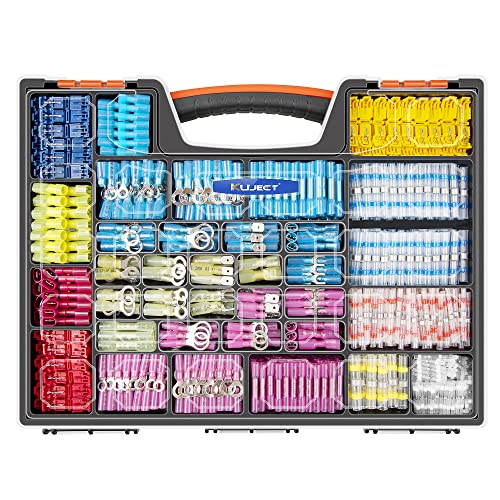
Where the 500-piece Kuject kit spreads across styles, this 1500-piece version doubles down on depth across the same terminal categories. Pros who chew through a hundred connectors on a single trailer harness won’t find themselves resupplying mid-job, and the included case has a handle plus small organizers that travel between the shop truck and a job site.
The packaging does real work. Instead of digging through a tangled plastic bag, the user opens a structured case with labeled compartments. That’s a quiet upgrade that saves time when a dozen wires are stripped and waiting in line.
Well-Handled Touches
- 1500 connectors across rings, forks, spades, T-taps, and solder sleeves give deep stock in every category
- A purpose-designed case with a handle turns the kit into a portable workstation between sites
- Adhesive-lined heat shrink insulation handles marine, automotive, and truck environments equally well
Room For Improvement
- The larger piece count and structured case take up more shelf space than slimmer alternatives
- Buyers who only need a handful of splices for a small repair may find the size overkill
Feature Card
Whose Shelf It Belongs On
Professional technicians and serious hobbyists who run multi-day wiring projects and want connectors on hand without repeat orders.
Swap It Out When
The Kuject Mini Heat Gun kit makes more sense for someone starting from scratch, since it bundles the heat source alongside a starter count of connectors.
Non-insulated terminals fill a specific niche: stud-mounted grounding points and battery lug connections where a ring terminal needs to seat flush against metal. The haisstronica kit provides 240 ring terminals and 90 fork terminals across the 22-10 AWG range, covering most low-voltage grounding work.
Tinned copper is the material choice here, and it tends to crimp more predictably than bare copper because the plating reduces oxidation at the joint. For projects that already plan separate heat shrink or vinyl boots, this stripped-down kit makes sense. For raw under-hood use, expect to add insulation after crimping.
Positive Takeaways
- Tinned copper plating resists oxidation at the crimp point and tends to flatten predictably under a proper tool
- A 240-piece ring count handles grounding harnesses that span the full vehicle chassis
- The 22-10 AWG range covers battery cables down to small accessory leads
Trade-Offs To Consider
- Without insulation, every joint requires separate heat shrink tubing or vinyl boots for sealed environments
- The kit excludes butt splices, so wire-to-wire repairs call for a second connector purchase
Who Will Love This
Technicians building battery and grounding harnesses where ring terminals mount to studs, bolts, or bus bars inside an engine bay.
Reach For A Different Pick When
Anyone who wants sealed, ready-to-use connectors off the shelf should consider the Kuject 500-piece assortment, which arrives with built-in heat shrink.
Solder seal connectors are an interesting middle ground between crimp-and-shrink and a full solder joint. The sleeve contains a ring of low-temperature solder and adhesive rings at each edge, so a single heat pass simultaneously solders the wire and seals the joint. The Kuject kit ships the connectors alongside a 350W dual-temperature heat gun, removing the tool-buying barrier for first-time users.
Two heat settings, 482°F and 752°F, let the user dial down for delicate work or up for faster cycling. An anti-scald front shield and overheat protection round out the safety story for someone new to working with hot tools.
Points In Its Favor
- Heat gun included, so beginners avoid the separate purchase and compatibility guesswork
- Dual temperature ranges cover both shrink tubing and solder seal sleeves in one tool
- Anti-scald shield and overheat protection soften the learning curve for first-time users
- The 26-10 AWG coverage spans small electronics through automotive accessories
Things To Weigh
- At 120 connectors, the kit is sized for learning and small repairs rather than long harness runs
- Solder seal joints are less reworkable than WAGO lever nuts when troubleshooting a fault later
Spec Overview
Best Suited To
First-time solder seal users who want a complete starter setup without buying a heat source separately.
Another Choice May Suit
The Kuject 1200PCS kit makes more sense once the basics feel familiar, since the larger piece count supports ongoing project work.
This kit builds on the starter format and scales it up for field work. The 820-piece connector count, bundled heat shrink tubing, and a 482 to 752°F mini heat gun all pack into a compact toolbox with an ergonomic handle. Field techs who repair trailers at a job site or boaters wiring at the dock get a single case they can grab on the way out the door.
Modular organizers inside the toolbox let the user rearrange compartments so frequently used connectors stay accessible. A custom-fit slot holds the heat gun in place, which protects the tool during transit and keeps it from rattling against the connectors.
What Works In Its Favor
- Toolbox format with an ergonomic handle keeps everything in one grab-and-carry container
- 820 solder seal connectors plus heat shrink tubing cover both connection styles in one kit
- A dedicated slot holds the heat gun in place during transport between locations
- Removable compartments make it easy to reconfigure storage as project needs shift
Soft Spots
- The AWG 26-10 range is solid for most low-voltage work but tops out short of thicker battery cables
- The compact toolbox adds bulk over a slim organizer of loose connectors, which matters for tight shop drawers
Perfect Match For
Mobile technicians and boat owners who repair wiring on the go and want connectors, shrink tubing, and a heat source in a single portable case.
Where A Sibling Pick Shines
For a stationary workshop where portability matters less, the Kuject 1500-piece kit offers greater depth across terminal styles.
The All-in-One kit pushes toward a complete mobile wiring workstation. Inside the ergonomic case: 2000 solder seal connectors, a 3-in-1 wire stripper, and a heat gun. The stripper alone usually justifies the kit for someone starting out, since matching the right strip gauge to the wire prevents the nicked-conductor problem that plagues beginners.
At 2000 pieces, this is the largest single connector count in the list, so the kit works well for shop inventory or multi-vehicle projects. The comfort-grip handle keeps the case manageable when it’s loaded down with everything else in a service truck.
Practical Pluses
- Bundled 3-in-1 wire stripper removes the need to source and match a separate stripping tool
- 2000 connectors support long-running shop inventory or multi-vehicle project work
- Ergonomic comfort-grip handle makes the loaded case easier to carry between vehicles
- Solder seal format simplifies the workflow to strip, insert, heat, and inspect
Honest Caveats
- The 3-in-1 stripper is convenient but doesn’t match the precision of a dedicated ratcheting stripper for repetitive production work
- All-in-one packaging means individual components can’t be replaced if a single part wears out
Quick Facts
Who Should Grab It
Mobile installers who value having a stripper, heat gun, and deep connector stock in a single organized case.
Skip It When
Anyone who already owns a quality wire stripper should look at the Kuject 820-piece kit instead and put the savings toward higher-grade connectors.
The 1200-piece Kuject kit strikes a middle path between compact starter sets and the largest multi-thousand options. The wider gauge range, AWG 26-8, matters for truck and marine work where heavier accessory cables show up alongside smaller signal wires, so the kit covers more realistic vehicle wiring without forcing the user to mix and match connector kits.
The 752°F heat gun and modular organizers round out a kit that travels well between a garage bench and a service truck. With the broader AWG spread, this is one of the few kits that handles both ends of an automotive harness without compromise.
Useful Highlights
- AWG 26-8 coverage accommodates heavier truck and marine cables alongside smaller signal wiring
- 1200 connectors hit a practical sweet spot between starter and bulk-only kits
- 752°F heat gun pairs with modular organizers for a tidy bench-to-truck workflow
Practical Considerations
- Solder seal joints are permanent, so troubleshooting later requires cutting and re-terminating rather than lever-actuated reuse
- 1200 pieces is a generous count, but high-volume shops may still find themselves reordering sooner than with the 2000-piece kit
The Right Fit
Garage owners and truck enthusiasts who wire across mixed gauges and want a heat source and connectors in a single carry case.
Reach For A Different Pick When
Anyone running a multi-vehicle shop that consumes connectors daily should consider the Ultimate All-in-One kit for its deeper 2000-piece inventory.
Choosing The Right Auto Wire Connectors For The Job
The first decision is environment. Marine, trailer, and under-hood locations subject connections to moisture, heat, and vibration, so heat shrink and solder seal connectors with adhesive lining tend to outlast non-insulated terminals in those spots. Indoor electrical repairs, speaker wire splices, and shop bench work face less stress, and reusable lever nuts like the WAGO 221-2401 start to make sense for those projects.
Gauge range matters more than people expect. A kit that covers only 22-16 AWG handles small electronics but fails on a 10-gauge amplifier power lead. The kits in this roundup span AWG 26-10 or 26-8, which covers most automotive and marine accessory work, but anyone running heavier battery or inverter cables should verify the top end before committing.
Connector style follows the job. Butt splices join two wires end-to-end, ring terminals anchor to studs or bus bars, fork terminals slide under screw heads, and spade or quick disconnects mate with modular plugs. A mixed assortment kit like the Kuject 500-piece or 1500-piece set covers most styles, while single-purpose kits suit focused work like trailer harness repair or grounding straps.
Finally, count on the tools you’ll need alongside the connectors. Heat shrink kits require a heat source capable of 250°F or higher, solder seal connectors need a heat gun around 482-752°F, and crimp connectors need a proper ratcheting crimper sized to the terminal barrel. Buying the connectors without the right tool leads to joints that fail in the field, so it’s worth checking the tool requirement before ordering.
Key Considerations Across These Picks
Where Shoppers Go Wrong
The most common slip-up I see is buying a kit that looks deep in pieces but only covers one connector style, then discovering halfway through a project that the job needed rings or forks. Mixed-style kits cost a little more per piece but eliminate the second-order trip to the retailer. Another mistake is buying non-insulated terminals for an under-hood repair and expecting them to survive moisture; vinyl boots or separate heat shrink tubing add a step that’s easy to forget.
When Paying More Pays Off
The jump from a 120-piece starter kit to a 1200 or 1500-piece assortment looks steep until the cost-per-connector math plays out. Bulk kits typically land at a small fraction of the per-piece price of small packs, so anyone running more than a single repair benefits from buying up. Premium kits also tend to include structured cases and bundled tools like heat guns or strippers, which removes the friction of sourcing accessories separately and gets a project moving faster.
Frequently Asked Questions
What Is The Difference Between Heat Shrink And Solder Seal Connectors?
Heat shrink connectors rely on a separate crimp to make the mechanical connection, then adhesive-lined tubing seals the joint when heated. Solder seal connectors contain a low-temperature solder ring inside the sleeve, so a single heat pass solders the wire and seals the joint at the same time. Solder seal is faster but less reworkable, while heat shrink connectors allow separation and re-crimping if needed.
Are Non-Insulated Terminals Safe For Automotive Use?
Non-insulated ring and fork terminals work safely on stud-mounted grounding points where the joint is mechanically enclosed and protected by the surrounding assembly. For wire-to-wire splices or exposed harness sections, separate heat shrink or vinyl insulation is required to prevent shorts, corrosion, and vibration damage. Most automotive installers add insulation after crimping rather than relying on bare terminals.
What Gauge Range Should I Look For In A Connector Kit?
AWG 26-10 covers most automotive and marine accessory circuits, from small sensor leads to mid-gauge amplifier or lighting wires. Heavier battery and inverter cables call for AWG 8 or larger, which falls outside most general-purpose kits. A wider range like AWG 26-8 in the Kuject 1200-piece kit handles more mixed-gauge work without forcing separate purchases.
Can Lever Nuts Like WAGO 221 Be Used In Vehicles?
Lever nuts are designed for indoor and low-voltage wiring, not the sealed, vibration-heavy environment of a vehicle engine bay or trailer chassis. They excel in home electrical panels, appliance repair, and shop bench work where toolless, reusable connections save time. For under-hood or marine applications, sealed heat shrink or solder seal connectors remain the safer choice.
How Many Connectors Should I Buy For A Typical Project?
Small repairs like a single trailer light splice use 4 to 8 connectors, while full harness replacements or stereo installations can consume 50 to 200 pieces depending on complexity. Buying a 300 to 800-piece kit covers most multi-project households without oversupply, while pros running daily installs benefit from 1200 to 2000-piece assortments that match shop inventory needs.
The Takeaway
The right auto wire connectors depend on where they’ll live, what gauge they need to handle, and whether a reusable or permanent joint fits the workflow. Marine and trailer work calls for sealed heat shrink kits with adhesive lining, indoor repairs lean toward reusable lever nuts, and solder seal connectors suit anyone starting fresh who wants a heat gun in the bundle. Match the kit to the project, and the wiring will hold up longer than the vehicle around it.
