

A standby generator only helps if the transfer switch does its job in the background. When the grid drops, an automatic transfer switch senses the outage, fires up the generator feed, and routes your panel to backup power without you fumbling in the dark. The picks below cover the most common residential and small commercial ratings, from compact 63A DIN-rail units to heavier 100A four-pole changeovers. I’ll walk you through how each one fits a different setup, where the trade-offs sit, and which homeowner or installer profile each one suits best.
A Side-By-Side Look
CNC 4P 100A AC220V Automatic/Manual Transfer Switch

CNC 2P 100A AC220V Automatic/Manual Transfer Switch
CNC 2P 100A AC110V Automatic/Manual Transfer Switch

CNC 4P 63A AC220V Mini ATS Transfer Switch
CNC 2P 63A AC220V Mini ATS Transfer Switch

CNC 4P 63A AC220V Automatic/Manual Transfer Switch
CNC 4P 63A AC110V Automatic/Manual Transfer Switch

100Amp AC110V 4P Mini ATS Dual Power Switch

CNC 4P 100A AC110V Automatic/Manual Transfer Switch
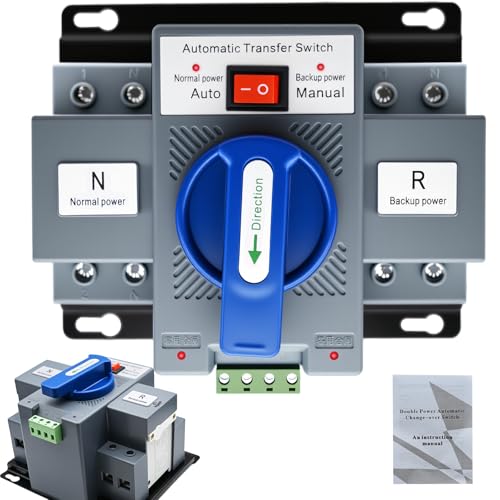
110V 2P Dual Power Automatic Transfer Switch (63A)
The Picks, Examined More Closely
For homeowners running larger 220V service panels, this four-pole, 100-amp unit offers the headroom most smaller ATS units leave on the table. Rated insulation voltage of 690V and a 5kA short-circuit capacity give it the kind of overhead I’d expect for a whole-home backup feeding multiple heavy appliances at once. Unlike the 63A two-pole CNC units covered later in this list, this one can sit at the heart of a panel without breaking a sweat during motor starts.
The dual automatic and manual modes also matter here. The right-hand lever lets a homeowner physically take control during extended maintenance or testing, rather than waiting for the controller to do the work. For property owners with workshops, well pumps, or central HVAC on the backup circuit, that mechanical override is reassuring.
What Pays Off
- 100A rating covers most full-residential 220V panels without sub-loading circuits
- PA6 housing with a 94V-2 flame-retardant rating for steady thermal performance over time
- Mechanical life rated at 8,000 cycles, so daily switching won’t wear it out quickly
- Manual lever override gives owners a way to force a source during long service windows
- 4-pole design handles both line and neutral switching for cleaner isolation
Things To Consider
- The larger 4-pole footprint demands more DIN-rail or panel space than 2-pole units
- 100A capacity is wasted on homes whose actual backup loads stay under 60A
- Installation should be handled by a qualified electrician, since the short-circuit rating only protects when wiring is matched
Who It Suits Best
Homeowners with a 220V service panel feeding central HVAC, well pumps, or workshop equipment, where the full 100A capacity actually gets used during an outage.
Consider Something Else When
Shoppers backing up only a few critical circuits on a small sub-panel will find the CNC 4P 63A AC220V Automatic/Manual Transfer Switch a better match for the load profile.
This two-pole 100A CNC unit shares the same core electrical ratings as the four-pole heavy-duty pick above, but the headline feature is its switching speed: 50 milliseconds from primary to backup. That’s fast enough that computers, modems, and other sensitive electronics often stay up without noticing the grid went away. For a small office or a home with a network rack on the backup side, that brief transfer window is the whole point.
The trade-off is the two-pole design. It switches line conductors but does not break the neutral, which is fine for most residential 220V sub-panels but less ideal for sites with strict neutral isolation requirements. Compare that to the four-pole CNC unit reviewed earlier, which handles both line and neutral switching for cleaner separation.
Notable Upsides
- 50ms automatic transfer keeps sensitive electronics from rebooting during outages
- Same 100A / 690V insulation / 5kA short-circuit capacity as the heavier CNC units
- PA6 enclosure with 94V-2 flame-retardant rating for steady thermal behavior
- Mechanical life rated at 8,000 cycles, suitable for frequent source toggling
Worth Noting
- Two-pole design does not switch neutral, which can matter for certain isolated systems
- Owners report the controller LEDs are small, making status checks from a distance tricky
- Speed advantage shrinks in value if your backup loads don’t include electronics sensitive to brief dropouts
Made For
Homeowners and small-office operators running network gear, servers, or other sensitive electronics on a 220V sub-panel where every millisecond of transfer counts.
Not Your Match When
Installers needing full neutral isolation should step up to the CNC 4P 100A AC220V Automatic/Manual Transfer Switch instead.
For North American homes running on 110/120V split-phase service, this two-pole 100A CNC unit matches the heavy-duty 220V model’s current capacity but at the lower voltage most US panels actually deliver. The 110V rating means it slots into standard residential service without step-up transformers or rewiring. I think of it as the natural counterpart to the 220V unit reviewed first, just pointed at a different grid.
The same PA6 housing and 94V-2 flame-retardant rating show up here, along with 8,000-cycle mechanical life. For homeowners whose backup needs center on standard 110V appliances rather than 220V heavy equipment, the lower voltage rating is the right fit.
What Makes Sense
- 110V rating matches standard North American residential service without modification
- 100A capacity covers a full main panel for most single-family homes
- Dual automatic and manual modes give owners control during extended outages
- PA6 housing with 94V-2 rating for heat and flame resistance
Trade Offs
- Two-pole layout skips neutral switching, which limits use in fully isolated systems
- Owners commonly report the DIN-rail clip fits tighter than expected in some enclosures, so verify rail depth before mounting
Feature Snapshot
Best Suited To
Homeowners on standard 110/120V service who need full-panel backup at 100A without stepping up voltage.
Look Elsewhere When
Shoppers with split-phase panels needing four-pole isolation should look at the CNC 4P 63A AC110V Automatic/Manual Transfer Switch.
The Mini ATS line from CNC trades raw current capacity for a much smaller DIN-rail footprint, and the four-pole 63A 220V version is a sweet spot for apartments, accessory dwelling units, and detached sub-panels. The 63A rating still covers most non-HVAC residential loads, and the four-pole design switches both line and neutral for proper isolation. Owners get full ATS behavior in roughly half the panel space of a 100A unit.
Millisecond-level transfer (the manufacturer’s term) keeps the failover tight enough for routers and entertainment systems to ride through the switch. For a small home office or studio, that combination of compact build and quick response is genuinely useful.
Strengths Worth Knowing
- Compact DIN-rail mount fits tight enclosures where larger ATS units won’t
- Four-pole switching handles neutral isolation cleanly
- 63A capacity suits most non-HVAC residential sub-panels
- PA6 housing with 94V-2 flame-retardant rating for thermal stability
Room For Improvement
- 63A ceiling rules out whole-home backup on larger panels with central HVAC
- Millisecond-level transfer is vendor-stated; actual bench figures are not published, so treat the speed claim with appropriate caution
Perfect Match For
Apartment dwellers and small-office owners with a 220V sub-panel feeding modest critical loads like networking, lighting, and a fridge.
Swap It Out When
Homeowners needing whole-panel backup at higher current should pick the CNC 4P 100A AC220V Automatic/Manual Transfer Switch instead.
Same Mini ATS platform as the previous pick, but pared down to two poles for the simplest single-circuit critical-load setups. Rated at 63A on 220V, it handles a fridge, a few lights, and networking gear without breaking a sweat. The manual override lever and indicator lights (green for source I, red for source II) make the mode of operation clear at a glance, which is helpful for less technical owners.
The trade-off is no neutral switching, so installers using this on a system that requires isolated neutral should look at the four-pole sibling above. For straightforward 220V sub-panel work, though, this is a tidy fit.
Useful Touches
- Clear green and red indicator lights for instant source identification
- Manual override lever for owner-controlled source selection
- Compact DIN-rail mount for cramped enclosures
- 63A / 220V rating covers most residential critical-load scenarios
Points To Note
- Two-pole design does not switch the neutral conductor
- Owners commonly report the included wiring diagram is brief, so installers may need to verify terminal layouts before connection
Who Will Love This
DIY-minded homeowners with a single critical-load sub-panel on 220V who want a simple two-source automatic switch without paying for four-pole hardware.
A Better Fit Elsewhere
Installers needing neutral isolation on 220V service should pick the CNC 4P 63A AC220V Mini ATS Transfer Switch instead.
This four-pole 63A CNC unit sits in the middle of the lineup in the most useful way: enough capacity for a mid-size residential 220V panel, four-pole switching for clean isolation, and a build small enough to fit standard DIN-rail enclosures. For a homeowner who doesn’t need the full 100A headroom of the heavy-duty pick but still wants proper neutral switching, this is a sensible middle ground.
The same PA6 housing, 94V-2 rating, and 8,000-cycle mechanical life carry over from the larger CNC units, so build quality feels consistent across the family. I think of this as the default residential pick when sizing is unclear.
A Few Highlights
- Four-pole switching provides full line and neutral isolation
- 63A capacity matches typical mid-size residential backup loads
- PA6 housing with 94V-2 flame-retardant rating
- Mechanical life rated at 8,000 cycles for long service
- Compact footprint for DIN-rail mounting
Small Caveats
- 63A ceiling caps use for homes with central HVAC on the backup side
Feature Card
Right Fit For
Homeowners with mid-size 220V residential panels who want full isolation without stepping up to industrial current ratings.
Reach For A Different Pick When
Shoppers running a larger 220V service with central HVAC should reach for the CNC 4P 100A AC220V Automatic/Manual Transfer Switch.
For North American split-phase panels, this four-pole 63A 110V CNC unit mirrors the 220V editor’s choice above in form factor but targets the lower-voltage market. It gives US homeowners full line and neutral switching at a current rating that comfortably covers typical sub-panel loads, including a kitchen’s worth of small appliances and lighting circuits.
The automatic and manual modes work the same as the larger units, with a mechanical override lever for owner-controlled source selection. For homeowners splitting their backup between grid and a smaller portable generator, the 63A ceiling is rarely the limiting factor.
Real-World Strengths
- Four-pole switching for clean neutral isolation on split-phase panels
- 110V rating matches standard North American residential service
- 63A capacity covers most sub-panel critical-load circuits
- Manual override lever for owner-controlled source toggling
Areas To Watch
- 63A rating caps whole-home backup for larger US panels with central HVAC
- Some owners report the indicator light visibility is limited from certain mounting angles
Built With In Mind
US homeowners backing up a sub-panel of essential 110V circuits on a split-phase service where neutral isolation matters.
Another Choice May Suit
Shoppers needing higher current on 110V should consider the CNC 4P 100A AC110V Automatic/Manual Transfer Switch.
This IGEYAPA unit is the only non-CNC entry in the list, and it earns its place by sitting at the intersection of transfer switch and solar-ready integration. The W2R designation points to its dual-source monitoring logic, which evaluates both the common source and the backup source before committing to a switch. When the common feed fails, the unit flips to backup within roughly 0.05 seconds, which is competitive with the faster CNC units.
The 100A / 110V rating matches standard North American residential service, and the four-pole layout supports neutral switching. For homeowners running an inverter-based solar setup that pushes power back into a sub-panel, this is a sensible bridge between generator backup and renewable integration.
Bright Spots
- Sub-50ms transfer speed keeps electronics from rebooting
- W2R monitoring logic checks source health before committing to a switch
- 100A / 110V rating fits North American residential panels
- Four-pole design for full neutral isolation
- DIN-rail mount for clean enclosure integration
Honest Caveats
- Solar-integration terminology in the listing is vendor-marketing, so owners should verify inverter compatibility before relying on it
- Documentation depth tends to be lighter than the CNC units, which can complicate first-time installation
Quick Facts
The Right Fit
Homeowners blending solar inverters with a generator backup who want a single ATS that can monitor and switch between multiple sources.
Skip It When
Shoppers with simpler grid-plus-generator arrangements will find the CNC 4P 100A AC110V Automatic/Manual Transfer Switch easier to install.
For larger North American panels where 63A simply isn’t enough, this four-pole 100A 110V unit brings the same current ceiling as the 220V heavy-duty pick to the lower-voltage market. The PA6 housing, 94V-2 flame-retardant rating, and 8,000-cycle mechanical life match the rest of the CNC family, so consistency is a quiet strength. Owners stepping up from a 63A sub-panel ATS to whole-home coverage at 110V land in familiar territory.
The four-pole layout switches both line conductors and neutral, which matters on US split-phase systems where neutral isolation is part of the code-compliant install. For new construction or full-panel retrofits, that detail saves headaches at inspection.
The Good Stuff
- 100A capacity covers most full-residential 110V panels without sub-loading
- Four-pole switching provides full line and neutral isolation
- Same proven PA6 housing and 94V-2 rating as the rest of the CNC line
- Mechanical life rated at 8,000 cycles for long service
- Manual override lever for owner-controlled source toggling
Less Ideal Details
- Larger footprint demands more panel space than the 63A Mini ATS units
- 100A rating is overkill for homes with modest backup needs
Technical Highlights
Whose Shelf It Belongs On
Homeowners with larger 110V main panels who need 100A capacity and proper neutral isolation for code-compliant backup.
Where A Sibling Pick Shines
Installers working on small sub-panels under 63A will find the CNC 2P 63A AC220V Mini ATS Transfer Switch a better physical fit.
The Zgqmcgy two-pole 63A 110V unit rounds out the list as the budget-oriented pick for light-duty backup circuits. It’s CE-certified and operates on 50/60Hz, so it works across both US and international grids. The roughly two-second transfer time is noticeably slower than the millisecond-class CNC units, so it’s best reserved for loads that can tolerate a brief dropout, like a fridge, a sump pump, or a lighting panel.
For workshop owners or hobbyists building out a small backup panel on a tight budget, the slower transfer is a fair trade for the lower cost. For anything with computers or networking gear, I’d look at the faster CNC units instead.
Positive Points
- CE certification adds a layer of regulatory confidence
- 63A / 110V rating covers typical light residential circuits
- Dual automatic and manual modes for flexible operation
- Blue housing makes the unit easy to spot in a crowded panel
Possible Compromises
- Two-second transfer time will reboot most computers and routers
- Two-pole design does not switch the neutral conductor
- Limited documentation depth compared to the CNC line
Who Should Grab It
Hobbyists and workshop owners backing up non-sensitive loads like lighting, sump pumps, or basic appliance circuits where a brief dropout is acceptable.
A Better Fit Elsewhere
Shoppers protecting sensitive electronics should pick the CNC 2P 100A AC220V Automatic/Manual Transfer Switch for its 50-millisecond transfer.
Factors To Consider When Choosing Ats Automatic Transfer Switches
Match The ATS To Your Service Voltage
The first decision point is the voltage rating, since an ATS rated for AC220V wired to a 110V panel (or vice versa) won’t behave as expected. North American homes typically run split-phase 110/120V service, while many international residential systems use 220V. The CNC line covers both with mirrored SKUs at every current level, so the choice usually comes down to which side of the grid your home sits on. The IGEYAPA and Zgqmcgy units are 110V-focused, while most of the CNC catalog covers both.
Size The Current Rating To Your Backup Loads
Rated current is the next filter. A 63A ATS comfortably covers most sub-panel critical-load setups, while 100A is the right call for whole-home backup with central HVAC, well pumps, or workshop equipment. Oversizing wastes money on capacity you won’t use, but undersizing creates nuisance trips when motor loads kick in. For most residential sub-panels, 63A is the practical middle.
Understand Poles And Neutral Switching
The pole count matters more than it might seem. A two-pole ATS switches the two line conductors but leaves the neutral connected to both sources, which works for most simple installations. A four-pole ATS switches both line conductors and the neutral, which gives cleaner isolation for systems with separate grounding or for sites where neutral bonding rules require it. Four-pole hardware costs a bit more and takes more panel space, but it can be a code requirement in some jurisdictions.
Look At Transfer Speed For Sensitive Loads
Transfer speed ranges from roughly 50 milliseconds on the faster CNC and IGEYAPA units to about two seconds on the Zgqmcgy budget model. Anything under 100ms will ride through on most computers and networking gear without a visible reboot. Slower units work fine for lighting, refrigeration, and pumps, but expect to reset clocks and reconnect to Wi-Fi after every outage.
Key Considerations Across These Picks
Where Shoppers Go Wrong
The most common mistake is choosing an ATS based on its current rating alone, without matching the voltage to the actual service panel. A 100A ATS at the wrong voltage is a wasted purchase. The second trap is ignoring pole count. Shoppers focused purely on amps sometimes end up with a two-pole unit where the local code or system design calls for four-pole neutral switching. A quick panel inspection before ordering saves a return trip.
The Case For Spending Up
Higher-tier ATS picks earn their keep through faster transfer speeds, four-pole switching, and stronger short-circuit ratings. For most homeowners backing up lights and a fridge, a 63A Mini ATS is plenty. For whole-home backup on a panel with central HVAC, the upgrade to a 100A four-pole unit is genuinely worth the step up. The faster transfer times also pay off when the backup side includes electronics, since every avoided reboot is real time saved.
Frequently Asked Questions
What Does An Automatic Transfer Switch Actually Do?
It monitors the incoming utility power and, when it senses an outage, automatically switches the home’s electrical panel over to a backup source like a generator. Once utility power returns, it switches back, all without manual intervention.
How Is An ATS Different From A Manual Transfer Switch?
A manual transfer switch requires someone to physically flip a lever to change between utility and generator power, while an automatic transfer switch handles the same switch on its own when it detects a power loss. Manual switches cost less but need someone home during an outage.
Can One ATS Handle Both 110V And 220V Loads?
Most ATS units in this category are rated for either 110V or 220V service, not both at once. North American split-phase panels typically use a 110V-rated ATS, while international 220V systems need a 220V-rated unit to match the service.
How Long Do These Transfer Switches Typically Last?
The CNC units in this list specify a mechanical life of 8,000 cycles and an electrical life of 1,500 cycles. For a homeowner experiencing occasional outages, that translates into many years of service before mechanical wear becomes a concern.
Is Professional Installation Required For An ATS?
Yes, in nearly all cases. ATS units handle full-panel current and tie into both utility and generator circuits, which means working with live service entrance wiring. Local codes typically require a licensed electrician for this kind of installation.
Wrap Up
The right ATS for your home comes down to matching voltage, current, and pole count to your actual service panel and backup loads. For most North American homeowners, the CNC 4P 63A or 100A 110V units offer the cleanest fit, while 220V service homes have parallel options at the same current levels. Workshop and apartment setups often land on the Mini ATS platform for its compact DIN-rail build. Take a quick inventory of your panel rating and the loads you actually want covered, and the right pick becomes obvious.
